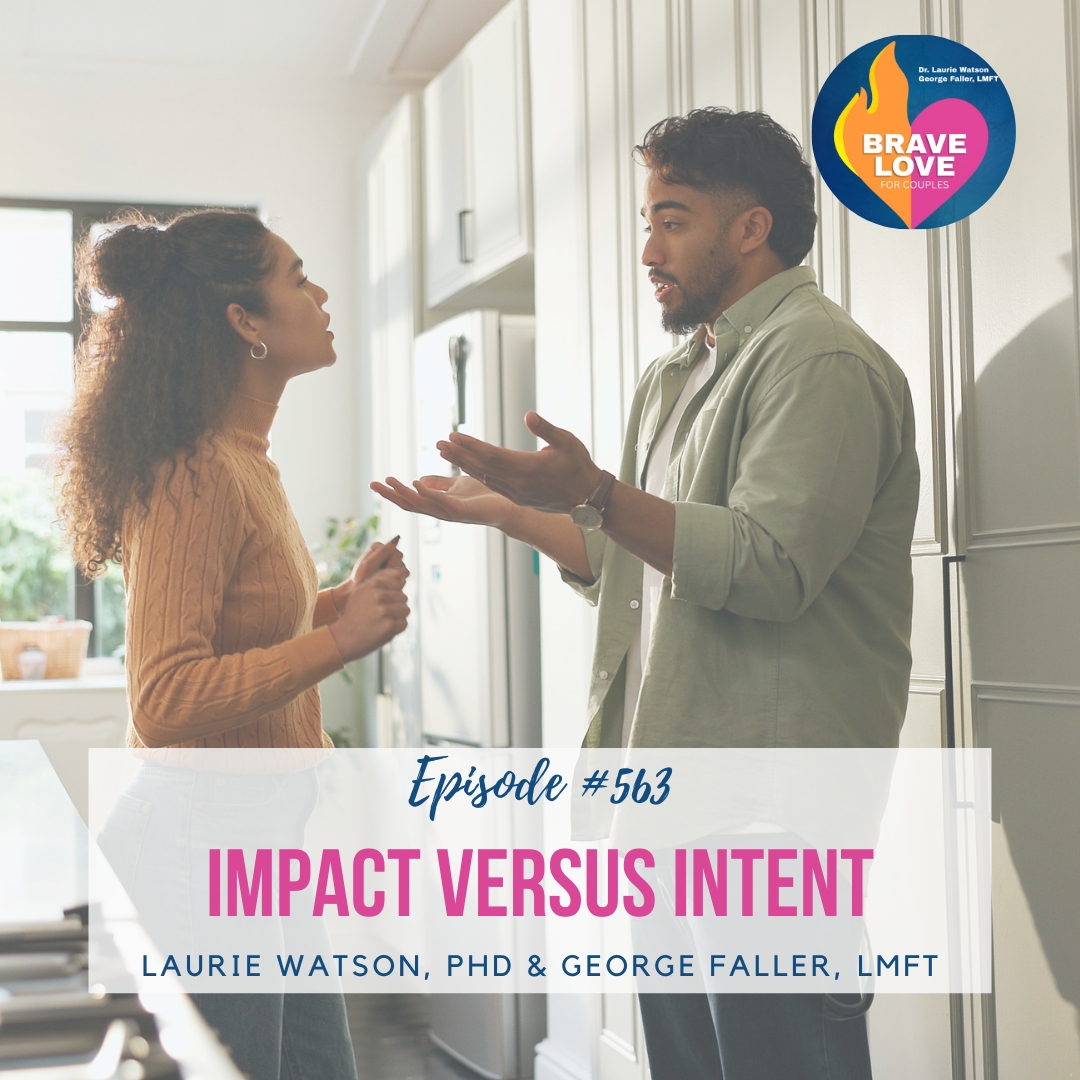
Welcome Brave Lovers! Have you ever said something to your partner that didn’t land well? You backtrack and try to explain your intent but they are still hurting and now angry. If you have, then this episode is for you!
Join our hosts, Laurie and George as they share what happens when the impact hits hard and the attempt to explain the intent falls flat. Listeners will learn how to hold both truths, have clean communication around the event and improve their timing. It’s important to remember that even with good intentions your partner can still feel hurt. Acknowledging their hurt will move the conversation closer to connection while explanation will create disconnection.
Make sure to grab a copy of our bestseller Brave Love, Great Sex, available everywhere!
Please help the pod by checking out this episode’s sponsor:
Uberlube.com — Laurie’s 20+ year favorite personal lubricant. Use the code ‘BraveLove’ at checkout!
Transcript
Laurie Watson, PhD (00:46.828)
Okay. Impact versus intention, George. We gotta separate these two things. What happens when we get hurt? Does that mean our partner meant to hurt us?
george (01:01.294)
Clean conversation. Let’s clean it up, Laurie. Get out your broom.
Laurie Watson, PhD (01:04.234)
Okay, let’s go. Hey, wait a second, get out my broom. Are you what are you saying there? You did did you mean to imply something with that?
george (01:11.598)
To clean up not fly on it, but you know
george (01:18.904)
That could have been one of those fraudian unconscious things. I don’t know. But it’s not my theory of of change, so who knows, Laurie.
Laurie Watson, PhD (01:25.302)
Yeah, but so your intention, right, was to just make a joke, but the impact might have hit me a little different. Let’s talk about that.
george (01:28.184)
Yeah, my.
george (01:38.336)
Yes. Let me defend myself. Say see how that works.
Laurie Watson, PhD (01:40.782)
Okay, let’s see how that works.
george (01:45.596)
I think this is so important. Well, before we jump in, Lori, hey, Brave Love, Great Sex. Launch Week was number one, right? Number one book on new releases. Thank you, all our listeners, for purchasing, spreading the word and keep it going. I mean, we’re getting great feedback. Yeah.
Laurie Watson, PhD (01:56.383)
Yes, new releases in in sex and marriage. Yeah. Yeah, so many. And and we’re not bad, just in other b categories too. We’re you know, we’re pretty high up on the list. So thank you all so much for buying the book and supporting us and so awesome. Thank you.
george (02:11.647)
And please
Keep spreading the word and do those reviews, right? They make a big difference too. So on Amazon and these places, please help us out. Again, the algorithms, the more they pick up people in action and traction, it just stays relevant instead of getting buried with the new next new book that comes out.
Laurie Watson, PhD (02:21.228)
Yes.
Laurie Watson, PhD (02:33.048)
That’s right. That’s right. Thank you.
george (02:36.161)
And we’re learning this game. Like Laura and I were have been late to the game, the whole social media stuff. At least I have. Lori’s been ahead of it than me, but it’s yeah, well, so it’s old dog new tricks, but once the dog
Laurie Watson, PhD (02:42.926)
I’ve tried to push you. But see, you know, once once you got a hold of it, you’re just like taking off. You’re doing a great job.
george (02:53.731)
Well, thank you. I d I didn’t realize it was really the the networking part of it. That’s the the the brilliance of social media. It’s you know, so many people kind of want to support and can get a message out that you just can’t do by yourself, no matter what good work you’re doing. So well, let’s do it. Let’s it intent and impact. I like when I’m working with couples to really break down the process to help them like know.
Laurie Watson, PhD (03:08.382)
Exactly. Exactly. So
george (03:20.053)
What the mission in that moment. And they’re very different missions, right? Intent is focusing on why I did what I did. So it’s focused on me. You know, why did I make the comment? Why did I walk away? Can I explore myself? Can I look at myself and not my partner? But impact is the opposite mission. Impact is saying, well, how did it land for my partner?
what’s happening to my partner. That is not the time to defend the self and talk about your intent, right? Those are very separate missions. One is view of self, the other is view of other. And really helping couples get cleaner in like what are they supposed to be doing really sets them up for more success.
Laurie Watson, PhD (03:59.799)
Right. And you know, I think most people have good intentions. Most of the time we’re saying something, maybe we don’t say it clearly enough or vulnerably enough, or something that just and it hits our partner and lands the wrong way, and we’re scurrying to say, wait, wait, wait, wait, wait. If you understand my intentions, you won’t be hurt.
george (04:03.426)
Yes.
george (04:21.407)
Yes. Hmm.
Laurie Watson, PhD (04:23.51)
And so the conversation is trying to explain our good intentions to the person over there who got shot and is bleeding and just needs us to come over there and apply a little pressure, right? So so we we have a part of us that sends a message.
But then it lands badly. And so we need to figure out, okay, how can I hold the truth that my intention was good and it landed badly on you? Like, whoo, it hurts you. What I just said, it hurts you.
george (04:51.315)
That’s this.
Mm-hmm. Yep. This is all about timing. And it both are happening simultaneously. I’m like, wait a second, Laura. I didn’t make mean anything by that comment. And I’m talking about me. And you’ll say, hey, wait a second, it hurt my feelings. Why? And like we are both just doing separate things. The timing is just wrong. And then it sets up these negative cycles, right? Where I don’t feel understood. You don’t feel understood. And now we got to double down. Now we got to escalate this thing. And we gotta, you know, this is the environment that negative cycles just blossom in.
Laurie Watson, PhD (05:23.082)
Exactly, exactly. And when we’re secure with our partner, we can believe both things. We can say, I believe that you did not mean to hurt me. I get that. And I’m over here and I’m hurting.
because of it. So how can we help each other understand this? Because I want to get curious about what your intention was. What were you really trying to communicate this? This is why I think when we slow down the process, either in therapy or just when we’re in conversation and we say it back, okay, so you’re saying X, Y, and Z about what’s happening for you. Okay, and I I’m hearing this, I’m hearing that. We just refra reflect simply. Hopefully that person says
Yes, that’s what I intended to say. Or no, no, no, I can see now where I went wrong. That that was not what I intended. You know, let me say it again. Let me say it differently. Can I have a do-over? Right? Many times a do-over is a method just to correct these things that happen all the time. And so they say, No, what I really intended was this, and the partner goes, Okay, so that lands a little differently with me. and we can clean it up right there.
george (06:36.835)
Yeah, I wanna highlight it’s such an important line Laurie said that, you know, we have to hold two truths. Both people have really separate experience in the same precise moment.
You could not intend anything and have a very different impact. And it what any good therapy is always trying to differentiate that, or it’s really trying to kind of slow that down and say, right. A lot of times people with intent don’t even know what their intent is. So it’s not like it’s why we get defensive. It’s like I’m in a good place, I make a comment, I don’t think much about it, it’s just flowing and spontaneous. And all of a sudden my partner’s frustrated with me. And I’m like, what are you talking about? Like you’re implying that I meant to hurt your feelings. And I know my truth, I know my heart, and there’s
No part of me. So it doesn’t make sense why I want to defend from that. And I miss the opportunity to actually see my partner’s hurt.
Laurie Watson, PhD (07:21.719)
Yeah.
Laurie Watson, PhD (07:26.22)
Right, exactly. And I would say from the other side, her feelings are real. You may be struck by something, but it’s not necessarily telling you the truth about what your partner meant, about their intentions, right? Sometimes what happens is
george (07:33.379)
Mm-hmm.
Laurie Watson, PhD (07:47.777)
Something lands on us, it hurts us a little bit because it’s landing on an old wound. It’s landing on something that is sensitive in us, you know? And I’ve done that, I’ve done that so many times where I feel something that is touching an old nerve.
george (07:57.484)
Yeah.
george (08:06.414)
Mm-hmm.
Laurie Watson, PhD (08:06.678)
And so then I react, my body goes on alert. Uh-oh, here it is again. And I’m trying to make sense of that feeling that my body is giving me, that high alert feeling. And as I make sense of it, I make sense of the person’s intention that may or may not be true at all.
Right, because I have an experience over here that is hurting and I I have to do something with that in my brain. And so then we assume bad intentions in the partner because that’s what our body does sort of naturally that takes tremendous growth and tremendous maturity coming to that secure place where we get curious about that. Like, is it does it really does my body really tell me the truth here that I need to be on high alert with this person in this moment or
Can I think about who they are to me in general? And maybe question, is my body saying the true thing? And then get curious. What tell me again what you just said, what did you mean there? Right.
george (09:09.0)
The order of matters. So often our body goes first and our mind plays catch up. Right. So this is what Lori’s saying again. I wanna highlight it’s so important that mistrust
Because we’ve been hurt in the past is already forecasting and coloring what the information coming in. And the so therefore the impact is hurtful oftentimes when there is no intent, because there’s been a history of being missed in this area. So if I’m with my wife, you know, and she says something and you know, I’m listening to what she’s saying, but somehow she expects me not to, and she says, You’re not listening, right? Like that, she’s making it.
an assumption around what’s happening, right? The intent is what she’s saying now because she wants me to listen. She thinks if she tells me, she’ll get me. But you know, the impact to that is, hey, wait a second, I’m trying and you’re telling me I’m doing it wrong. And now I get angry at that. Now I get frustrated. Now I don’t want to listen to you. Now I’m gonna shut down. I’m gonna walk away. So this these things move so fast and a lot of times they’re not conscious choices. It’s just it’s this physiological response to a threat. And then our brain plays catch up afterwards.
Laurie Watson, PhD (10:19.286)
Exactly. I was sitting in a consult yesterday with a couple therapist and talking to a couple. And the woman had had a small baby and had kind of taken pains to get the baby to go down early in the crib, which was a difficult task in and of itself. The reason she did that was because she wanted to spend time with her husband. And the husband, home from work, delighted in his infant, comes in.
To the room, to the baby’s room, picks up the sleeping baby because he wants to snuggle the baby. Beautiful, beautiful. But unfortunately, the the wife is bent out of shape, right? Because she’s like, I just got the baby to sleep so that we could be together. And yeah, and so she’s angry, and the evening ends up with a slam door. And we were talking about it, right? Like her heart, her heart’s intention.
george (11:05.54)
I had this fight so many times with my wife.
Laurie Watson, PhD (11:18.412)
was to spend time with him. And unfortunately, the way the negative cycle interacted, beautiful thing that he wanted to be with the child. She even loved that. But it was just like you said, bad timing. And so the evening ends with the slam door. And so we were talking about it that the slam door was was the message, but the intention behind it was, I want to be with you. And then the negative cycle takes over, her protective mechanism gets in
She’s angry because she’s saying he doesn’t get it. He doesn’t care. He didn’t want to spend time with me, clearly, because he woke up the baby. You know, and he’s like, whoa, whoa, whoa, whoa, I do want to spend time with you. I just wanted to snuggle the baby for a few minutes. You know, and I really, really I thought she knew that. I thought she knew my intention was just to snuggle the baby and you know, it w this happens. It happens with people who are so loving to each other.
You know, th these people were really actually loving souls and had great intentions and boom, the intention to spend time with you ends with a slam door.
george (12:19.928)
Okay.
george (12:26.04)
And they keep multiplying, it gets harder and harder to explain your intent as it moves quicker and quicker. So when he walks away from the slam door with the intent of taking space, he doesn’t recognize the impact as she feels rejected by his taking space. And she gets angry with the intent of motivating him to engage. And you know, the impact is it tells him he’s failing and makes him want to go away. So again, we get this dance between intent and impact that gains momentum as both partners don’t really kind of understand.
Laurie Watson, PhD (12:29.069)
Right.
Laurie Watson, PhD (12:41.132)
Yeah.
george (12:56.137)
Each other’s intent or impact.
Laurie Watson, PhD (12:58.144)
Exactly. That the impact of the s slam door tells him you’re doing it wrong as a father. And it’s confusing, right? Because his heart is about the child. I mean, he’s a gentle, tender father who’s longing for his child. He’s been gone all day. It’s so confusing. And yes, he he goes away with this message, right? I messed up. I did it wrong.
george (13:07.172)
Sure.
Laurie Watson, PhD (13:25.868)
My partner is mad at me. He does not hear the intention of I wanna spend time with you, baby. It’s like that was so lost. That was so many like tiny iterations away from where they began. So sad.
george (13:38.77)
Yeah. And it’s so hard to not get defensive when you know your heart and you know you just want to be with your son and somehow you’re being told you’re a bad father. Like that confusion just pulls out defensiveness. And defensiveness makes it all about me and it doesn’t show any curiosity to the impact. And again, this is the heart of all negative cycles. So maybe we’ll come back and talk about it in the bedroom.
Laurie Watson, PhD (14:01.365)
Okay.
So I want to say one more thing that our attachment style can sort of pervasively impact the way we we receive and feel an impact from people’s intentions, right? If we don’t trust others growing up and haven’t learned to trust others because of good reasons, you know, sometimes messages get sort of warped.
george (14:15.288)
Mm-hmm.
Laurie Watson, PhD (14:31.832)
quite regularly, and that’s really disruptive to our primary relationship and to the relationship with others all around us. It’s very difficult. I saw on social media this very fun post of a securely attached person responding to an insecurely attached person’s impact. They kept saying, But you intended to hurt me. And the securely attached person can kept saying things like, I see what I said hurts you.
Now you’re just trying to get out of it. You’re just trying to be so reasonable. Wow, even as I try to hear you now, it it hurts you further. You know, I mean just kept coming back with secure responses and the insecure person, right, because of the warp in their pattern of not being able to trust, kept hearing it as the intention was to hurt. So it we are responsible for our impact, but we are also responsible.
for the way we hear people. I think both things are very true. because if if you constantly kind of warp something just based on your worldview, the view of other, right? And it tells you something about yourself. People are hurting me, people are out to hurt me, you know, I’m somehow or another not valuable to people, there’s growth that needs to happen there, right?
george (15:55.577)
Yeah. I do this all the time with my kids. You know, sometimes I have more flexibility and it’s a lot easier to keep my focus on impact. You know, and they’re like not trusting they’re like, What are you therapizing me, Dad? What’s going on here? ‘Cause again we’re used to defensiveness of people not understanding and kind of getting in this power struggle of, you know, whose intent is right.
Laurie Watson, PhD (16:16.11)
Sure. Sure.
george (16:19.234)
Well, I do like I think it makes it simple. And maybe we’ll do a nail a fail and then a nail lorry in a bedroom if we come up with an example. But you know, they’re separate missions. And when a couple can choose, do we want to understand your intent or do we want to understand the impact on me? Like what are we trying to understand? It’s so much cleaner when couples know what they’re working towards instead of trying to do both simultaneously, which is a setup for failure.
Laurie Watson, PhD (16:24.395)
Okay.
Laurie Watson, PhD (16:44.544)
Okay, so I’ve got a great example for us, G. So I think you should be the guy who Joey and Maria, you should be Joey, and Joey is struggling with ED. Okay. And so he’s kind of brings this vulnerably to Maria, and then let’s see what Maria says.
george (16:46.436)
All right.
george (16:50.222)
Joey Maria.
george (17:06.594)
Yeah, so Maria, I mean, this stuff is so hard to talk about ’cause I never really have had this problem. And I it it it just like I know I should be able to talk about this with you and you’re very open and you know, you actually sometimes like having these conversations and it makes it feel closer, but I really just hate talking about it.
Laurie Watson, PhD (17:31.137)
I know, I know this has been such a big problem between the two of us. And honey, I’ve been doing some research and the research really is saying that, you know, if you lose that belly weight, it may improve E D. I I I mean, I’m in this with you. I’ve been doing as much reading as I can about it. So I was just thinking, you know, maybe we should like, I don’t know, go keto or something or start, you know, try to walk after dinner. What do you think?
george (18:00.948)
sure.
Laurie Watson, PhD (18:03.138)
Wait, what just happened? I I thought that was a good idea. We we were talking about how to resolve this problem, right?
george (18:10.048)
Yeah, I mean it’s it’s hard enough talking about this problem without adding another problem. Now I gotta change my diet, I gotta lose weight. I mean, come on, that’s like
Laurie Watson, PhD (18:18.904)
Honey, I just want you to be healthy. I think this, this is just a little problem. And I’m I’m with you in it. I mean, don’t, don’t you see? I care about you. I care about how healthy you are. And they’re saying that ED erections that fail are really a first sign of health problems. And my God, it’s like I’m gonna live forever with you.
george (18:41.124)
Yeah, but you’re just relentless with the suggestions and trying to fix things like, Come on, this is d do you not see what happens to me when I’m trying to talk about something, but when you add something else in there, I’m like
Laurie Watson, PhD (18:48.086)
Yeah.
Laurie Watson, PhD (18:55.84)
I I thought we were talking about your E D and how to fix it. And I I I really don’t I don’t see why you’re getting so sensitive about this, honey. I it’s not that big a deal to me. I mean, you’re always so good to me in bed. It’s like this is just something that we can work on together. We can fix it. I think that yes, diet and exercise will really work. And it’ll make you healthier.
Okay, that was definitely a fail, right? How do you feel, George?
george (19:30.596)
Well again, and this is such a re realistic fail because again, Marie is really trying to help. Her heart is in the right place. She’s coming forward. She’s doing reading. Look at all the work Marie is doing, because this matters so much to her. But look at the timing of it. I mean, that’s hard enough for me to even talk about the ED without f introducing moral problems on top of it. I mean, that’s belly weight and eating wrong. I mean, I was thinking about
Laurie Watson, PhD (19:47.019)
Exactly.
Laurie Watson, PhD (19:53.455)
Belly weight and exercise. Great. Are you even attracted to me? Good lord.
george (20:00.673)
I was thinking about that chicken meatball parmesan hero I was about to have. Now I gotta feel guilty because of my belly fat. So you know, I can feel myself want to exit this conversation.
Laurie Watson, PhD (20:05.646)
Yeah, for sure, for sure. Okay, so let’s do a repair, right? I’m gonna still fail you, not come to you totally with a good I my intention is still good, but it’s still gonna hurt you. And I want you to repair with me. How about that? Okay, okay, you start. Talk about your E D, buddy.
george (20:36.792)
Yeah, Marie, this is not easy for me to talk about. I just I never thought I’d kind of it wouldn’t work like what’s happening. It’s I know it’s normal but it doesn’t feel good and it just and I know you’re receptive to these conversations, but I just every part of me doesn’t want to talk about this.
Laurie Watson, PhD (20:56.034)
Well, I think it is normal for a man your age, you know, to have some of that. But I’ve been doing some reading and it’s kind of scared me because they’re also saying that E. D. is the early sign of, you know, heart disease and the metabolic syndrome. And so maybe maybe this is just a reflection of kind of the belly weight and the lack of exercise ’cause you’ve been so busy.
I’m also thinking, you know, maybe we’re approaching this just a sexual issue instead of a lifestyle issue. What do you say if we kind of address this? Maybe go to the doctor.
george (21:30.36)
mean again, it it feels like you’re not listening to me. This is hard enough to talk about without piling on more things to that I don’t want to talk about. So I just find myself I I really would rather not have this conversation.
Laurie Watson, PhD (21:45.131)
I really care about you. I
george (21:48.293)
Why I know you do, but I I need you to see like the timing of bringing this up. Maybe we can talk about this another time, but like when I’m struggling to barely hang in here and talk about E D, I I don’t have any capacity to start talking about my diet on top of that.
Laurie Watson, PhD (22:00.527)
Yeah.
Laurie Watson, PhD (22:05.75)
Yeah, yeah. Okay. I see. I see. I hurt you. Or I you know, I was missing kind of where you were going with this. I didn’t I really kinda cut you off. I didn’t even get you let you get it all the way out. With then my brilliant suggestion it’s not it’s not helping.
george (22:26.552)
you for that. It’s yeah, it’s it’s a hard spot to be in where I just I don’t I know I want to talk to you about it ’cause you’d be open to it and I I think if I can get better at it, it would feel better, but it’s such a big mountain to climb. They just kinda even even I just think about it not working and I’m like I wanna just put my head down and and cover up.
Laurie Watson, PhD (22:30.274)
Yeah. I
Laurie Watson, PhD (22:52.076)
Yeah, yeah. Yeah. No, I I that was dumb. I’m sorry. I should have I should have been more thoughtful about I know this is vulnerable for you and and I gotta say, the fact that you’re bringing it up, pretty great. So I let’s go. Can we have a do over? ‘Cause I I do wanna hear about your your thoughts about your penis. Thank you very much.
george (23:10.264)
Yeah.
george (23:14.521)
Yeah.
george (23:17.858)
the penis guy not working, you wanna know about him, huh? I’d rather talk about the penis when he’s working.
Laurie Watson, PhD (23:19.79)
I do, I do. Yeah. Okay. How did that feel? Yeah.
george (23:28.418)
Yeah, that felt much better. I mean, the acknowledgement, there was no bad intent and kind of I I know that, but just the timing of it that you can see the bigger picture and you can see like I didn’t even finish getting out these words that I’m struggling with before I got more struggle thrown on top of my plate and like that just became overwhelming. And instead of you getting defensive, because you have all the right reasons to talk about, it’s just the wrong timing. It’s not about right reasons, it’s about when.
Laurie Watson, PhD (23:45.229)
Right.
Laurie Watson, PhD (23:53.153)
Right. Right, exactly. And I can kind of feel in the Maria’s body that I’m inhabiting for just a minute, like she doesn’t want to bring up the E D, right? So she’s waiting for her partner to bring it up and then she springs on him this new great information.
george (24:05.102)
Mm-hmm.
Laurie Watson, PhD (24:12.076)
You know, she’s she her timing is like, finally we can talk about it. And it’s it just, you know, smashes him, right? So vulnerable to talk about E. D. as a man. I will say, George, just f just one last note about E. D. was talking to a couple the other day, long standing problems with his sexual initiation.
george (24:20.471)
Exactly.
Laurie Watson, PhD (24:35.666)
And found out that, you know, I said, Okay, you know, first question now out of my mouth for a man who has low desires, tell me about your erections and do you ha have any E D or early ejaculation? Tell me about that. He’s like, yeah, I’ve been having it since probably we got together. And it was like
you know, the George Fowler smashed into my head. Laurie E D is such a root cause of lack of initiation. Not really lack of desire, but lack of initiation. And it just it anyway, saved that session. So thank you very much.
george (25:06.628)
Mm-hmm.
george (25:13.449)
Well and that’s the timing. I mean, for you to
To be curious about what’s getting in the way of this natural process. And that curiosity, I mean again, when we’re being curious, we’re really trying to see a person’s world and the impact of their world. I mean, that’s the caregiving system at its best. It’s focusing on the other. And I and I loved how you caught in being Maria that because you were waiting for a moment to talk about things that were important for you, it becomes about you. And that’s so human. And it needs to be a time for that. And I would love
Laurie Watson, PhD (25:45.208)
Yeah. Yeah.
george (25:48.07)
For you know, the next day for for Maria to say, Hey Joey, I have a lot of information. If we can find time, I would love for you to be able to just kind of give me a couple of minutes, I can share this with you. And then Laurie would be the mission, right? And Joey’s job is not to get defensive. I mean we we switch back and forth.
Laurie Watson, PhD (26:01.078)
Yeah. Maria, but yes. Uhhuh. At least in our role plays. Yeah, exactly.
george (26:12.354)
Yeah. So again, to hopefully this not an opportunity for you all to just get a little bit cleaner in your communication to start picking these missions. Like who is the person that’s sharing their intents? Or are we trying to talk about impact and make the choice instead of letting a negative psycho make the choice for you?
Laurie Watson, PhD (26:34.54)
Right. And we need to take responsibility on both sides. When we hurt somebody, to see that we’ve hurt them, regardless of our intention. And if we’re regularly hurt, we also have to take responsibility to think about, you know, there are sensitive places in me from my history, from our history, that I need to probably address so that I can hear you more clearly.
george (27:01.976)
Thanks for listening, y’all.
Laurie Watson, PhD (27:02.402)
Okay. Woo! Keep it hot.