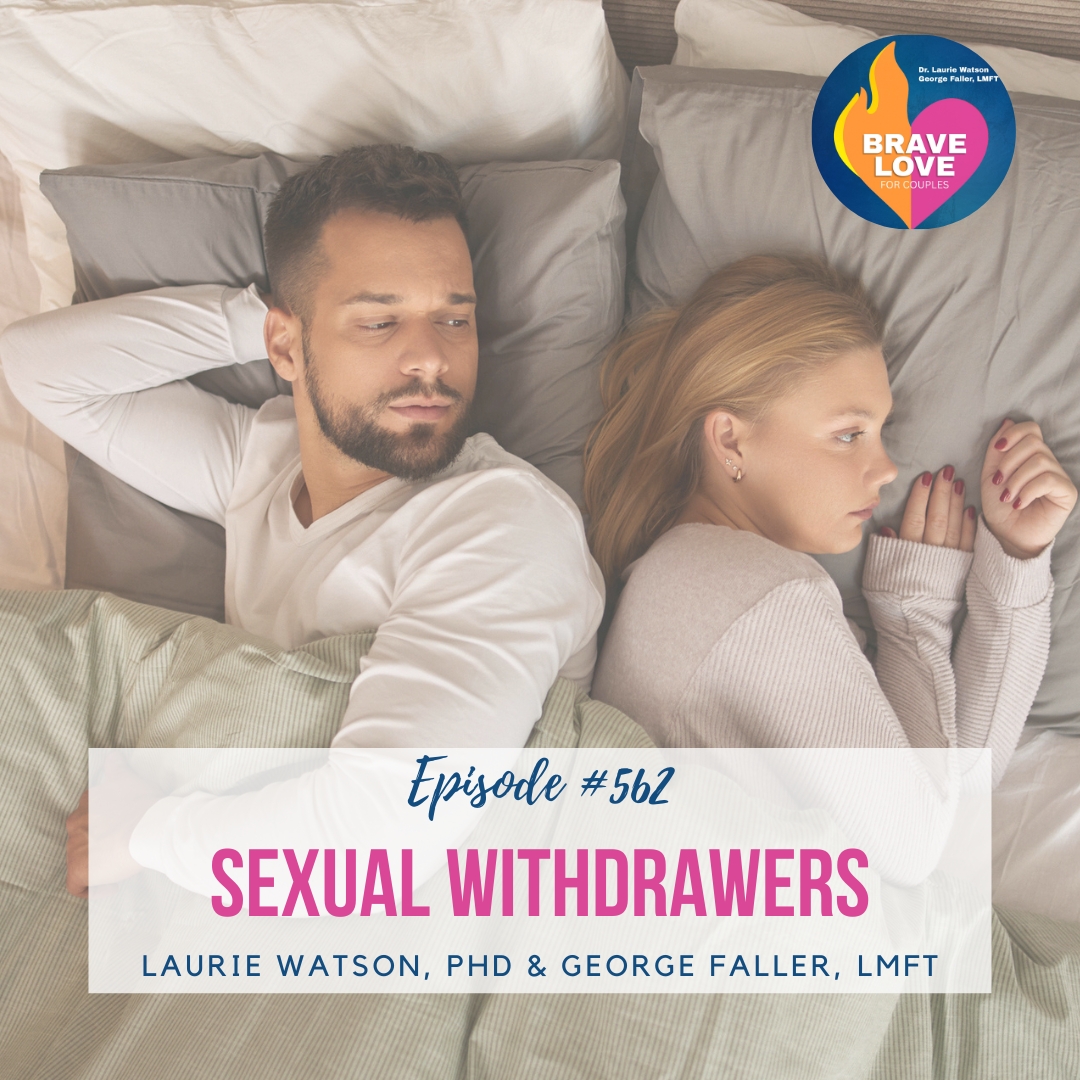
Welcome Brave Lovers! If you don’t want to have sex and your partner always does this is the episode for you!
Join hosts, Laurie and George as they expand on the world of the sexual withdrawer. We explore why the sexual withdrawer may shut down when the pressure cycle is on; past trauma, relational issues, resent or just downright bad sex and provide the valuable language withdrawers need to communicate to their pursuing partners. We get curious and ask what does not wanting to have sex mean and how the withdrawer can pay attention to what is happening inside of them. Their excellent role play walks listeners through a bad take and good conversation.
You’ll take away ways to identify what is happening when I don’t want to have sex, where that shut down is coming from, how to share and better express needs. Want more help here? Our book is out now! Pick up a copy of Brave Love, Great Sex today!
Transcript
george (00:07.32)
Sexual withdrawals. Let’s mix it up, baby. Let’s increase the those levels of engagement.
Laurie Watson, PhD (00:11.18)
Yeah.
Laurie Watson, PhD (00:15.553)
If you don’t wanna have sex and your partner always does, this is the episode for you.
Laurie Watson, PhD (00:23.513)
Wo
Laurie Watson, PhD (00:27.981)
Today Show those muscles again, George. Ooh, and the and the cover of the book. Yeah, that’s even better. Yeah. This is the week.
george (00:35.84)
Ya is better than the muscles. All this work, many years of work here, Laurie, to get this to birth this baby, to put it out into the world, to unleash it.
Laurie Watson, PhD (00:46.229)
Yes. Yes. So so excited. This is a great day. Great week. It came out Wednesday.
george (00:53.164)
This is a great day and we’ll probably we’ll probably forget came out Wednesday. Please buy it. This is the week. We’re hoping next week we come on, we’re gonna say we made the bestseller list. You know, we gotta hit a certain number if we’re pushing a if you’re become a bestseller, it just helps with the message. It’s really isn’t about the ego part of it. We recognize it’s just a book a year from now who’s gonna remember some of these things, but it does help get the message out and we’re a hugely huge proponents of
Laurie Watson, PhD (01:03.607)
Yeah.
george (01:22.616)
this mission of really helping people crack the code of love. This isn’t that mysterious. Like there is concrete things in that book that will help you have conversations, that will improve your relationship. We guarantee it.
Laurie Watson, PhD (01:34.103)
Right. And we have written a book with a method to find emotional connection and sexual intimacy f long lasting in re your relationship.
george (01:45.038)
Well worth the investment, Laurie. And please give us feedback. Let us know, you know, w how it’s landing.
Laurie Watson, PhD (01:52.281)
Absolutely. Follow us too on at Fallow George and at Dr. Laurie Watson on our new Instagram accounts as well as at Brave Love Great Sex.
george (02:05.911)
Keep it rolling. Momentum’s growing. Good stuff. So here we are. We’re gonna talk, we’re finishing this series. We talked about emotional pursuers and withdrawers. We last time talked about sexual pursuers. Last but not least, sexual withdrawers.
Laurie Watson, PhD (02:08.739)
Yep. Yeah.
Laurie Watson, PhD (02:24.727)
Right. And sexual drawers, what does it not mean? It doesn’t mean we’re not talking about asexual people. We recognize that some people out there kind of have an orientation where they’re never gonna want sex. We’re not talking about people who don’t like sex necessarily. Believe it or not, they may like sex, they may masturbate, but we are talking about the position that they take in the pressure cycle where one partner is.
george (02:28.833)
They don’t like sex.
Laurie Watson, PhD (02:53.815)
Pursuing, asking for sex, maybe over asking for sex, and you feel this woo-hoo pressure. And the other thing is sometimes there’s something inside too where sex becomes very conflicted for you. Maybe it’s trauma. You know, you come from a background where you were hurt sexually, or just even from a household like that was reverberating with dishes breaking.
You know, and your nervous system never learned how to relax. And so now you’re in a partnership or a marriage and it’s really hard to relax and let yourself dream and feel okay about being intimate. So sexual withdrawing we understand is complicated.
george (03:40.108)
And a lot of times a sexual withdrawal is the wisest person in the room, right? Their body is recognizing the sex that they’re saying no to is not really great sex. It’s pressured sex, it’s guilt sex, it’s obligatory sex, it’s shame sex, it’s trauma sex. I mean, there’s nothing wrong with the body wanting to avoid a situation that’s likely to be threatening.
Laurie Watson, PhD (03:48.067)
Mm-hmm.
Laurie Watson, PhD (04:04.781)
Yep. I I I saw this very early on in my practice. We were working with a woman who didn’t want to have sex ever with her partner. Turns out her partner was an alcoholic and angry all the time and she was just shut down. Sh and we told her, you know, I think your vagina is pretty smart here. You’re you’re it’s it’s telling you something. She was young, they didn’t have children.
And when she left the relationship, she got into another partnership and ta She was sexual because the relationship was better. You know, so sometimes that desire to move away is really deeply important about where you’re at in the relationship. And I know that’s that’s hard for us sexual pursuers to hear ’cause we’re like, no, no. It’s it’s it’s just something else. They don’t like sex.
george (04:58.593)
It’s a it’s a powerful shift to really get both partners to blame the cycle for the withdrawal, not the person. Like there’s something broken within them why they don’t want to have sex. There’s actually something threatened inside of them that’s not liking this space that’s going to be opened up in a sexual encounter.
Laurie Watson, PhD (05:18.637)
Yeah. And I I do want to say something because we did write a book on attachment. You know, sometimes our attachment style, which I don’t think is set in stone, and I think the good news is is that a romance is a way that we heal whatever injuries happen in our childhood. But, you know, intimacy and closeness makes us a little nervous. And sex, there’s hardly anything closer than sex. And so people enter, you know, a partnership maybe before all that.
longing and limerence of falling in love kind of that that bypassed these other inner issues about fear of getting too close and getting overwhelmed. And so they were able to have sex in the beginning of the relationship, but then as they go along, kind of these old patterns emerge. It’s like, not safe to to offer myself to this person because
Then I could be dependent on them, reliant on them. And maybe you learned very early on that wasn’t true. And so literally putting yourself in someone’s hands physically just doesn’t feel so good.
george (06:28.417)
Yeah. And so much of the work that we’re trying to do to get with sexual withdrawers to re-engage is not what most people are trying to do, which is just to pressure them, right? Give them the book, fix them to perform better. It’s still focus on servicing their partner. We’re inviting withdrawers to say this is an assertion of self. How is it okay for you that this beautiful way into connection has been shut down? That these fears that get triggered are never expressed, never responded to.
And that when they’re not responding to your body is going to do what it’s supposed to do, which is to protect you from wanting to put yourself in that space. Like they’re set up to not want to have sex and then blamed for not wanting sex. And then they believe there’s something wrong with them and they don’t want to have sex when all this is just a setup, people.
Laurie Watson, PhD (07:15.361)
It’s such a double, triple, quadruple whammy, right? They lose something. And I I was talking to I I think, you know, my first book, Wanting Sex Again, was really written for women who are sexual withdrawers. And I used to hear that, like I never want to have sex again and I would just feel so discouraged. But as a therapist, as I listen to people
george (07:19.063)
Yeah.
Laurie Watson, PhD (07:40.671)
It really meant something very deep. And I think that’s what we would l and like to invite you to think about. For you, what does not wanting to have sex mean? And what is it sacrificing you to not have sex? I mean, I just like if you were to ask your daughter if you’re if your daughter were to come to you and say, I just I’m in this relationship but I never want to have sex, like, would you feel heartbroken? Like, oof.
That’s not the way it’s supposed to be. That isn’t all life has to offer, you know.
george (08:14.015)
Sad. It’s sad that you get so focused on preventing the bad thing, the defense, that you lose access to the longings. We are made to want touch and to be in relationship in whatever capacity we want. I mean, we’re not pushing people to have sex. We’re pushing people to talk about, you know, what is I love that question, Laurie. What’s happening inside of me? How do I start paying attention to me again to fight for these parts of me?
Laurie Watson, PhD (08:40.493)
Yeah, yeah. I mean, I think for some people they feel resentful in their relationship, you know, and that resentment just kind of is like a poison that crowds them sexually and they they don’t want to be sexual with somebody that they feel so resentful of. And I’m like, girl.
You know, if it’s girl and I think men can feel resentful too. Absolutely. You know, okay, so not okay, scratch that, Joe. Take that out. So I I look at them and I think, if you’re so resentful, then something needs to be resolved. You know, you gotta fight for that peace then to be resolved so that it can free up the energy that might be natural between the two of you. It’s like don’t don’t let that go. That’s too important.
george (09:30.616)
Yeah, the resentment is poison. And this is this is what happens when we keep keep putting ourselves, and this is the emotional cycle, right? If you don’t feel connected and your body just feels used, if you feel like you’re not emotional, your partner’s not emotionally present. I mean, there’s so many factors that could send a signal to your body that it’s not safe, you know, and then we try to override that and push ourselves past it, which just traumatizes it more. And what we’re inviting you all to do is listen to that.
Laurie Watson, PhD (09:49.709)
Right.
george (09:57.9)
If you don’t feel safe, when is the time to talk about that? Are you going to keep putting yourself in this space where you’re going to be re-traumatized or are you going to stand up for that part of you and send a clear signal and say, hey, wait a second here. This doesn’t feel so good. I know it does to you. Great for you. But this is why it doesn’t for me and to kind of stand up for that part of you.
Laurie Watson, PhD (10:17.087)
Exactly. Sometimes women have told me too, you know, I I don’t have orgasms. And I’m like, whoa, really makes sense why you don’t want to have sex. You know, if you don’t if you’re not getting the pleasure out of the sexual experience that you did once or you’ve never had, you know, it makes a lot of sense that this is not an activity that, you know, is so compelling.
george (10:45.965)
Yeah. And
Laurie Watson, PhD (10:46.061)
You know, you gotta strip down, get naked, and you know, have sex with somebody that you don’t get the pleasure from that they’re getting. It’s like, yeah, this this is something to be examined. But I I can’t tell you, George, people who have come to me and said, Yeah, it’s been this way for 12 years. One woman said, I’ve had sex three times a year for twelve year for twelve years. Three times no, I’ve had sex three times a week.
for twelve years and I’ve never had an orgasm. I’m like, first of all, kudos to you, girl. Like, how did you keep going? You know? How did you keep doing that? That’s amazing. That’s a huge gift of love.
george (11:30.185)
Yeah, let me jump in on that ’cause that is so inspiring to me when people are willing to sacrifice themselves and try to love their partner, even though their body’s not getting the reward system for that. You know, it creates problems in the long term, certainly, but the the intent behind it is so beautiful. I mean, that’s what love is. We I want to give caregiving. I want to respond to my partner. I’m willing to kind of see what happens and
It’s so much easier to start with drive, to start with passion and desire, right? It’s to to not have that, to have more receptive style and to keep doing it year after year after year. Wow.
Laurie Watson, PhD (12:06.935)
Yeah. Well, I mean, I think even beyond reception or drive, I mean, it’s just like you gotta have that big bang, you know, so to speak, to to really reinforce physiologically desire. And I don’t think, you know, necessarily that you have to have an orgasm every single time, but if you don’t want to, but they help and
george (12:30.007)
They help. They help.
Laurie Watson, PhD (12:33.857)
And they’re really fun. And if you’re not having them and I sometimes women will say to me, I don’t know if I’m having them or not. And I’m like, You’re not ’cause you would know. You know, it’s it’s such a powerful experience.
george (12:42.797)
Yeah.
george (12:48.887)
Well, and it’s the same for a lot of men, right? If they feel like it’s not gonna work, they they’ll have some ED, or if they feel like the pressure of I don’t feel so close emotionally to you, I don’t like putting my body in that space. They they take the same distance to try to create safety. And the result is still the same. It’s more distance. So let’s come back and let’s talk about how they can do it differently.
Laurie Watson, PhD (13:10.049)
Yeah. Okay.
george (13:18.583)
You wanna lead us off or yeah.
Laurie Watson, PhD (13:19.009)
You said something you said something, George, and and I think you said two things that men too cannot feel safe emotionally. I’ve absolutely worked with male sexual withdrawers who, you know, they have drive, they have good erections, but they’re, you know, their partner seems scary to them. They’re always angry. And they’re like, I just don’t feel safe. It doesn’t feel that that closeness and intimacy because I don’t know when they’re gonna flip out on me and be angry at me.
george (13:30.017)
Mm-hmm.
Laurie Watson, PhD (13:48.323)
So that’s one reason, but you also said another really important thing. And if if doing this podcast with you has taught me anything is how critical performance feels subjectively to a man. You know, like if he’s gonna get E D, he might actually have desire, but he might move away from sex because of that fear of failing and not performing the way he sees himself, what that that it’s necessary for him to perform.
Right, he sees his role that way. And I think that’s so confusing. Yeah.
george (14:20.397)
When shame is lurking, confusing a hope.
Laurie Watson, PhD (14:26.231)
I think it’s so confusing to women, like when all of a sudden your partner is not wanting sex, it’s like, What? What is this all about? But you’re saying when shame is present, go ahead.
george (14:37.697)
Yeah, shame in both, the female or male. When they roll over and they protect themselves by not having sex, the shame is waiting for them. Right. And the shame is not what’s being expressed. This sense they know they’re letting their partner down. They feel bad about themselves. The word they often use, I know I’m failing. I know I’m disappointing the other person. They don’t want to disappoint the other person. So much of their performance is trying to make their partner happy. And yet here they are back in a doghouse, back in this place of failure.
Laurie Watson, PhD (14:40.951)
Yeah. Mm-hmm.
george (15:07.553)
And they don’t know how to put words to that place.
Laurie Watson, PhD (15:07.841)
Yeah. Yeah.
performance anxiety is so problematic, you know, because you already feel anxious about it and then and you already feel ashamed about it. So then saying something about it just feels like this impossible hill to climb. Okay, so let’s do a little role play about sexual withdrawals.
george (15:31.757)
Mm-hmm. Fail now. Who do you want me to be?
Laurie Watson, PhD (15:36.633)
why don’t you be the sexual pursuer since that’s kinda stereotypical?
george (15:43.593)
We can mix it up too. I I like the idea. There are so many men that I work with exactly as Laurie described, is they they want sex but because they don’t feel safe they emotionally they just shut it down, which is you know, it can be confusing for everybody.
Laurie Watson, PhD (15:45.122)
And I we’ll
Laurie Watson, PhD (15:58.167)
Yeah. Okay, so I’ll be the sexual pursuer then. And I’ll be Maria, who although Maria usually is the withdrawer, but we’ll just we’ll just say she she she ha had a moment. And maybe Joey is not feeling so confident.
So Joey, you know, the kids are gonna spend the night at Donna’s tonight. So it’s kind of our night. I was wondering what you thought about that. Maybe we could crack open a bottle from our anniversary and just hang out.
george (16:29.293)
So let’s let’s let’s pause. I’m sorry. I’m not sure what I’m doing. No, no, no. I know you did, but it’s not are we doing a fail first? I’m not sure what like I I want you to come on.
Laurie Watson, PhD (16:32.105)
Aw I just did a great come on. Okay, go.
Laurie Watson, PhD (16:39.511)
We’re doing a fail first, then a then a w a a win.
george (16:44.013)
Okay. I wasn’t sure what we were doing, so take two.
Laurie Watson, PhD (16:46.815)
Okay, sorry about that. Okay, take two. So Joey, the kids are at Donna’s tonight. And I was just thinking we could crack open that bottle from our anniversary and just hang out together, do some Netflix and chill, emphasis on the chill. What do you think?
george (17:10.551)
Well, it yeah, I mean may it sounds like maybe we could do that. you know, I do want to watch that show on Netflix. Maybe we could start with, you know, that that new episode we’ve been waiting for ’cause it does t come out tonight.
Laurie Watson, PhD (17:24.053)
Well, yeah, it does. That’s that’s really great. I what I’m I’m a little surprised. Like you always say I should initiate and then when I do it’s like it feels pretty lukewarm. Maybe you think you’re the only one who should initiate. I just I don’t know. I don’t know what’s going on here.
george (17:28.619)
Yeah, we just get some time to talk and
Laurie Watson, PhD (17:49.165)
What’s going on with you?
george (17:49.389)
So let’s pause. I I’m well we’re lost in a mission here, so I don’t know what we’re demonstrating.
Laurie Watson, PhD (17:55.064)
Mm.
george (17:58.146)
Maybe we should not be Joey Maria ’cause it’s
Laurie Watson, PhD (18:00.459)
Yeah, it’s too confusing. Okay. What do we want to do here? So the fail is you to shut down.
george (18:08.683)
Yeah, wh why don’t you just be a we’ll be a different couple and you’re gonna you’re gonna want sex and I’m not gonna be interested and you’re gonna focus all on me and get annoyed at me and then round round two you’re gonna kinda talk about your hurt.
Laurie Watson, PhD (18:22.177)
Okay. Okay.
george (18:26.903)
So let’s do let’s do
george (18:32.033)
What’s your name? Wanna be
Laurie Watson, PhD (18:35.181)
That Jane.
george (18:36.661)
All right. Jane and and Bob.
Laurie Watson, PhD (18:40.377)
Okay, Jane and Bob. Okay, let’s be Jane and Bob. You’re gonna be the sexual withdrawer. I’m gonna be the female sexual pursuer. Okay, Bobby. Okay, Bobby. Let’s let’s go, Bobby. So, Bobby, I was thinking we could, you know, Friday night’s kind of free. We could go for a date, hang out afterwards. What do you think?
george (18:50.343)
Yes. Mixing it up. All right.
Yeah.
george (19:08.821)
Yeah, if we could kind of range, you know, make sure the kids are good and you know, everything’s squared away, it it probably makes sense. We could kind of find some time.
Laurie Watson, PhD (19:19.969)
Yeah, well, I’ve squared the kids away for sure. So Mario’s, you know, we could get a reservation, go there first, come home. I don’t know, you know, have a little nookie. What do you think?
george (19:35.085)
So let’s pause again. I I want I know, but you’re you’re coming on too nicely. It’s hard for me to reject.
Laurie Watson, PhD (19:37.921)
I have now, come on, three times.
Laurie Watson, PhD (19:47.414)
you c you just went you I just lost your volume. Fuck.
Laurie Watson, PhD (20:05.289)
Yeah, yeah. There you are. Okay, so you want me to you want me to come on? you you want
george (20:05.409)
Hello? I’m back? All right. I’m saying I
george (20:13.025)
View of other. I want you to c come on in a way that’s annoyed at me, like you know, you’re just like what about tonight? In a way that’s not super cause then I’ll it’s you’re making it hard for me to say no. I wanna just say yes to you. It’s too it’s so nice. I wanna how do you have a problem with that?
Laurie Watson, PhD (20:20.01)
Okay. Not sexy. Okay. Okay.
Okay. Okay.
So Bob, you know, Friday night is free and I’ve got the kids all arranged and I don’t know what’s been up these days, but do you think you could we could have sex on Friday night?
george (20:49.889)
I mean, sure, it sounds like a good plan. I mean, I know it’s been some it’s been a tough week and we’ve been kinda irritated with each other and
Laurie Watson, PhD (20:57.773)
Well, it’s kind of been three weeks.
george (21:01.399)
It’s however long it’s been, but it’s been we’ve been had a lot of stress on our plates and I just hope that we can enjoy each other a little bit first before we start, you know, getting to step ten.
Laurie Watson, PhD (21:17.143)
Well yes. I I mean I wanna enjoy you too, but I just feel like step ten. What do you mean? Like sex is step ten. Since when did sex become step ten? I I I really don’t understand what’s happening here. Like you used to always be about sex and it’s like I can’t I can’t raise your interest, buddy, for anything these days.
george (21:31.425)
I can’t.
george (21:43.253)
Well, it’s not about raising my interest that I am interested. I just really wish we didn’t fight so much.
Laurie Watson, PhD (21:50.733)
Well, overall I think we do pretty good. I mean, yeah, we squabble a little bit, but this one, you know, I don’t know, it’s kinda standing between us. I I really don’t understand what’s going on with you. I I just feel like like I’m putting myself out here and I I can’t believe you’re turning me down. It’s like
george (22:15.373)
I’m not turning you down. This is the problem. You always see the negative in things. I’m I’m just trying to say we’re fighting a lot, can’t we just enjoy each other? Go out to dinner, have a good conversation, see what happens. Like it’s all this pressure and plans and all this other stuff. It’s like we should work a little bit harder on on us not fighting, I think.
Laurie Watson, PhD (22:35.198)
Okay, yeah, maybe so, but
I I really I don’t really get what’s up. There’s something that is up here and it’s really different. I just don’t know.
george (22:48.173)
Yeah, it’s always my fault somehow.
Laurie Watson, PhD (22:51.063)
Okay. Okay, let’s let’s now I’m completely depressed. And and this is a sexual withdrawal, maybe who well, let’s see what happens when we approach it sort of where the the sexual pursuer brings a little more presence and self and the sexual withdrawal is more willing to risk. Shall we do it again?
george (22:58.369)
Yeah.
george (23:14.003)
Yeah, which just as as we’re processing what just happened, that if if if Laurie’s saying there’s a problem, I’m hearing it as me. I’m defending myself. I’m not seeing her problem. She’s talking about it, but it still feels like what we always do. You know, I’m defending myself, she’s blaming me, and we just played our roles, right? So we really need Laurie to introduce it differently if I’m gonna be able to kind of respond in a different way.
Laurie Watson, PhD (23:39.929)
Sure, sure.
george (23:42.903)
Take two.
Laurie Watson, PhD (23:43.886)
Take two, Bob. I know that things have not been quite the same between us actually and I’m not sure what’s happening inside you. I know inside me I I’m getting messages which you may not be intending to send that you’re not as interested in sex right now, and that’d be okay. I wish we could kind of talk about it a little bit more about what’s happening inside you or
Maybe it’s me, you know, maybe I don’t know. I know I put on about ten, fifteen pounds. Maybe you’re not as attracted to me these days. I I I can take it, you know, whatever is happening, I I just would love to know what’s going on for you. And I was really hoping that maybe maybe this weekend we could talk about it. We have a little free time on Friday. I’ve got the kids squared away and would you be willing to just sit with me and
noodle together about whatever is going on and we can because I I really miss you. I r miss being with you.
george (24:45.325)
Yeah.
george (24:48.735)
No, I think that’s a good idea. I appreciate you bringing it up because again, we there’s been a lot of tension the last couple of weeks and you know, we’re too busy to usually talk about it. So I think it’s a good idea to just try to get on the same page and I can certainly talk about what’s going on for me, but I also want to know what’s going on for you because you know, I I don’t often hear about that.
Laurie Watson, PhD (24:56.247)
Yeah, yeah.
Laurie Watson, PhD (25:13.143)
Yeah, well gosh, I really appreciate you saying that. I I’m willing to talk about it for sure. I I don’t know. I think when we we talk most of the time we can resolve things and I I don’t want you to feel pressure or criticized. I I just miss you. I miss this part of being really regular together sexually and in bed. It’s it’s been such a great place.
And I just I I’m hearing something that’s going on. And I I don’t I just would love for us to be clear about it.
george (25:51.054)
Yeah, and I appreciate hearing how important it is. It’s important to me too. I love that feeling w after sex and during sex and we’re on the same page. I mean, that is that is the best for me. And it just feels like sometimes it’s harder to f to find how to get into that place. It’s like the doorway is getting narrower with the stress of our lives for me.
Laurie Watson, PhD (26:03.587)
Yeah. Mm.
Laurie Watson, PhD (26:13.333)
I didn’t know that. And I I really appreciate you saying that you love that feeling too and it’s the best for you when we’re connecting in bed and afterwards. I those words just right there, I’m I’m looking forward to this conversation because they feel encouraging to me. Thank you. I appreciate that.
Yeah, so this is a safe couple, a secure couple that problem solves together. They’re not blaming each other, they’re not pointing fingers, they’re not making up meaning. I think this is one of the things that in EFT is so powerful is we often ask people, What do you tell yourself about this emotion that you’re feeling? What are you telling yourself about what your partner did? Because there is something, right, that
We unintentionally are trying to make sense of our partner’s move. And so we we say something inside about what it means. And many times that is not a benign sort of explanation. It’s often like, my partner doesn’t care about me. My partner’s not attracted to me. My partner doesn’t find me sexy anymore, doesn’t want that, you know, whatever it is, it kind of escalates the moment. But this couple is staying curious instead.
george (27:32.289)
Yeah.
Laurie Watson, PhD (27:33.419)
about their partner’s intentions, about the meaning, you know, so that that leaves them calmer to keep talking and to be able to see their partner’s good parts.
george (27:45.482)
Exactly. And when they have that conversation on Friday, Jane’s gonna have to come from a place of when she talks about a rejection, not focusing on Bob, but actually focus on what happens to her. Come from that place of self that, you know, some of those fears of not being attracted or no longer d desired, or maybe there’s something broken or unlovable. Like those fears, the beauty in those fears is it tells us what we need to heal.
Right, that caregiving response. Asking for help is our greatest strength. That’s not a weakness. To want to face those bad places with me instead of in isolation is just neurologically and physiologically a much better efficient way of dealing with the threat.
Laurie Watson, PhD (28:15.16)
Right.
Laurie Watson, PhD (28:30.603)
Right. What we believe is if we can be clearer about what hurts us, then we can be clearer about what we need to reassure us and together in a partnership we can find a way to ask our partner for that.
And then when they meet us there, voila, we f have more security, right? It’s it’s a system that creates love and security and safety to talk about anything. It creates the safe place for sex to happen. You know, so it w I think, you know, we don’t want you to be afraid of hurting because underneath hurt is a need that can be met nine times out of ten.
george (28:49.153)
Voilà.
george (29:14.367)
In the hurt lies the solution. And it’s not just a win for Jane when she can get help. It makes Bob feel pretty damn amazing that he gets to be the one person on this planet who can show up and help in this moment. Both win. That’s what we call co regulation. When the need is met by caregiven, both nervous systems expand and then it creates the safety. I mean, the irony for me is Bob is when I get that feeling of safety, I am much more accessed now to my desire, my
Laurie Watson, PhD (29:47.797)
Exactly. Exactly. Yeah, so sexual withdrawers by the book. We have a solution in there that makes it not your fault. And sexual pursuers, we’re standing with you. We know how frustrating it is. We want to help you too. As well as we understand that our emotional connection is absolutely
george (29:58.828)
Nice.
Laurie Watson, PhD (30:12.937)
Inseparable from our sexual response. So we want to help you in both places. Brave, love, great sex. Thanks for listening.
george (30:20.695)
Keep it hot, y’all.