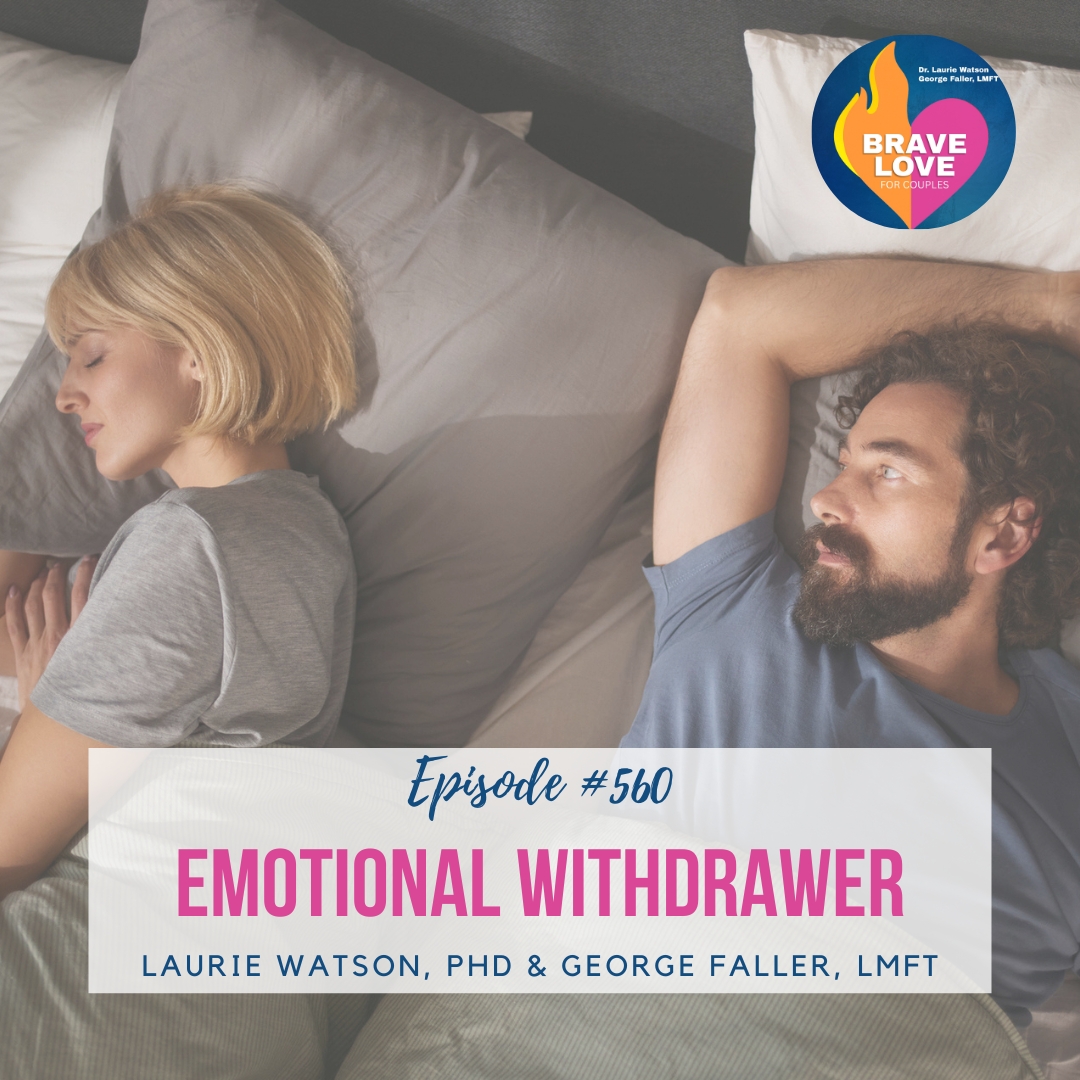
Welcome Brave Lovers! In today’s episode, we are diving into the world of the emotional withdrawer. When the withdrawer is feeling overwhelmed, they may pull away or shut down, often leaving their partner feeling confused and isolated. Listen in as we explore the underlying reasons for this dynamic and provide practical steps to help withdrawers re-engage with their partners.
We discuss how to create a safer space for vulnerability and the importance of attunement in breaking the cycle. Whether you are the withdrawer or the partner, you’ll gain valuable insights into building a more secure and connected relationship. Let us know your thoughts on our instagram @BraveLoveGreatSex and don’t forget to pre-order a copy of our book, Brave Love, Great Sex
Transcript
Laurie Watson, PhD (00:57.87)
George, let’s talk about emotional withdrawers again, right? ‘Cause I wanna understand how we help them change on their own, maybe without therapy.
george (01:09.879)
Bring it on.
Laurie Watson, PhD (01:11.467)
Okay.
george (01:14.049)
So part two of our little mini-series here of working with the four different attachment styles emotionally and sexually. Today we get Lori’s favorite, the emotional literature.
Laurie Watson, PhD (01:26.178)
That is my favorite. And just before we start, we wanna say our book is on sale, pre-sale is here, and we appreciate all of you who have already told us that you’re buying it, told us that you’re waiting for it. And we have that pub date on September fifteenth. So important to kind of I guess what, if we all buy it on the same date, then it hits the best seller list. And so that’s what we’re looking for.
george (01:55.361)
And any of our listeners are going to buy ten or more books and you let us know you do that, we’ll send you a signed copy or a shirt or something. But we really appreciate people helping us out here, you know, getting the word out there.
Laurie Watson, PhD (02:07.134)
Yep. George is gonna manage all that. Okay. Great. Now that’d be wonderful. Okay, so emotional withdrawers, right? When the relationship gets intense, these people are turning away, trying to find safety on the inside, trying to find safety handling things on their own. How do you light
george (02:09.512)
I’ll manage that. Reach out to me.
Laurie Watson, PhD (02:29.282)
firecracker under a donkey who’s saying, I don’t want to move forward. I don’t want to go that way. It doesn’t feel safe. How do they like learn to do this on their own?
george (02:39.188)
Hmm. Well again, this is more my style. Having been a withdrawal most of my life and working with so many first responders and military. You know, I always find it helpful to connect first to I love that Lori said the word safety. That’s all they’re trying to do. They feel staying engaged is gonna make things worse.
Laurie Watson, PhD (02:55.938)
Yeah.
george (02:59.19)
You know, their partner’s gonna get more irritated, they might get irritated. They’re trying to avoid escalation. So they’ve been taking space to calm things down their whole life, more than just this episode, right? This interaction with their partner. They’re just trying to go because when they go away, they can think more clearly, they can problem solve, they can, you know, they have a sense of agency. So they’re really looking for that feeling of safety when they go away.
Laurie Watson, PhD (03:18.734)
So
george (03:24.852)
A lot of times people miss that. They don’t get that. That, you know, it it it feels like to the pursuer they don’t care. That’s why they’re walking away. It has nothing to do with that. It has everything to do with their body is actually threatened. They’re getting a message, they’re doing something wrong. They don’t know how to stay engaged and fix it. Their attempts to do that are not working. So going away is their body’s chance to reset and to, you know, feel a little bit safer. And and if you notice most of the time with drawers, after they feel safer, they come back out.
Laurie Watson, PhD (03:24.866)
Yeah.
george (03:53.493)
maybe an hour later or the next day or whatever it is, but that that sh is evidence that that what they’re trying to do has a healthy intent, although the impact is pretty horrible to them.
Laurie Watson, PhD (04:04.908)
like the worst thing they can hear is we need to talk, right? Like the four worst words a withdrawal can hear is we need to talk. Because it’s like, shit, you know what what what is coming next? I yeah, it’s so scary. Like they
george (04:11.315)
huh.
george (04:15.018)
Yeah, they know what’s coming next. We need to call talk is code for. Let me tell you all the things you’re doing wrong. They know that. It’s just like you do with your kids, right? You tell your kids we need to talk. They’re like, here it comes. They know what’s coming. They’ve that’s muscle memory.
Laurie Watson, PhD (04:24.014)
Yeah.
Yeah. And and true. It’s like if their partner is upset with them and trying to be calm, trying to find some space to do that, they do come to them and say that and the withdrawal just wants to go into the garage, right? Go piddle around, go do anything but engage. Because right in their childhood they learned the safest way to be is to
To be independent, to do everything themselves. I I think one of the things that I that is so sad to me about emotionally avoidant people and the emotional withdrawal is that they really did not get what they needed. And there’s like this wall, I think, of grief that all the things that the I just think about the hugs, the
understanding kind of the emotional talking to when they’re children, the the tender care, the micro needs that little children have to just be attended to and helped understand the world. They didn’t get any of that. And so they longed for it, they needed it, they wanted it. And and when they didn’t get it, I think that they they take this inner vow that says, I won’t need anymore.
I will just not need anymore. And I think that for them to reengage in their partnership and to start to need that care and that connection is like it it’s like a it’s a dam, that’s what it is. It’s a dam that will break and all the sadness of what they didn’t get kind of comes pouring out. And so they defend against that by not needing in their adult lives as well. That that feels just terribly sad.
george (06:21.739)
That was a I I love your big heart, but it was a good pursuer’s description, you know, with big emotions and y you’re a hundred percent right. It’s a failure in co-regulation, it’s neglect. The most resilient thing the most resilient thing you could do as a kid if your needs are not being met is to not need. I mean, that’s that’s the choice that you have, the language. And then you find yourself in settings where not needing is celebrated. You know, on this on the sports field, pressure in school, jobs you want, like
Laurie Watson, PhD (06:33.217)
It is neglect.
Laurie Watson, PhD (06:39.66)
Yeah.
Laurie Watson, PhD (06:45.879)
Yeah.
george (06:51.227)
We like people out of calm under pressure. So this this resilient thing that they do to survive gets gets celebrated and reinforced, you know, and rewarded, right? And they get to the point where they it’s hard to even access like a wall of grief or sadness. Like that feels so it’s there somewhere, right? But it’s not conscious. It’s not something they’re yeah.
Laurie Watson, PhD (06:58.456)
Gets rewarded. It gets rewarded. Yeah. Yeah.
Laurie Watson, PhD (07:09.946)
I don’t think they I don’t think they access it. I think that they defend against it and and it makes sense to defend against it because if if the dam broke, right, they I think the fear is they would be swallowed up in it. I think the good news is we know that once they begin to see what they need in terms of attunement and care for them and that it’s okay to depend on somebody.
That actually there there is grief that comes forward but is healed. I I care for my grandson quite a bit. And, you know, there are about 20 micro moves that I need to do every half hour. You know, little things where it doesn’t go well, where he’s asking a question, where, you know, his mood is just up and down, as all toddlers are, you know, just
All toddlers and I have to kind of help him understand this with my narrative. You know, like, yeah, yeah, that that car doesn’t work. I wonder what happened. Maybe it’s broken. Maybe we need to see if we can fix it. You know, just like all this little kind of talk that helps him understand his world. And I imagine that emotional withdrawers just didn’t get much attunement.
They didn’t get anybody describing to them what their emotions were about and why they were so upset, why they were frustrated.
george (08:28.876)
Yeah.
george (08:34.963)
Especially around what we call low road conversations, right? When you’re afraid, you’re sad about something like this is where we need people to come alongside of us. And I work with so many families. And you know, the parents come in and they’re like, yeah, we’ve never done that for them. We grew up in families that did we didn’t know how to do that, you know, just we provided for them, we loved them, we did all, but ha talking about those feelings, we’ve never done it. Like, what is it like to grow up in a family that never did it?
Laurie Watson, PhD (08:52.6)
Didn’t do that. Didn’t do that.
Laurie Watson, PhD (09:03.714)
Right, exactly.
george (09:03.799)
You know, so that’s but I’m trying to s connect
Laurie Watson, PhD (09:07.924)
I I wanna I wanna tell a story. you know, my daughter-in-law who I absolutely love to the moon in back. I mean, she is like such a good person and and has gifted me at, you know, to really become my daughter. but she all of the children’s books talk about the the child is afraid at night. And she’s like, why do they do that?
Why do they keep saying, you know, why do they have story after story where the child is afraid at night? And I just realized, you know, she was the oldest child, she was very independent, she was very capable. But, you know, every time she says that, I feel so sad inside George, ’cause this is the part I know that she wasn’t allowed to feel afraid at night. You know, there wasn’t somebody comforting her saying, It’s normal, it’s natural to feel afraid at night and Momma’s here and
Or daddy’s here and we’re gonna comfort you and protect you. It’s like I know this is a resilient part. It functions resiliently, but the sadness in me is like, that that fear at night, you weren’t allowed to feel that when you were a kid. And so she’s just like blank in these children’s books. Does that make sense?
george (10:19.125)
Yeah. It does. And if I was working with her, you know, because she had to survive by not connecting, I want to pace and not make the emotion too big, right? We we’ll withdraw reengagement, is that about them feeling some live emotion?
And having some success with it. Right. So in that situation, that’s a great example of of some of her frustration that she’s saying, why does it always why can’t it be happy? A lot of withdrawals, that’s what they’re that’s how they learn to feel safe. Focusing on the positive, being happy, right? So
Laurie Watson, PhD (10:54.318)
And and I I don’t wanna diss her in any way ’cause she is absolutely the most attuned mother ever and and is very good at emotions. This is just one the tiniest little thing, but it it’s I think, you know, as more of an emotional withdrawal or an in independent person, right? She didn’t get the co regulation. She didn’t get the care. Let’s just say it. You know, she didn’t get the care that she needed. So it wasn’t safe to feel afraid at night.
george (10:58.582)
Yeah.
george (11:04.033)
Yeah. It’s
george (11:22.653)
And that ability to work with the frustration and give her co-regulation there is how withdrawal reengagement starts. It’s little steps. It’s them being able to touch a little bit of feeling and actually having success with it. You know, maybe when they make a joke, instead of getting annoyed at them, you’re able to say, huh, that was good timing. And that joke was your way of just taking a little space. You’re so good at this. I get that. It’s like withdrawal reengagement is a slow process. You gotta think about the decades.
of no co regulation in emotional places.
Laurie Watson, PhD (11:55.906)
But what what just just for the record, w we’re really wanting the withdrawer to find inside the the reason to re-engage themselves, right? You’re talking about and I know we kind of go back and forth about this, but i if we’re relying on the emotional pursuer to co regulate them, you know, and they don’t take it in, you know, what what lights the fire under them to say, Okay, my life would be better.
if I depended more on my my partner. I mean that just seems counterintuitive.
george (12:31.615)
Yeah, it it’s an assertion of self, just like it is for the pursuer. It’s them trying to see the cost to themselves of constantly hiding their emotions and their fears. And where that leaves them is chronically alone in places like they want to be there for their partner, they’re there for their kids, they’re there for their friends. They’re usually very dependable, but they’ve just learned to be alone in their own emotional places. And we’re just trying to get them to say, like, don’t listen to me.
Laurie Watson, PhD (12:45.954)
Mm-hmm.
george (12:59.817)
Try it out. See what it’s like when you let somebody in, you know, with a struggle. I know our nervous systems do better with fear and hurt with someone else than isolation. That’s just a fact. I just I can’t talk them into it. I’m not trying to sell it. I’m just w looking for opportunities where they can feel something and they can feel the power of co-regulation.
Laurie Watson, PhD (13:00.31)
Right.
Laurie Watson, PhD (13:20.524)
Yeah. And but we’re talking about our work. You know, like what is it like? Y you said for you, you know, w certainly you were learning, right? Education helped you. Like this is probably a better way. anything else that helped you decide to move forward?
george (13:40.759)
Well let’s talk about that. I need some space on my break.
Laurie Watson, PhD (13:43.513)
ooh, okay, let’s let’s come back. Give George a little break.
george (13:56.118)
I mean, the irony, it’s the same process for all humans. So it makes it easier when you have a target. Whenever we’re threatened, we protect ourselves. So I started to learn. I was protecting myself by never talking to my wife about my struggles, about what was happening. I thought that was being strong and manly. I didn’t want to burden her.
And I started to realize that, you know, actually what that was leaving was me alone with it and her alone with it. As I started to get like some
Laurie Watson, PhD (14:27.298)
How did how did you like realize that though? Give us a moment that you’re like, okay, this this doesn’t work so good. And especially I’m wondering about for you, like, did you feel the aloneness? Like, maybe it would be better if I told my my wife about what was happening inside me.
george (14:49.335)
Yeah, I mean it I remember there was a moment, you know, this was only a couple months after nine eleven, and I’m still going down the ground zero. And, you know, there’s a saying in my firehouse, a lot of firehouse, whatever you see here stays here. So you’re trained not to talk about what’s gonna happen at work. And she’s trying to respect that and not bug me. And but both of us are worried. I mean, so I remembered I had read something.
about another attack going to happen that maybe they planted a bomb inside the rubble and something else might happen. So I mean it’s a little distressing where every time you got to go to work, it’s not like one fire like we’ve been trained to do. It’s every single day the same threats, the same waiting for something to happen. So it was just one day and I was afraid to say anything to her because I didn’t want her to worry more about me. So we just basically avoided it, which left both of us alone with it.
And I don’t know what I was thinking about before I left one day, but I was just like, you know what? It is stressful that not knowing what’s gonna happen. I guess that was the the hardest thing for me going down there was this sense of helplessness. I didn’t know what to do and I didn’t know what was gonna happen. And I’m not used to that in my life. I have a lot of control and understanding. So I just shared with that that helplessness.
Laurie Watson, PhD (16:09.864)
Mm, beautiful. Wow. Wow.
george (16:10.303)
You know, and and and she looked at me and she just said, Yeah, I mean I I c I imagine how hard that must be. You know, I I feel helpless too. And it’s, you know, I’m just so glad you talked to me about it because still we I know we can’t fix it, but she just gave me a hug and I never get like that hug and my nervous system was just like, Whoa, wait a second. I it didn’t change anything with going down there.
But I felt less alone with that feeling that I was having. So that was my body had a little taste of co regulation.
Laurie Watson, PhD (16:36.962)
Mm-hmm. Mm-hmm. She was with you. And and and she didn’t fix it. She didn’t say she didn’t give you some sort of hope or platitude or it’ll be okay. You know, it was just like she’s like, Yeah, I imagine that’s really hard. Scary.
george (16:59.895)
I mean, I love I love this saying from Brene Brown. I tell all my clients, like, if you don’t know what to do, just say that. Like, I have no idea what to do. We can’t fix this. I’m just glad you shared it with me. And I don’t want you to be alone in that place. That’s what empathy is. It’s a choice to just feel the feeling with the other person so they don’t have to face that feeling alone. And that’s what we’re trying to get with drawers to do.
Laurie Watson, PhD (17:19.606)
Yeah. Yeah, I I often often talk about it like, you know, when the person is in the pit, they don’t need somebody to pull them out, you know, and say, Look at all the sunshine out here. They need somebody to crawl into the pit with them and just sit there with them. You know, just just be with them. There isn’t there isn’t necessarily a fix, but presence being with somebody is kind of the healing.
Yeah, that’s that’s amazing, George, that you were able to take that chance to tell her when your training, your firehouse, everything in you said don’t don’t burden her, you know, your protectiveness as a husband. I don’t want my wife to worry more. But you kind of took the chance to say, This is what I’m facing. I’m going into this thing.
george (17:47.639)
Exactly.
george (18:08.309)
And it was
Yeah. Well, thank you. But it it would even though it was a huge risk, it wasn’t big emotions, it wasn’t big tears. It was just like, yeah, I feel helpless and stressed. Like that was enough of a risk. And she responded to that risk. And I think that’s the a lot of withdrawers listening. Like you don’t have to have big crocodile tears and cry for hours. Whatever feels genuine to you. It’s just about sharing a signal. That’s all an emotion is. And you know, for most withdrawers to feel
Feelings underneath is a sense of either helplessness or a sense of failing. Like I’m trying, but I’m coming up short. And they just deal with those feelings in isolation. And we’re just trying to get them just like the pursuer to share some of those feelings so they could experience the power of co-regulation.
Laurie Watson, PhD (18:55.308)
Yeah, and I hear you. I’m not saying that the withdrawal would come when I was talking about kind of the wall of grief, I’m talking about the childhood grief of not having been attended to that does eventually need to come forward and to the dam has to break. I’m not saying that withdrawers would start with big emotions. You actually started very small, you know, with just your your top your you know, your feeling about going to work and and how it was kind of fearful.
george (19:06.358)
Yeah.
george (19:17.591)
Yeah.
Laurie Watson, PhD (19:25.232)
to do that. But that wasn’t all the grief and s and pain and why you became a withdrawal, right? Which is something else again.
george (19:27.369)
Yeah.
george (19:34.232)
I’ve had plenty of withdrawers when they tap into the depth will weep for twenty minutes straight. What you’re talking about I’ve seen plenty of times. And I’ve also seen plenty of withdrawers never do that and still withdraw or re engage, still be able to kind of share their, you know, their inner self. And and this is an assertion of self. We’re drawing the hardest thing is a lot of people coach withdrawers on how to perform better. Like, do this, do that, take these steps, read this book. Like they’re good at performing.
We’re trying to get withdrawers to take a step for themselves to recognize their way of managing their threats and their fears has left them more alone and they deserve better. And they want to stand up for themselves and say, I do deserve better. Just like I would respond to my child when they’re scared. I deserve that same witnessing. I like you said the word presence. That’s all we’re asking for.
Laurie Watson, PhD (20:22.862)
Sure, sure. And certainly withdrawers can re-engage and become partners that start becoming more satisfied in their relationship as they re-engage. I’m kind of thinking about, you know, I want the withdrawal to feel healed all the way down, all the way down to their toes from their childhood as well.
george (20:38.817)
Yeah, yeah.
george (20:43.211)
Good image. I I often use with with drawers, like they’re actually good at this in different settings. Like when I’m a firefighter, I’m crawling into a fire because other firefighters are there. I’m using co-regulation to deal with a threat response. So like this is what we naturally do. How do we do that in our home front, just like we do it professionally? Hold on one second. She’s vacuuming now.
Laurie Watson, PhD (20:59.15)
Mm-hmm.
george (21:45.451)
Yeah.
And my cleaning ladies vacuuming right outside my door. All right. Yeah, this is the life I lead. All right. So where were we at?
I was talking about the firefighters, all right. So I mean I always try to yeah.
Laurie Watson, PhD (22:09.89)
You were talking about okay, so tell us you were you were talking about how when you’re going into the fire, you’re co regulating. You’re not necessarily sharing emotions at that point, but you are connected to your firefighter brother, right?
george (22:26.123)
The same process. I’m dealing with a threat response with another nervous system. And once we start pointing out, like this is what you do on a football field, right? You’re dealing with the stress and the challenge and the physicality because you’re part of a team. You’re part of something. Like this is the human nature where, you know, herd creatures, we deal with threat together.
Laurie Watson, PhD (22:31.683)
Yeah.
george (22:47.691)
That is our gr a great strength that we have. We’re just trying to see that that’s not weakness to need that in conversations. And I think a lot of what truras, once they start to make that leap, they start to say, wait a this is not a bad thing. This is not a weak thing. This is just like I they’re good at sharing laughter. They’re good at sharing positive emotion. This is the same thing. It’s just a different signal.
Laurie Watson, PhD (23:06.754)
Yeah, exactly. And if we could get people to do that with raising kids, you know, which is such a battle. If they could co regulate there and need each other instead of, you know, feel the competition and and worry about whether or not they’re going to have their time or if is is it fair, you know, all of that. I I it’s it’s tough out there.
Especially with that challenge. I know you’re talking about sports, but I see it just with young families, with young families.
george (23:36.492)
Yeah, everything. Yeah.
Well, we’re trying to just honor the process. With drawers learn to shut down because it’s a failure in co-regulation. They get reinforced by the world that it’s good that they don’t express these feelings. And they like that about themselves and they should. Then they start hearing messages that they’re failing all the time because they’re not emotionally engaged. And although this this was the script they were given. And then they start feeling like there’s something wrong with them. Maybe they’re broken, they’re failing because they can’t they keep letting people down no matter how hard they try.
Laurie Watson, PhD (24:06.359)
Yeah.
george (24:08.629)
You know, and and they never get help in those places. I mean, every fight is a failure in co-regulation. Every time the withdrawal goes away, hold on, hold on, hold on, hold on. Cause every time they go away, my God, Lord, are you kidding me? Seriously? Do you know how many times you go on and on, keep this to the thing? I mean, it did really.
Laurie Watson, PhD (24:14.208)
And and co a failure in okay. Well you you go on and on. Yes. Yes.
Laurie Watson, PhD (24:29.389)
Okay, go on.
george (24:31.613)
Every time they have a fight and go away, a failure in co-regulation, and then they go away, they self-su. That is success and self-regulation. That is what the space does. It it makes them feel safer. So we wonder why they always want to go away when that’s where they feel safety and get success and they don’t get any co-regulation.
Laurie Watson, PhD (24:49.772)
Yeah. And co-regulation would be care, right? Somebody with them, caring about them. Yeah. Okay. Thanks for listening.
george (24:55.22)
Exactly.
george (24:59.671)
We still got like two more minutes.
george (25:17.111)
So the encouragement here is just if you identify your withdrawal for good reasons, it’s just trying when the timing is right for you to take the time to just tune into your own experience. Take that focus all for the performance. Like Spidey Man, you’re always bold to pursue a which rower, always looking at the other person, trying to fix the problem. And which is saying, hey, wait a second, take a break from that, look inward.
And just try to listen to some of these threat responses right before you walk away. You’re walking away because something’s going on. And if you can stand up for that side and ask for help, well, listen to Lori and I, you’ll start to see some of the benefits of that.
Laurie Watson, PhD (25:55.276)
Yeah. And I think what you said was you decided somewhere along the line to take a little risk and your partner met you with care. And that felt much better. And it kind of changed everything. So beautiful. Beautiful. Okay.
george (26:08.189)
Amen to that. Amen to that. And again, you hear Lori keep saying the same thing with kids. Like we’re trying to teach kids the value. I mean the the nuances. And Lori describes a grandson, like
Twenty times during an hour, she’s teaching him emotionally things, what to do when you’re angry, when you’re frustrated, when you’re sad, when you lose something. And that’s how our nervous system learns to stay engaged when we have success in co-regulation. There’s no shortcuts to reps. And that’s why we tell with drawers. Just start with one little step at a time. And for pursuers to be patient. This is, you know, a lot of times it’s decades in the making.
Laurie Watson, PhD (26:46.718)
It is definitely decades in the Moiki for sure. Okay. Thanks for listening. let’s see. Thanks for listening. Be brave.
george (26:58.838)
Keep it hot and have great sex.