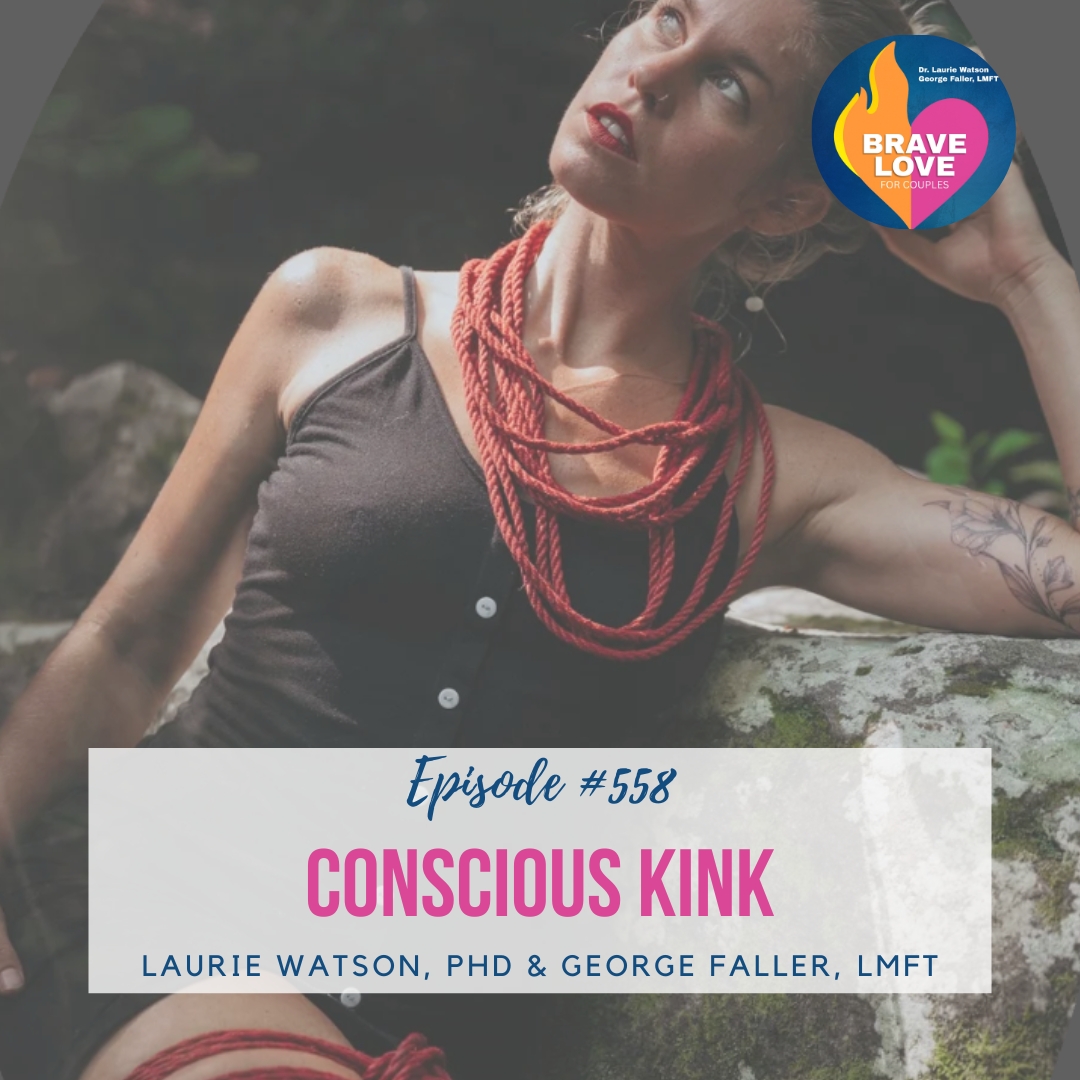
Welcome Brave Lovers! In today’s episode, our hosts are joined by renowned Shibari Artist, Kati Bird. Shibari is the Japanese art of decorative rope bondage.
Listen in for this exciting conversation as Kati shares more about the art and how it can be transformative for couples. Kati details how the process involves clear and explicit conversation between partners and can create a somatic experience that evokes emotional intimacy as well as physical.
She shares that there is frequent checking in, attunement and the creation of space for communication that can allow participants to experience deeply. This unique practice has many benefits and with Kati helps educate and reduce fear and stigma around the practice of Shibari.
If you’d like more information or to work with Kati directly; visit her website at www.shibariunraveled.com Lovers–we are less than one month away from the release of our book. Make sure to order your copy of Brave Love, Great Sex today!
Transcript
george (01:00.328)
Exciting guest today, Laurie. We got Kati Bird, Shabari artist. What does that even mean? Here we go.
Laurie Watson, PhD (01:06.971)
Ooh. Ooh, I’m so excited. Welcome, Kati.
Kati (01:12.357)
Thank you.
george (01:14.86)
So let’s give a little backstory here, Kati. You know, Laurie’s meeting you for the first time. Both of us presented at in sessions with Esther Perel, and you know, I only made the end of your your your seminar that you were doing, and I was like, what the heck is going on here? You know, I’m watching this video of it looked like dancing with ropes that was all about kind of what we and me and Lauriw try to do with couples, attunement, resonance, getting people in vulnerability.
You know, and in my limited trading, I’m thinking of like PDSM and cake and all these things as whips and leather and paint and all these other things. I was like, this is a different world that I’ve never seen. We we gotta get Kati to talk and educate me and us a little bit about this beautiful work that you’re doing.
Kati (02:04.237)
Yeah, yeah, thank you. Yeah.
Laurie Watson, PhD (02:06.744)
T tell us tell us about this. What is Shabari?
Kati (02:11.151)
Yeah, so Shibari is the Japanese art of tying the body in ropes. So yeah, its history is kind of in the dark arts of Japan. was originally utilized as a way to ensnare captives. So it has sort of this background, from there it transitioned out of there and became more of an erotic art.
where Japanese men were like tying women and making these really beautiful decorative poses. But also what I really see in the history too is this desire to kind of put someone in a vulnerable place and witness them in a space that you don’t typically see them.
And I think that that still stands today, whereas there’s this aesthetic piece of seeing the ropes really beautifully, but there’s a huge relational piece of being witnessed and seen in like, you know, when you don’t have your arms and your arms are tied behind you, it’s like you can’t adjust your hair in a certain way, or you can’t move your outfit in a certain way. You’re very much exposed and there’s something very…
erotic in that sort of helplessness or surrender or beauty in seeing someone in a way that they wouldn’t typically be presented. least this is what I see in it as well. And then just the emotional piece of creating emotion by putting people in different positions and having this sort of power dynamic and exchange.
Laurie Watson, PhD (03:17.838)
Hmm. Hmm.
Laurie Watson, PhD (03:28.554)
Mm-hmm. Mm-hmm. Interesting. Very interesting. And y at this seminar that George had, you had fifty couples there doing this, right? Doing this with you?
Kati (03:39.035)
Yeah, yeah, yeah, with Astaire, I’ve worked with her a couple times and she’s had some bigger groups and it’s like an hour, an hour and a half, so it’s a very short amount of time to lead people into a very…
powerful situation and also with very little knowledge of the ropes because I don’t have a lot of time to teach and so my attention is how to how to drop them into connection with each other and to deepen that polarity of okay I’m the leader and I’m the one taking charge and you’re the one surrendering and what does that mean and how does one drop into surrender and leading them through breath and touch and movement and play and
Also having this moment for them to share their boundaries and their fears and having this conversational piece of bringing in what are my boundaries in this interaction and what am I afraid could happen and what do I want to happen. And having them explore both sides of this polarity of being the one who’s tying someone and then also the one who’s receiving ropes on their body and.
Laurie Watson, PhD (04:28.578)
Mm-hmm.
Laurie Watson, PhD (04:36.343)
Mm-hmm.
Kati (04:39.769)
Maybe George saw it in the end, like it provokes people. It provokes a lot of emotion in people. Safety, surrender, being held or witnessed in a way that they had never experienced before. And I think what’s really interesting in these spaces is that a lot of men’s voices come into the space where they share like, wow, I’ve never received that kind of embrace before or attention in this way. Or women sharing, wow, I felt a lot of safety in this space that I haven’t felt. And I wouldn’t have expected with the ropes because I thought this was some weird sex thing.
Laurie Watson, PhD (04:51.629)
Mm.
Laurie Watson, PhD (05:01.784)
Okay.
Laurie Watson, PhD (05:09.472)
Hmm. So it’s more than sex. Shibari is something else. Tell us, you know, what what other things besides eroticism and arousal do people expect when they do the tying and being tied?
Kati (05:26.991)
Yeah, I think many people have seen the ropes in a sexual context and that either turns them off or really turns them on, one of the do. And it is not just a sexual experience. I mean, I’ve tied my mother. I…
Laurie Watson, PhD (05:40.49)
I saw that. I saw that on your website. Your yeah.
Kati (05:44.215)
Yeah, and so like what I love about the ropes that’s really opened it up for me is it can be for anyone. It can be for a self practice. It can be with friends. It can be with lover. It can be with partner. It can be with family. And what I’ve really seen about it is it for me, the ropes creates.
playground. It’s like, hey, let’s enter the ropes. And when we enter that playground, there’s like when you enter a game, when you start like a sporting it, like you’re going to play basketball or something, you need a court, you need a time frame, you need the rules, you need the teams. So same kind of thing. It’s like whenever you and I enter a rope space, it’s like we create a space together. It’s like, okay, we pick a block of time, we pick a setting, we pick a music, we pick, we talk about conversation, like how’s your body? How are you feeling? Like what do want to experience? So it opens up intimacy because ropes are risky and it’s vulnerable. And so
it encourages a conversation piece around intimacy inherently because of what it is, which I really appreciate is like, because we’re doing this, now we have to talk about it. We’re in typical intimacy. It’s like, okay, we’re just gonna roll with it and kind of see what happens. And there isn’t always that conversational piece, but with the ropes, I find that most of the time when you pull out a rope, you’re like, wait, what are we doing? How are we gonna do it? What do you like? What do you don’t like? Like, how long are we gonna do this for? Exactly.
george (06:58.803)
It forces you to be explicit. What I really what I really like about like what we do in therapy is a lot of it is trying to get people to go into their vulnerability, but they’re going through it in their mind. Right. And we try to bring awaken the body in the process, but the ropes immediately bring in the somatic. They immediately
Like you said, if you can if your arms are behind your back, your body is already in a place it’s normally not because we’re we’re pretty well defended. So it forces that process in a way that I didn’t think was possible. It like accelerates the body’s vulnerability.
Kati (07:33.074)
sure and speaking to attunement it’s like both parties need to be attuned or should practice attunement because you’re gonna
So the one who’s leading, it’s attuning to what is your desire and what do you want to create and how do you want to lead this experience because you’re going to be slowly taking away aspects of control. If you’re taking the person’s left arm and right arm and their legs, then you’re in charge of their body, of their movement, of making sure that they’re safe, of listening to them, to their breath, to their sounds, to their expressions, to understand what they’re feeling or asking if you don’t feel sure.
Laurie Watson, PhD (08:04.771)
Mm.
Kati (08:08.569)
Yeah, I just really love that the ropes creates that sort of space to connect with other people and in mostly a nonverbal way. Of course, there’s people who do ropes and do like shop talk. It’s like you’re tying and you’re talking about TV and this, that and the other. But for me, that’s not the time.
When we do ropes, it’s really about going into the relational piece and the vulnerability of being seen and witnessed. Even as a leader, it’s edgy to take charge and to tie someone in to pursue my own desire and interest. Where I’m being witnessed in my own pleasure or my own insecurity or uncertainty as I lead. And then also on the other side, when you’re receiving the ropes, where it’s like, you’re enjoying or you’re uncomfortable and someone’s eyes and attention is 100 % on you. That’s also pretty edgy.
Laurie Watson, PhD (08:26.124)
Mm-hmm.
Laurie Watson, PhD (08:38.242)
Mm.
Laurie Watson, PhD (08:44.108)
Mm-hmm.
Laurie Watson, PhD (08:54.732)
Hm. So start start us go ahead, George.
george (08:55.145)
Yeah, we were I
george (08:59.623)
I was talking Kati right beforehand. Like when I watched her work, and we do a lot of live sessions with couple, what I really appreciated was her ability to read micro expressions, like with the tiniest little body movement. She would read something, adjust to it, move the position. I mean, it’s beautiful to see a master at work that is, you know, and you’re doing this live, there’s vulnerability and that, but your your skill in being able to really pay attention to what’s emerging.
You know, I I think it’s a great lesson, regardless if it’s ropes or not, it’s just that ability to read.
Laurie Watson, PhD (09:34.774)
Attunement, yeah. Tell us like how would a couple say, Hey, I want to play with ropes and I I’ve seen this thing. I mean, how did they get started? How do they decide who’s going to be tied? Where does consent come into this? Talk to us from the beginning.
Kati (09:50.351)
Yeah.
Well, I think definitely learning with someone. there’s different Shabari masters who have different specialties, different teachers who have different interests, kind of like with dance. There’s different dance teachers that have different concentrations of the type of dance they want to lead. And it’s the same with Shabari artists as far as like what they want to emphasize. And for me and my teachings, I really emphasize the connective piece, the emotional piece and the creativity with the ropes, where it’s not explicitly just about the technicality, because I find that the technicality really puts people in their
heads where it’s important to learn the technicality for sure but when you enter the session it’s more about the connection and if the person is really focused on doing the right tie and the right knots the attention is on that and it’s off of the person that they’re playing with. So this is one way that I structure it and then getting into it and getting started yeah I think it’s really about dropping into
into meeting someone and learning with them and then learning to create spaces where communication is really the largest piece, I would say, to opening these spaces because without it, you’re not able to go as deep. And so in these different frameworks that I would go into, it’s like we ask, what kind of sensual touch would you be interested in experiencing and getting really explicit about what kind of touch that is? What kind of…
Are we going to be sexual or not? And I actually think it’s really interesting when you take sex off the table, that creates more creativity because like, okay, well we can’t do sex. So how can we play here? How can I play with you in a way that isn’t going straight to the ABCD of this interaction? And is there other ways that we can experience pleasure together? And maybe that pleasure looks different than just…
Laurie Watson, PhD (11:35.497)
Mm-hmm.
Laurie Watson, PhD (11:39.022)
Mm.
Kati (11:42.935)
nice touches, like maybe it’s also bringing intensity to the body and witnessing your partner like kind of process a sensation. For me, when I tie someone and I witnessed them like processing a challenging sensation, it’s really intriguing. It adds more emotional depth when I see them like breathing or like sighing or moaning. To me, that’s erotic, know, especially if it’s within their boundaries. So couples like learning a lot about
like how to communicate going into a space, how to check in, how to read the body. When is a yes, when is a no? How can you stop the session and what happens if you stop a session and how to take care of someone after the session and how to dedicate time to them to close the experience. To me, all of these frameworks around Shabari and creating conscious kink translates to other aspects of intimacy that can open up and like blossom how their typical everyday sexual dynamics can occur.
Laurie Watson, PhD (12:38.999)
Interesting.
george (12:39.211)
Conscious kink. I like that that that label. Well let’s let let’s come back and let’s get personal and talk about which which roles people would prefer here. All right.
Kati (12:49.265)
Mmm.
Yeah, so.
george (12:54.527)
So we again were talking and Kati said, Would you be interested in in in doing some ropes? And I was like, Whoa. I like control a lot. So being being in a role of like that would be probably a growing edge for me. But you’re also saying you’re in the role of the leader. I mean, there’s a lot of, you know, there’s a lot of responsibility, a lot of need to read. But so which do you prefer? I’m sure you’ve tried both a lot.
Do you have a preference or what’s what’s the pros and cons of both?
Kati (13:27.617)
Yeah, well for me, I mean, this is what I’m doing for my work. And so it’s what I’m doing a lot of is I’m holding space for others to surrender, to let go. I work with men and I work with women and both have their different needs stepping into the space.
george (13:43.103)
What would those differences tend to be?
Kati (13:45.827)
Yeah, well I find that, I mean, I’m sure both of you can really relate to this, as can I. But like, with the leadership and with the taking charge, this is how we’re operating in our everyday. It’s like we have schedules, we have families, we have jobs, and it’s like you’re always in your head and you’re planning and decision making and leading and…
just high functioning life and rarely are we able to turn off the mind and completely let go and let someone else take charge. And so what I love about this space and what I’ve witnessed a lot with men is first off men are rarely held because usually men are a bigger stature, bigger bodies and so they don’t even feel like they can be held because they’re too big. They’re probably told that when they were kids, hey, you’re too big to pick up now. Like, you’re such a big guy. And even receiving an embrace unless it’s from like another man of similar stature, I don’t know if men are actually relaxing their bodies and sinking into
totally releasing, whereas the ropes create this really strong structure and containment where actually they can be held. And I think it’s a sensation that many men actually haven’t experienced ever or maybe just once or maybe when they were just babies. So even if they think they can’t surrender, when they feel this sensation there’s something in their body that says, my god, I can’t even believe how much I’ve needed this.
Laurie Watson, PhD (14:48.333)
Hm.
Kati (14:58.169)
And like the emotion that comes in that of like, wow, I haven’t been held and I’ve been holding so much in and I’ve been carrying everything. And right now someone’s giving me, not only am I embraced by the ropes, but now I’m receiving this nice touch or rocking or attention or touch, a variety of touch. Like I feel like with men, they’re expected to know how to touch a woman or touch their partner in certain ways that they themselves have never experienced on their own bodies. And that also is baffling to me. It’s like, you’re expected to be this magnificent lover, but you yourself have never received this touch.
fascinating and yeah.
Laurie Watson, PhD (15:28.846)
Mm-hmm. Very fascinating. How did you how did you get into this? How did you find Shabari?
george (15:29.951)
That’s brilliant. Yeah.
Kati (15:36.773)
complete accident. I had heard of it, an ex-partner had showed me they were into it and I was like my god that is some violent abusive thing on women that I would never do. Like that’s some weird sex stuff and I’m not into it and I was a very much like there was a solid I never ever ever will I ever. Fast forward and I have a background in rock climbing and also at that time like outdoor survival so I’m very familiar with the rules.
Laurie Watson, PhD (15:39.146)
Laurie Watson, PhD (15:47.182)
Hm.
Yeah.
Laurie Watson, PhD (16:04.192)
Yeah, there’s some ropes there.
Kati (16:06.307)
Yeah, absolutely. And I hadn’t been climbing for quite some time and I stumbled into a workshop. I just got invited. I had no idea what it was. And it was a ropes workshop. because I had missed climbing so much and I saw the ropes, that was my immediate affiliation. And I didn’t even think about that previous story.
And we got into the workshop and just the dynamics of asking about boundaries and the care and the consideration of like being tied and tying someone and the sensations. Gosh, when I, when I experienced being tied and it was very basic, it was a very short encounter where the person tied me my arms to my chest. I mean, it was a beginner’s class their first time. And then we sat down and they just like rocked me side to side. And then they like gave some gentle caresses to my arms. And I just, the contrast of the constriction
and the soft touch, felt more sensational than it typically does because like the restriction was creating a sensation and then this additional texture and then they untied me and I was flying high. I was like so altered. I was like, I felt like I took drugs. I just was so relaxed and so at peace and there was no thoughts in my mind and I was like, what is this? And then I continued to go to the classes and then the next class it was like all these things that came up for me around fear around like, okay, now I’m tied.
but what if they do something that I don’t like? And then I realize that these are some of the barriers to me for surrendering. It’s not this, it’s like this is revealing to me stuff that already exists within my system, already exists within my history. So this is the playground where I can start to practice vocalizing my concerns or advocating with my voice, which will also translate into my intimacy. It just creates a little hologram of that.
george (17:49.654)
Well and you’re using the word a lot playground, which I can certainly see, but you’re also making space for like traumas to be revealed. That this could be a place of healing, right? If if you start tapping into parts of yourself that haven’t been able to come out.
Kati (18:05.007)
Yeah, and back to that, when I said conscious kink, this is why, like how I perceive the ropes isn’t how everyone perceives the ropes. Because some people have no interest in the past wounding and what this brings up for you emotionally and how, like your traumas. Some people are like, I don’t have space for that. This is a kink space. We do the thing, I take care of you and then it’s done. So yes, a lot can come up in this space, especially if it’s invited or it’s emphasized or if it’s looked at. Kind of like that example that you were giving me before of this, of that, man Owen Marcus.
to like when he tells someone to tell a story and he notices, your eyebrow, what happened there? And that same attention when I’m tying in the ropes, I’ve noticed, hey, I see something here and I bring attention to it. And they’re like, yeah, this is reminding me of when my mom used to abuse me. Okay, let’s go there. And so like there are openings in these spaces if we create space for it. And I feel like a lot can be transmuted in this space because it’s so body oriented. And not only is it body oriented, but it’s relational.
Laurie Watson, PhD (18:55.309)
Mm-hmm.
Laurie Watson, PhD (19:04.962)
Mm-hmm.
Kati (19:05.125)
where I myself when I’m tying, I can embody different roles. I can be the mother, I can be the father, I can be the lover, I can be the one who’s more intense. I can be like all these different polarities that access the human.
Laurie Watson, PhD (19:16.823)
Hmm.
Yeah, I think I’m interested in the somatic aspect that would sort of do something and bring something out. You’ve said it that you felt and experienced something. Do you have any sense of like why that is, why the constraint of the body or constraining another’s body like causes this emotional reaction? Like what’s being triggered? Almost like I I’ve heard it talked about with Reiki, right?
Reiki massage, the way that that releases like emotional, pent up feelings and experiences and memories. w do you have a theory about why that happens?
Kati (19:59.001)
Yeah, I mean, I believe that it actually starts in utero. I think that like containment and being held and compressed starts there. Even being birthed and being squeezed, like being birthed and squeezed releases all the hormones into the system, which creates our consciousness. And I think a lot of people who struggle with anxiety or different neurological things, containment and pressure helps relax their system.
Laurie Watson, PhD (20:03.832)
Hmm. Hmm.
Mm.
Kati (20:26.781)
There’s many different practices that are coming out around this or have existed in tribes and other cultures around like burying someone or wrapping them in sheets or whatever, weighted blankets. It’s all the same thing. It’s containment. And the human body needs connection and needs to feel held. And we have kind of forgotten this, but containment and being squeezed and help does something for us. It releases hormones into our system, endorphins and oxytocin and serotonin and dopamine.
Laurie Watson, PhD (20:40.376)
Mm-hmm.
Laurie Watson, PhD (20:51.438)
Yeah.
Kati (20:56.655)
which are necessary for our development. And so the ropes, when we see like the kinky stuff are like, that’s scary. But then when you experience it, you’re like, my gosh, I had no idea I could feel this in this thing. I’m being bound in ropes, which looks scary to the outside, but I feel extraordinary. I feel bliss. I feel relaxation. I feel peace. I feel loved. And
Laurie Watson, PhD (21:17.058)
Yeah. Hmm.
Kati (21:21.377)
this sense it’s really it’s it’s it gives nutrients to your soul to your being to your body and the somatic piece also is it brings attention to sensation.
The ropes have this sort of unpredictable texture where it’s like there’s the gliding, there’s the sliding, there’s the constriction and all of this. The mind can’t really track because it’s covering multiple spaces at the same time. If you’ve ever received a multiple hand massage, you may have noticed this, like, okay, one person’s hands, can track it. Two people’s hands, like four hands on you, you start to not be able to tell what’s happening. More hands and your brain just kind of like disappears and you’re like, wow, I’m just experiencing a lot of sensations.
Laurie Watson, PhD (21:46.487)
Mm-hmm.
Kati (22:04.511)
fully in the body. The brain can’t even compute what’s happening. So it really takes you into the body, which how many of us are actually able to get out of our minds unless we do the same thing?
Laurie Watson, PhD (22:07.906)
Mm-hmm. Mm-hmm.
Mm-hmm. Well
Yeah, one of the things, techniques that I talk about with women who are struggling to have orgasm is that multiple stimulation sometimes distracts their brain from being able to worry about how they should perform or what they should do. It’s almost like, you know, maybe anal stimulation plus clitoral stimulation or something all together. They they can’t track it explicitly. And so then their body just kind of releases into pleasure.
Kati (22:38.598)
Yes.
Laurie Watson, PhD (22:44.078)
So I I think you’re saying something like that. And no, I’ve never had a multiple person massage, but now that you talk about it, maybe I’ll have to try that.
george (22:49.573)
Yeah. She’s signing up for one.
Kati (22:51.535)
She’s like, going for it.
george (22:54.569)
Yeah, I I love the expansion. I mean, again, my mind narrowly thinks of it just sexually. And when we talk about an attachment bond, we’re always talking about three systems. You have the, you know, the sexual system, you have the emotional vulnerability system, and then you have the caregiven s response to those two need based systems. And what you’re describing is an interaction of all three of those systems.
Laurie Watson, PhD (23:16.718)
Mm-hmm.
george (23:16.789)
You know, there’s this sexuality component, there’s incredible emotional vulnerability, and there’s a tuned responsiveness. It’s relational constantly that’s happening, safety, containment. I mean, you got a lot of elements that are happening, and it looks like a dance. It looks it looks so seamless and fluent, and yet it’s it’s striking at so many levels.
Laurie Watson, PhD (23:32.526)
Hm.
Kati (23:35.601)
Absolutely, and it can also be very basic. You know, I teach beginners classes and I
I teach people from like a very easy level because I want them to leave with not just a technical skill, but how to connect. And it’s there’s things that we can do without the ropes that also have such a powerful impact, which really just has to do with deep listening to another person and asking them questions about their body and like even being asked, like what’s the kind of touch you do or don’t want or like what’s the kind of things you’re interested in actually having the permission field to speak to that and someone else honor that is quite extraordinary. And then just holding space.
Laurie Watson, PhD (24:07.544)
Mm-hmm. Mm-hmm.
Kati (24:09.851)
like presence, pure presence where someone is just like placing their hands on you and not moving and regulating their own system and doing their own breath and really attuning to themselves while simultaneously attuning to you. This in itself is its own sort of magic where people rarely feel just pure presence without doing or having to say be do just there in silence that in itself has a power without even the ropes.
Laurie Watson, PhD (24:23.148)
Mm-hmm.
Yeah.
Laurie Watson, PhD (24:38.22)
Mm. Very interesting.
george (24:38.443)
I wanna highlight yeah, I wanna highlight
We we work with men and we’re trying to get them to be emotionally vulnerable. But it’s hard to give something to your partner you haven’t received. And I’ve never heard of that same thing physically, because men usually it’s their primary way into connection. But you’re right. I I remember as a little boy like liking my father’s hug because it held me and I felt safe and it swallowed me up and I don’t get that at all anymore, you know? So it is I think you’ve talked me into it, but
Do not do not tell the guys at my firehouse anything about this, all right? As long as we keep that a secret, we’re good to go.
Kati (25:19.729)
Got him!
Laurie Watson, PhD (25:19.982)
Ha ha Wow. Yeah, George has been not so interested in talking about kink even. So you’ve done you’ve done something really interesting here. Persuaded him. I will say though, George, you have a son now who’s bigger than you are. He could give you a tight squeeze.
Kati (25:30.779)
Yeah.
george (25:39.145)
He can but it’s a different a safety feeling, right? When it’s you need it it but yes, I’m gonna think about that more often. It’s very a concept I hadn’t played with.
Laurie Watson, PhD (25:41.162)
It’s a different dynamic, yeah. Yeah, of course. Yeah. Yeah. Yeah.
I well I think I think the reason I say that is because I have boys who are much bigger than I am. And so I experience as a mother this juxtaposition of being the small person now, being held and hugged by, you know, larger people. It’s really interesting, but and I love what you said, Kati, about compression and how that sort of is reminiscent, I think, of the womb.
Of birth and how it must trigger primitive places in the brain that maybe are good, you know, good sorts of places in our brain, but also maybe trauma, because we know that sometimes people do experience trauma in birth. And so maybe it’s a reprocessing, you know, bringing it into the present. And as you bring emotion consciously.
Then your brain can re categorize it in a way that sort of brings order to something that was chaotic and disordered. So maybe that’s what’s happening here.
Kati (26:53.515)
sure absolutely a lot of the times in sessions there’s something that I would say like becomes a refrain.
george (26:53.6)
Yeah.
Laurie Watson, PhD (26:58.978)
Mm-hmm.
Kati (26:59.013)
where a lot the times we experience trauma in isolation or alone in some kind of way where like we have the experience and then we’re alone with our process, with our emotions, with our fears, with the story, with many things. And what I’ve experienced in many rope sessions, because I kind of open it up to whatever people come to me with all sorts of intentions and desires and fears and stories. And then I just kind of allow whatever wants to come through from their body and whatever wants to come through me to happen. And what I witnessed ends up happening many times is there are stories that come through where all
the strapped down to the hospital table and they’re sticking tubes up their nose and they’re back in that story. Where all of a sudden they’re back in a dynamic, I’m giving real examples that have happened in sessions, all of sudden they’re in a dynamic where they’re verbally fighting with their mom like they did every single day and they’re back in that scenario and it’s like the touch reminds them and the dynamic reminds them and it brings the story up in front and center and it’s like alive in the system. And usually I don’t know this
Laurie Watson, PhD (27:37.56)
Mm-hmm.
Laurie Watson, PhD (27:41.976)
Mm.
Kati (27:58.859)
is happening in the ropes, I just kind of follow the cues and follow the impulses and follow the emotion.
For instance, with the story with the guy with being strapped down, he had this story of having to go through surgery when he was really young and they strapped him down to the table and they shoved the tubes up his nose. And all of sudden he’s tied and he can’t move his hands and he can’t touch his face. And the same thing came up and he starts screaming. He’s like, my God, get me out of here. Like, and I’m like, okay, breathe. What’s going on? He’s like, there’s something in my nose. There’s something in my nose. And I’m like, okay, what do you need? He’s like, you need to wipe it off. Get a napkin and wipe it. And so I grabbed a napkin and I’m wiping his nose. I was like, that better? Is that, you okay? And then I put my hands on him calmly.
and I’m breathing calmly and regulating my system. And then he regulates himself and he’s like, I’m good and I’m okay. And what ends up happening is like, we rarely get that care, consideration and reassurance and calmness actually in a certain situation that actually brings us back to a baseline or completes the story. And like in another session that I’ve had with someone.
Laurie Watson, PhD (28:52.386)
Mm, mm.
Kati (28:57.505)
we kind of got to this like playful moment where I felt like this spice like he had this look in his eyes like he kind of wanted to hurt me and he was tied and then I just was like playing and tugging him and pushing him a little bit. We had this like playful push and pull but I could tell that he like wanted to get me in a playful way and then after I untied him and laid him down and covered him in a blanket and laid beside him and wrapped my arm around him and he started sobbing and I didn’t know what was happening but then when I when the session was over he’s like my gosh I can’t believe this he’s like when we were
in that kind of push and pull tension, it reminded me of the times that I would fight verbally with my mom and I would yell and she would yell and we’d go back and forth. And then eventually I would hit a point where I couldn’t do it anymore and I’d run away to my room and hide under the blanket.
And then she burst in my door and yell at me through the blanket. But he’s like, I was done then. I wouldn’t come out. I would just be hiding under there, like curled up and sad and crying. And she would just yell at me. He’s like, but you came and you laid beside me and wrapped your arm around me.
And that had never happened in the story where I received love and care. And so what happened is that reframe happened where another option happened, the care, the love in that story. And so he experienced something different. So it moved to the piece. I think it like moved the file somewhere else where another ending to the story was possible.
Laurie Watson, PhD (30:05.73)
Mm-hmm.
george (30:15.957)
We would call that in our language limbic revision or, you know, a corrective emotional experience where you added a new element to the old story. And in doing so, it rewires the brain, right? It goes from isolation to safety and the power of co-regulation. So how can our listeners find you? You know, they g I’m sure they could be fascinated by some of this.
Laurie Watson, PhD (30:20.364)
Mm-hmm.
Laurie Watson, PhD (30:28.428)
Mm-hmm.
Kati (30:34.833)
Yes, I am touring all over the world. When I’m in the US, I base in Salt Lake City and Boulder, Colorado. And yeah, people can find me through my website, shabarianravelled.com and reach out to me. I work with individuals in one-on-one sessions and I work with couples and I work with groups and I do retreats. You can get me in any which way you want. You can bring me to your town and you can come to mine. Yeah.
george (31:02.027)
Awesome. Awesome.
Laurie Watson, PhD (31:02.818)
Well, thank you so much for being with us. And again, we want to emphasize, you know, this has to be done with trust and consent. And but it was a fascinating conversation, Kati. Thank you for being with us.
Kati (31:14.875)
Yeah, thank you, Lori. Thank you, George. It was delightful to be here and talk about this with you. Yeah.
george (31:20.231)
Awesome seeing you again.
Laurie Watson, PhD (31:22.328)
Thanks for listening.
george (31:23.797)
Keep it hot, y’all.