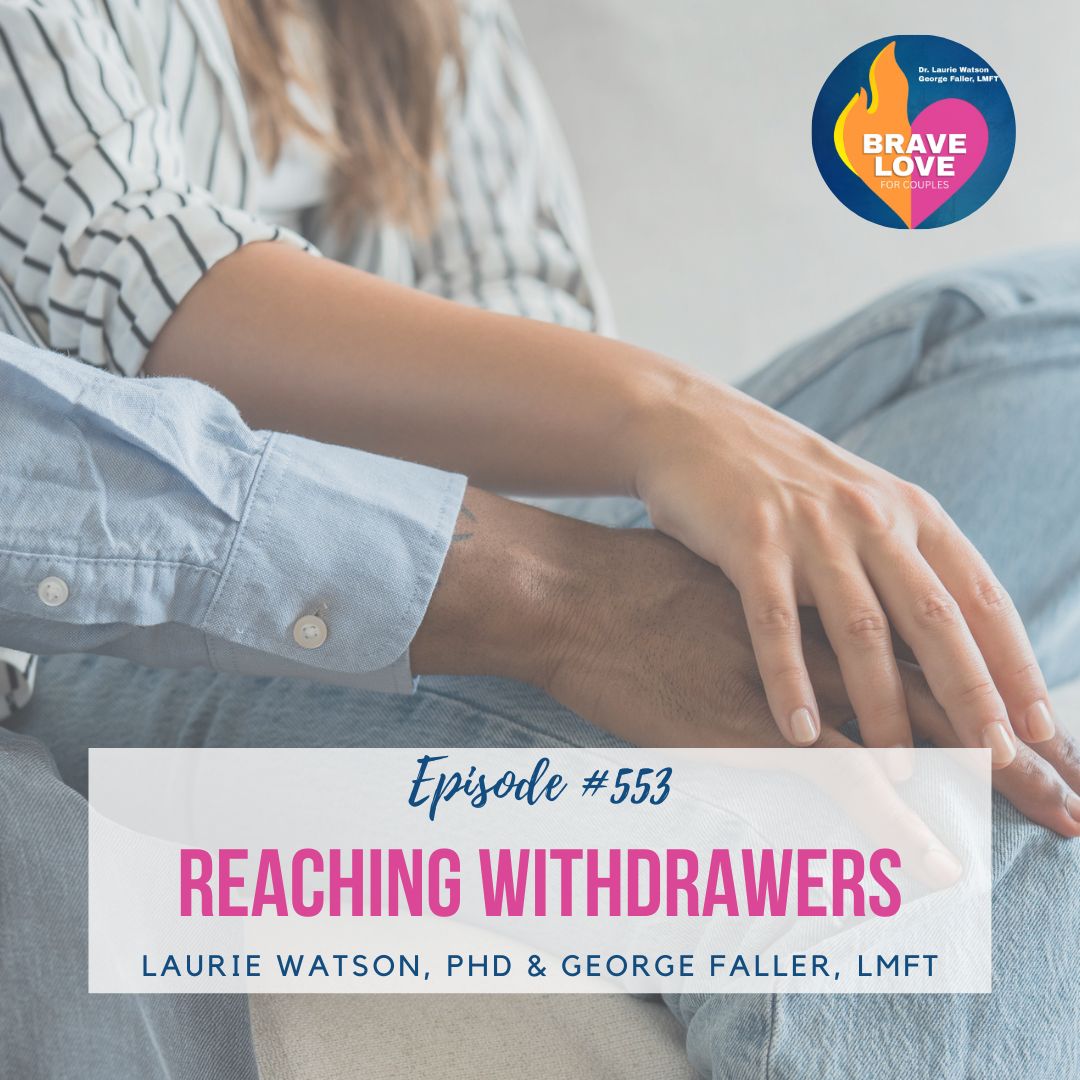
Welcome Brave Lovers! In today’s episode we are discussing reaching withdrawers through the body. When the withdrawer is anticipating something negative, they become activated, freeze and fall into a shame spiral. This shame spiral causes distance in the partnership and is a step in the negative cycle. Creating body awareness, and identifying what feelings are present can help withdrawers slow down and stay engaged.
Listeners will learn how to do this today using the acronym ROC. R-elax, O-pen up, C-onnect. George guides the audience through, how to relax, opening up and getting curious, and connecting with others on your experience. This practice builds the skills of self-awareness, regulation and improved communication in relationships. How can you use ROC in your life? Let us know on our instagram @BraveLoveGreatSex and don’t forget to pre-order a copy of our book by the same name!
Check out Owen Marcus’s organization Meld to find out more.
Transcript
Laurie Watson, PhD (02:14.979)
Okay, we gotta help get through to these withdrawers, George. They seem like a rock to me. I wanna find a way to to reach them, especially when they’re related to me.
george (02:27.724)
Well, we all need reaching a little bit of help, right, Laurie?
Laurie Watson, PhD (02:31.246)
Okay, good.
Okay, our book is coming out September fifteenth.
george (02:39.394)
We keep pimping it, but we’re doing that ’cause we need your help. So we believe it’s gonna make a a big difference and every little pre order helps. Move it up the list, right, Laurie?
Laurie Watson, PhD (02:50.917)
That’s right. So maybe order for your friends for Christmas, your family members, the people that you think need some help, maybe the people that just wanna have better sex. Brave, love, great sex.
george (03:03.576)
Brave. I just had my Fourth of July party with my whole extended family and we had this discussion. So people were pre ordering right there. It was pretty cool.
Laurie Watson, PhD (03:12.933)
Woo That’s great. You had a big crowd, I saw that on Facebook.
george (03:17.066)
Mm big crap. And you know, it’s d don’t be embarrassed. It’s good to bring it up and start a conversation. These are important conversations.
Laurie Watson, PhD (03:25.041)
George has been known to start several conversations with his family. that’s good. That’s really good. Okay, you have a new acronym for us. Tell us about how you came to this.
george (03:31.734)
Yes. Viva la clitoris was one year, but this year was the brave, love, great sex year. So
george (03:44.142)
Well let’s get some background. I I I just did some I did a training with Owen Marcus who created the MELD group, which is men’s emotional leadership something, dynamics. And he’s been doing this for forty years. He’s really pretty fantastic and you know the gist of what he’s trying to do is say with so many men it’s it’s physiology, not psychology.
Right that, you know, so often therapists or their partner are trying to reach them through their brain. But we know when a threat responds, especially for withdrawers who take space and shut down, you can’t access their brain when they’re shut down. So it’s like if if the doorway that closes it is, you know, their body shuts down, then you actually gotta go through the body.
You know, and I w I find this helpful, you know, just trying and we know the field of therapy in general is moving towards the somatic, seeing the importance of kind of working in real time with the body. So this is just a another intentional way of doing that.
Laurie Watson, PhD (04:30.491)
Yeah.
Laurie Watson, PhD (04:43.641)
Right, exactly. I I often say that physiology informs psychology, especially for males when they have so much testosterone, in terms of how they feel about sex. I mean it their body tells them an absolute truth about what is going on. And so their mind is shaped by what their body is saying.
george (05:06.763)
Hmm, exactly. And when it comes to the threat response, I I like he talks about the simple process that he sees all the time is you know, first they feel the pressure, you know, s of what could happen. I mean, the pressure is online most of the time in a lot of these conversations because their body is anticipating what’s likely to happen. And then there’s activation, right? They hear the comment, hey, you know, why didn’t you do this or why didn’t you do that?
And immediately, because the body’s already bracing for the trigger, when it comes, you get this freeze response, right? Which is what we talk about, that dorsal vagal nerve response. It’s like, uh-oh, here we go again. Here we go again. Shut down, check out, disappear, right? And as they start to shut down, along comes the shame, right? The meaning making to like I’m screwing this up again. I’m failing. I’m bad. I’m not enough. I’m like all of that crap.
Laurie Watson, PhD (06:00.365)
Never gonna be enough. Right.
george (06:01.897)
Never gonna be enough. Why do I bother doing this? The helplessness of all this crap. And then comes the action tendency and then comes the withdrawal of just get out of the space. You know, and if you want to kind of access that, and we want to start talking about how they feel, what they think, but like that pressure is the starting point of it, right? That’s why it’s somatic and that’s the doorway that he uses. I mean, I actually did this men’s retreat with him as a participant, which was really weird.
And be the g you know, guy who leads these these weekend retreats to be the person in it. You know, nobody knows who I am and try to get me to cry and be vulnerable. Like all the stuff I like to teach about but not actually do. Like, yeah. So that was, you know, two days of of of pressure was a good word, but it was it was a really it was a great experience to see though, like how we all can access our own bodies, you know, in in in deeper ways and
Laurie Watson, PhD (06:35.855)
Yeah. You have to be you have to be vulnerable.
Laurie Watson, PhD (06:47.313)
Torture for George.
george (06:59.559)
What I love of his is his acronym. You know I’m an acronym junkie. But what he’s trying to do in with me what everybody was doing this weekend over and over again is what he calls rock ROC. You know, first thing you gotta do is you gotta relax. Right? You’re being intentional and you relax. And we we hit this hard with with sex and great lovers. They’re relaxed. You know, allowing your body to kind of
Laurie Watson, PhD (07:03.928)
Yes.
george (07:25.705)
You know you’re in the present moment when you can relax and and we could always trust our breath, just listening to our breath in and out, right? We’re we’re in that mindfulness moment when we’re starting to get into that state of just being present. Right. And then the O is in that space is you really wanna open up. You wanna really explore and be curious about your own body, what you’re feeling, you know, any tension anywhere, you know, any any pain, any stress. You know, if we
And a lot of times we ask this question if you’ve never really done this, you it’s hard to find anything. But if you keep trying, it gets easy and easy because there’s always a physiological response. What it’s interesting is last thing to see is connect. He tries to then get men to share what’s happening with them with other men. And this is all happening in a group setting. And it’s pretty amazing to see how naturally when somebody starts to be vulnerable and they start to open up.
How it pulls the caregiving response from the people around them. And then that’s what leads to the co-regulation, right? It leads to that fear response is being shared with another nervous system, right? And when that happens, it really changes how the body experiences the threat response. So instead of feeling disconnected and isolated and alone with the shame.
You’re open, you’re just talking about what’s coming up for you and other people are witnessing and just kind of sharing their empathy and putting their arm on your shoulder. And before you know know it, it starts to work through those emotions. It starts to discharge.
Laurie Watson, PhD (08:57.577)
Mm. Mm-hmm. So let’s say this in a lay person’s language, right? We just want the the rock is such a good acronym because that’s kind of what it seems like for the withdrawal that they’re just the gray rock, right? They’re just sitting there immobile, not reachable, not feeling. But really the antidote to being the rock is the rock acronym, which is to relax.
george (09:13.313)
Yeah.
Laurie Watson, PhD (09:34.57)
after you’ve kind of dealt with the threat response, the part of you that says, it’s not safe to connect. It’s not safe to need anybody. Needing people is is a bad thing, right? Because I learned early on, not a good thing to need anybody. But you’re saying if if they can get in touch with their body and be and be in a relaxed state, then they can feel freer to connect.
george (09:59.63)
Exactly. And the stress and pressure is anticipating a failure in co-regulation. Right. Every time there’s a fight and they feel bad and they don’t know how to talk about and they go away to self-soothe that. Like every time the body says, see, don’t talk about these things. Don’t depend on people. They let you down. It doesn’t work. You know, they have thousands and thousands of their interactions and you can’t talk their body out of it. Their body actually has to experience feeling the stress.
communicating that stress and actually having success in co-regulation. You know, that is when the nervous system, you know, gives care given to their emotional kind of threats or needs. And that’s what transforms how the body experiences the threat response.
Laurie Watson, PhD (10:46.489)
Yeah. And success in co regulation in layperson’s terms means what?
george (10:53.325)
It’s simply when you have a fear or a hurt, and that hurt is shared and it is responded to. This is James Hawkins, you know, he talks about Doc Hawk Deforoz, you know, the person, I have to realize first of all that I’ve been threatened, something’s happening in my body. And then after that, I have to actually reach to my partner and let my partner into the experience.
And then my partner has to respond to you know my reach. And then I have to receive my partner’s response. And that’s really all co regulation is. It’s it’s r receiving and responding. Yes.
Laurie Watson, PhD (11:27.269)
Yeah. Right. And it’s an empathic response. It’s an empathic response. Our our partner wants to be with us, cares about what we’re feeling.
george (11:38.786)
Yeah. And the thing that gets in the way of that is most partners have their own emotions and their own triggers and then they make it about themselves and before you know both people in distress and neither one of them are getting responsiveness or caregiving. And that’s really all a negative. We’re in the cycle.
Laurie Watson, PhD (11:49.103)
Mm-hmm. And then we’re in the cycle. Then we’re in the cycle.
george (11:54.072)
We’re in a cycle. And this is a way out of it because I think as a pursuer, when you see your partner trying to put words to that physiological response, it’s really not about you. Right. It’s easier for your caregiving sister to come on and say, wow, like, yeah, you can feel even now tense in your shoulders. And and you know, it’s your your chest is constricted and it’s hard to and you just want to get out of here. You want to pull away. I mean, on the outside it looks like nothing, but on the inside, there’s that’s actually a lot of work.
Laurie Watson, PhD (12:22.937)
Yeah. Let’s give let’s give an example. What was it like for maybe do you have something for yourself where you’ve been a rock and you’ve been able to go through this process and then connect?
george (12:37.133)
Trying to think of
george (12:45.259)
I think I I gave an example of when I was a kid and there was a lot of distress happening in my fight in my house. My parents were fighting, my dad was threatening divorce. You know, it was just a a lot to witness. And obviously I was scared about what would happen. The consequences would be great. But there was nobody noticing that because they were too caught up in their own stuff. Right. So that that was a good example of how
I had to learn to stuff my own fears, my own, you know, vulnerability. You know, I had to go into problem solving mode. At an early age, I’m trying to write contracts up between my parents and trying to get them to communicate with each other. And meanwhile, b back as a little kid, even though in my town they didn’t have therapists, I didn’t know there was such a thing. Right. But there the idea that, hey, wait a second, what about me in that space? What about the terror that a kid feels that the
Laurie Watson, PhD (13:25.871)
You you were a therapist even back then. Yeah.
george (13:42.06)
People they love, their parents are being mean and hurtful to each other, you know. And it was really their job to see that and to help me with that and to give me care given. But because they couldn’t, because they were too overwhelmed with their own emotions, like it wasn’t safe. So my body did what all bodies do. They shut down when nobody’s gonna give you. But that is a failure in co-regulation. That teaches my nervous system not to want to engage.
Laurie Watson, PhD (14:06.693)
Yeah, it’s a failure of your parents taking care of you, which is what we’re supposed to do to provide comfort when our children are in distress. And of course they were in so much distress themselves, they didn’t have the insight or the awareness of how it was impacting you and probably their other children. So you’re left alone and one of the ways we survive when we’re left alone is to just say, Okay, I I will take care of myself. I will survive and we
suck those feelings inside. We don’t tell anybody because nobody’s really asking for us, you know, about what, you know, what what is going on in us. I mean, some people also do the other thing, right? They become more distressed, create havoc so that they get the attention. Sometimes like negative attention is is better than no attention. But some it’s one or the other, right? We either hold it inside or we act out and try to get more attention.
And it sounds like your nervous system said, smarter, smarter to just hold it inside.
george (15:07.691)
Right, and it’s
george (15:13.129)
Exactly. And this isn’t conscious. It’s not like we make a choice and we know we make this choice, which is why talking to the brain often misses the mark in this area. Like I know that story, but I haven’t really gone back to it in a physiological way. So let’s come back and talk about that.
george (15:44.203)
Maybe we can give an example of Joey Maria after this too and how they might do it.
Yeah, you wanna bring us back?
Laurie Watson, PhD (15:56.274)
So talking about this situation, George, it’s such a good example of you know how one person yourself kind of decides independence is a better strategy to survive because when you were in distress as a kid,
george (16:08.769)
Right.
Laurie Watson, PhD (16:13.013)
Nobody was coming for you, right? Nobody was coming to alleviate that anxiety that you felt about, my God, my world’s falling apart. My parents could split apart. Th this is terrible. Not only is it what would happen if they divorced, but I like what you said. Just the the terror, the emptiness that a child feels when their parents are hateful to each other.
In the south we call that being ugly to each other. You know, it’s just so so hard to witness that. We don’t even know how to get our bearings as children.
george (16:45.205)
Yeah. So in this, for me, if we use the rock, and that’s what I did in this group, it’s like the relaxing is just setting a scene, just reminding yourself, your feet are on the ground. Can you feel yourself breathing? Can you get your body in a place where, you know, you’re just trying to be
curious. And then as we start to open up into the scene, it’s just revisiting the scene. It’s really seeing that little boy at, you know, eight years old, who’s so focused on the fight that there really is no space to actually pay attention to your to my own body and kind of what’s happening. And that’s the invitation. That’s the curiosity to say, well, you know, let’s go back and let’s see what that little boy is feeling. You know, and you can feel like I can feel my
fists, you know, squeeze in. I can feel my body bracing. You know, even though I’m not focusing on that because I’m watching my parents, you know, as I start to let my body return to the scene, I can feel the threat, you know, a pit in my stomach that’s like, no, this is bad. This is not good. Right. This is, I’m scared of what’s happening here. And I don’t know what to do about that.
Right. So again, I wasn’t able to really process those feelings when those physiological responses when it was happening. But it’s that’s the good news. It’s never too late to return because your body remembers. And just going back there, you know, I can feel my own sadness for me as that kid that didn’t get seen, and the cost of not being seen, of what it’s going to cost me to do to survive, and you know, have to kind of shut some of these feelings down.
And just longing for that permission that just be seen and held and said it’s okay to be scared and you know it’s gonna turn out okay. And you know, so just giving my body the space to feel the the the sadness.
george (18:43.945)
And and have that witness, have the group just come closer and and just say, Yeah, this sucks, you know, it wasn’t okay. We hear you now. And you know, the responsiveness of the group literally gives an opening for the sadness to be expressed and for the fear to kind of feel like it’s being comforted.
george (19:51.468)
And a lot of times as therapists we try to get there through the story. You know, but this was different. It’s getting there through the body. It’s really starting with can you just as you’re a little boy, what are you feeling?
It’s just check in with your body. Like as you listen to the tightness, I mean I can feel as I squeeze my fists, like, shit, I I’m back there. You know, it’s it’s so much easier to l let my stomach just do what it did that day. You know, and and as as that gets witnessed, it just it starts to move, right? It gives space and safety for the sadness, the aloneness, the not being seen, the failure in co regulation.
george (20:39.531)
I felt relief that you know, this space that I didn’t even know I was holding on to, you know, for all these decades, that it was just I received comfort, you know, from strangers, from people who just, you know
another human who can touch something similar. We all know have versions of this, right? That we all feel lonely and dropped and helpless. And when somebody else just joined me in it and I felt less alone, it became a lot less scary.
george (21:21.143)
Yeah.
george (21:34.434)
Yeah, and I think some of that could come afterwards, but it was really the responses of the other men that is what didn’t happen. That was the success and the co regulation, the connection or the you know, that really was the key to doing it differently. And it it creates a resourcing in me that like makes it easier now in the present moment with whatever life throws my way to be more curious about my own physiological response.
You know, we talked about this too with sex. You know, a lot of times men are so focused on their penis and you know, the orgasm that they’re pretty disconnected. You know, that they they don’t feel their body. They’re in their heads and and it this is another version of the same thing. It’s really just trying to integrate and see the importance of the body in everything.
Laurie Watson, PhD (22:27.921)
Yeah, and I loved what how the acronym as I was listening to you applies to sex. Like if that rock part melts and they can be relaxed and open and connected, we know that those are the essential qualities for secure sex, for sex that is the most alive. I I think that men don’t necessarily have to be relaxed to have sex. I think sometimes they are in performance mode and they just do it. But I I think the good news is is that they
can get more out of it. Their body can actually feel more in a relaxed physiological state where they’re aware of what they’re feeling and where they let connection come in from their partner. I mean it seems ironic to even think about well we’re having sex and we wouldn’t be connected, but many people do all the time. You know.
george (23:01.761)
Mm.
george (23:10.381)
Yeah, that’s great.
george (23:17.973)
Yeah. And it I mean, that was one of the fun things about doing this two day retreat. It’s like at the end of it, they were like, do you you want to talk about nobody even knew I was an EFT trainer or any of this stuff. They’re like, anything you want to add? I was like, Well, funny you should say that give me twenty minutes, I actually want to talk about sex, ’cause this is the primary way most of these men actually find connection and none of them are talking about it. You know, so it’s and and using the rock.
To apply to the bedroom just like you’re doing it outside the bedroom. I think it’s a real gift for everybody to just be more present and more aware of their bodies.
Laurie Watson, PhD (23:58.64)
Yeah. So we want people to feel first really, I think, the state that they’re in. Maybe the more defensive part, the protection of anxiety or performance, and just feel that and then see if they can address those places in their body and find a relaxed state. Yeah.
george (24:05.41)
Yeah.
george (24:24.063)
Exactly. And and notice if you don’t notice anything, that’s okay. That’s a start. You’re looking inward instead of looking outward, which is what a lot of which you were they’re so focused, like me and that little boy on the environment of what’s happening and what they could do and how could they fix it and how could they problem solve. Like if your awareness is vigilant external, it’s okay not to know so much about what’s happening internal. Right. But if you that’s why I love to just return to my breath.
That if I can just listen, feel my breath coming in and my breath coming out, I’m back into my body. I’m back in the present moment. Right. I can listen to that. And if I spend a couple, you know, seconds really listening to my breath, before you know it, the rest of my body starts to come back online.
You know, maybe I will feel a tightness in my shoulders or my neck, or maybe I will feel, you know, a little tightness in my chest, or maybe I will feel my head. You know, there’s so many things happening. And that’s the good news. Every single time there’s a threat, there’s always a physiological response attached to that threat. And then this is what we’re trying to get people. This is the doorway in. We wanna go doorway in through the thoughts and cognitions and words, but so often you want to get people.
Present back into their bodies.
Laurie Watson, PhD (25:39.45)
Yeah, not good news that our body feels under threat, but it’s good news that we can use that to find out what’s happening on the inside and then get people through it. Right? They we can get them through that part of them that stays locked up in the defensive place, the protection, whether that gives them kind of tightness. If we can observe that, then maybe we can change it.
george (26:05.544)
Yeah. And it’s
Laurie Watson, PhD (26:06.563)
I I also want to say, I I think what’s so important about what you’re saying, George, is that whatever the body is telling us, it often tells us that if we become aware of it faster than our brain does tell us. So when we get angry, for instance, you know, my stomach will feel tight before my mind says, I’m really angry. You know, and if we start to learn the connection, then we have a heads up. It’s like, yeah, I’m actually feeling very
george (26:28.588)
Yeah.
Laurie Watson, PhD (26:36.477)
threatened here. That’s why I’m angry. That’s why my stomach is tight. Now I have more choices about what I’m gonna do because I’m more self-aware instead of that part that anger comes, we lose our temper because it happens so fast.
george (26:51.847)
Exactly. And this is we talk about body in, body out. Right? It this is where it starts. It starts with the body in. That’s where the original threat, you know, starts to show itself. And if we don’t listen to the body, it’s hard to know body out. Like what happens when you actually can be present, listen to it, share it, get the connection, see the body transform from stressed, embracing to relaxed and open and reassured and safe. I mean, the body does tell the story.
Laurie Watson, PhD (27:18.693)
Yeah. But body in is is the tension, the stress that comes over our physical being, and body out is when we let that go, come become more relaxed again, which only in that relaxed state really are we as able to be connected, to be open to ourselves, to what our partner is going through, and then to connect. Yeah.
george (27:26.743)
Yeah.
george (27:46.37)
Yeah.
And that’s successful co-regulation. And it’s a lot of times early on you might have mistrust. And that just means your body’s not taking it in. It’s not trusting that. It’s too new. That’s okay. That’s what’s alive, right? Your mistrust is now embodied. And we just give space to that. You know, but we want you to know what the target looks like. It should end with a feeling of safety, security, lightness, calmness, ease. You know, and it was pretty magical to see, you know, all these men that have no real experience.
With therapy or therapists. They’re just regular people off the streets coming together. And, you know, in a matter of a two days, they’re literally becoming experts at co-regulation. Things they haven’t been trained to do their whole life. So we’ll give the link to you all if you, you know, know someone you love and wants to go to a meld retreat. Owen Marcus is a master at just, you know, just really opening up the space for people to be curious about what’s happening in their bodies.
Laurie Watson, PhD (28:45.777)
For men particularly. These are men’s retreats, right? And his whole ministry, if you will, it’s not religious, but his whole work is toward helping men connect.
george (28:47.147)
Particularly Nanya.
george (28:56.427)
He also does a lot of home me tight weekends with his with his partner, with with couples. So again, this is just w whatever it looks like, but good stuff.
Laurie Watson, PhD (28:59.211)
with his partner, right. Yeah.
Laurie Watson, PhD (29:07.077)
So well thanks for listening.
george (29:09.431)
Keep it hot, y’all.