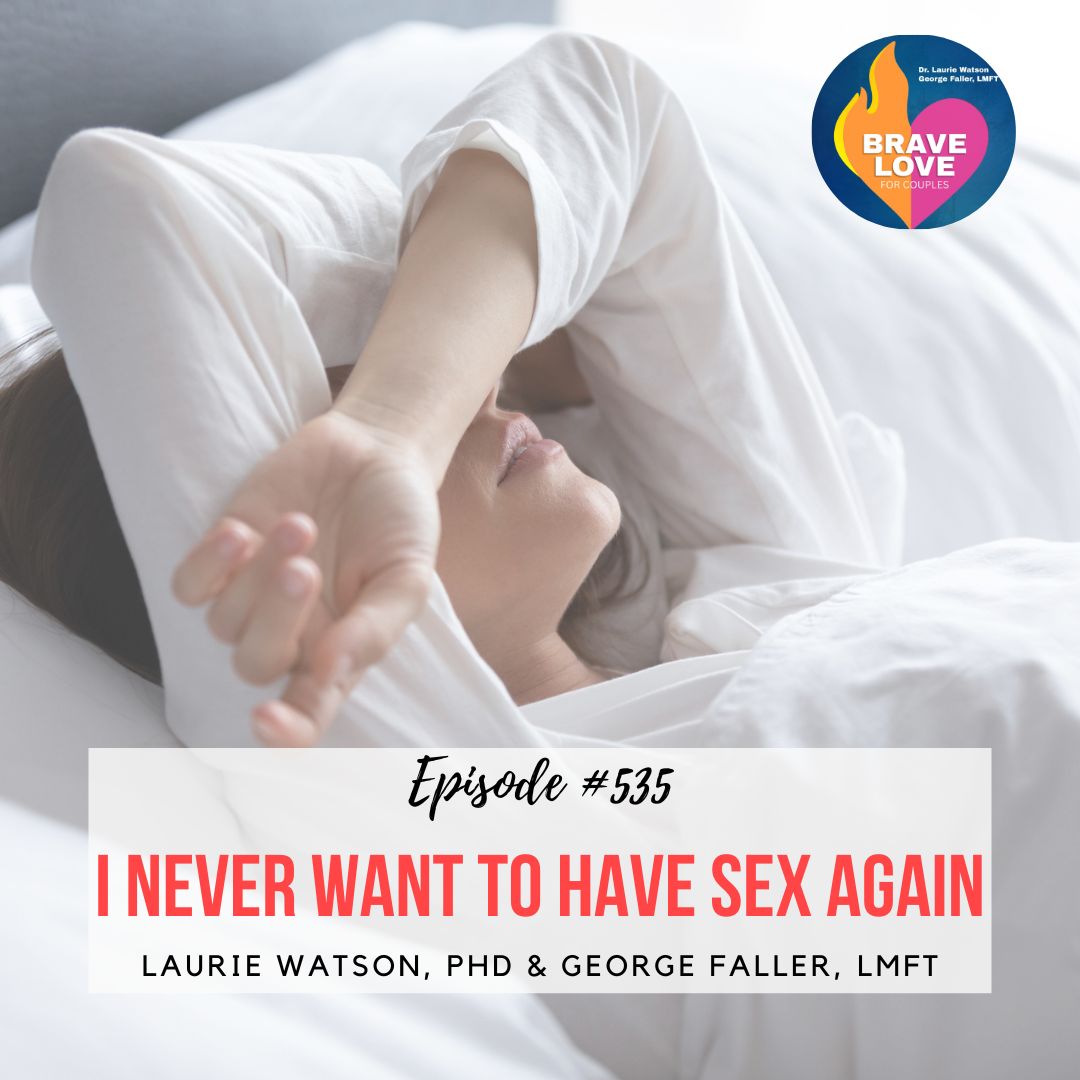
Greetings Brave Lovers! Have you or your partner ever uttered this statement? This definitive declaration has been shared in our therapy offices many times and we are bringing it to today’s episode to explore the reasons why and the ways to fix this issue.
Join hosts Laurie and George as they get clear on what is going on for the sexual withdrawer that doesn’t want to have sex. This is often a healthy response to relationship dysfunction but it becomes part of the negative cycle. Our hosts remind listeners that it is okay not to have sex if you don’t want to but we need to be able to talk about it.
Dive in with us as we share how to construct a healthy conversation, break through the avoidance and reduce the pressure this topic brings up. More pressure equals less sex and both partners need to work together to make interactions safer, better and less tense. George and Laurie’s role play will give you the insight you need into your partner’s world. Be Brave Lovers!
Support this episode’s Sponsor (and help the pod!):
Uberlube.com — Laurie’s long-time favorite personal lubricant. Get some today!
Transcript
Laurie Watson, PhD (01:03.911)
I never want to have sex again, George. I could care less.
George (01:14.296)
Woof, here it is.
Laurie Watson, PhD (01:17.529)
Yep. This is, know, why I wrote my first book, Wanting Sex Again, is because this is what I heard from people. Let’s talk about this. What’s going on?
Laurie Watson, PhD (01:30.295)
I would just say, first of all, our book is coming out, Brave Love, Great Sex, coming out in September. Please think about that. We’ve got a link on our website, which we’re still working on as we’ve converted over from ForPlay. But this is the same place, same great role plays. We’re still doing the stuff, right, George?
George (01:51.64)
That’s right. And whoever wants to buy the first thousand books, we have a special gift for you. Just send us an email.
Laurie Watson, PhD (01:56.743)
That’s right. Send us your email for sure. OK, so right. The withdraw who is saying, I don’t want to have sex again. It doesn’t mean anything to me. Right. When you’re a partner to that, it can just hit you like like complete being completely being deflated.
George (02:01.166)
to read out.
George (02:26.082)
Yeah, this is so common and so tragic for everyone involved. The person who doesn’t wanna have sex, the partner who’s being rejected, now is destined to a life of not having sex. mean, there’s no winners in this. And yet it’s so, so common. 20 % of couples are not having sex. This is an epidemic that we see as couples therapists. And I always wanna start off with, know,
Laurie Watson, PhD (02:40.795)
Yeah.
Laurie Watson, PhD (02:50.903)
Absolutely. Crazy hair.
George (02:54.36)
healthy to not want to have bad sex. know, people not wanting to have sex comes from the byproduct of pressure and things not going right and shame and nasty things. So, you know, we start that we understand the last thing we were telling people is you must have sex or we’re going to push you to have sex. I mean, it just adds more pressure, obligation, duty. Like that stuff doesn’t work.
Laurie Watson, PhD (02:57.324)
Absolutely.
Laurie Watson, PhD (03:06.565)
Yeah.
Laurie Watson, PhD (03:18.213)
Yeah, exactly. we’re not talking about, just to be clear, you know, we’re not talking about people who are asexual. That’s a whole nother category. We’re talking about people who are in sexual relationships, who have been sexual in the past, but find themselves like, I don’t want to have sex anymore.
George (03:40.44)
Yeah. So where does that? I guess we often as therapists, especially from an EFT perspective, right? We want to be so respectful of that, that we can wind up avoiding some of these conversations. We don’t want to put pressure. And I guess the way I try to kind of distinguish is it’s okay not to want to have sex. It’s not okay to not want to talk about
It sucks. And this is a critical threat. It’s a failure to repair in a relationship. We have to confront it. We have to deal with it. And I think there’s a lot of effort. Like the person not wanting sex is like, I wish I wanted sex. If you gave me a pill and I’d want sex again, I’d take it. you know, are they willing to do the work to actually kind of get that back online for them? There’s no shortcut to doing the work, to facing it, to confront it.
Laurie Watson, PhD (04:20.473)
Yes! Yes. Yes.
Laurie Watson, PhD (04:29.286)
Yeah.
Laurie Watson, PhD (04:33.115)
Right? I love what you’re saying and it’s so important. It’s like, it’s okay to not want to have sex. But if you’re in a partnership where your partner wants to have sex, it’s not okay to not talk about that because it’s a big issue. You know, so, but I think what’s tricky if you’re a couple, it’s like, yeah, but if I’m the sexual pursuer and I want sex, just bringing it up and talking about it is going to create more pressure.
which is gonna, I know in the cycle, going to make my partner even wanna do it less. So we’re in this bind, right? We gotta talk about it, but talking about it in and of itself creates pressure. What do we do, G?
George (05:15.553)
this is, I think I’ve shifted a little bit of my position because traditionally we see the impact to the person who’s being rejected all the time. And we want to like coach the withdraw on how to kind of have sex and perform for that partner a little bit more. Like it’s still, it’s still, there’s more of the same. Like we’re trying to get them to do it right without like, I’m actually, I’m trying to fight for that sexual withdraw for themselves. Like they deserve.
to enjoy sex, to enjoy touch. There’s so much to this that they need it for themselves. They’re not doing this for their partner because they want to keep the promise to their partner. They want to keep the promise to themselves. Like how are we okay losing this part of ourselves that’s critically important to feeling safe and connected in the world? I mean, it’s okay to have discrepancies. You don’t need it as much as your partner, but you do need it. We all, there’s, I’ve never seen a baby that doesn’t want touch.
Laurie Watson, PhD (05:52.678)
Yeah.
Laurie Watson, PhD (06:07.024)
Mm-hmm.
George (06:11.499)
And we start to see once sex shuts down, touch all over the place shuts down, right? I want to leave my partner on. I don’t want false hope. And before you know it, all touches disappearing. And how is that okay? This is a fight for yourself. This isn’t a fight so you can do it for your partner. Just that mindset shift, I think is really important.
Laurie Watson, PhD (06:21.177)
Mm-hmm. Right. Right.
Laurie Watson, PhD (06:30.053)
Yeah, because we need touch and I agree with you. You know, when you kind of give up on sex, it’s like, does touch even make sense? You know, because if it’s gonna, if touch in and of itself is gonna lead to the negative cycle because I’m gonna turn my partner on or give my partner false hope, you know, I don’t even want to reach out. And I think too, you know, if sex is bad or the many, many reasons people
don’t want to have sex, that maybe it’s not that they just don’t like sex, but the many reasons. Touch is very complicated. It’s like, OK, I don’t know. This is going to bring up longing if I even touch my partner. And maybe I’ve given up hope. so giving up hope of having the sex that feels attuned. So I don’t want to touch either.
George (07:25.877)
It’s avoidance of the complications that often are negative, that you’re willing to give up, you know, the things that are really good and important about it. You know, but the good news to me is we do this all the time in therapy with emotional withdrawers who don’t want to do vulnerability, who don’t want to have conversations with their partner.
Laurie Watson, PhD (07:35.75)
Yeah.
George (07:48.17)
You know, and they tell us, please tell us what we can do, what book we need to read. And yet, well, that stuff’s great, but we actually need them to fight for their own vulnerability. We need them to do it for themselves, to come from a place that says there are times, maybe not as much as my partner, but I also want responsiveness and care given from my partner. That’s not weakness, that’s a strength. Like, so we fight for those emotional withdrawers to experience success in places where they normally don’t.
Laurie Watson, PhD (07:48.454)
Mm-hmm.
Laurie Watson, PhD (08:06.993)
Sure.
George (08:16.225)
This is exactly what I want to do in the sexual cycle for sexual worse, to fight for them, not to perform better for their partner, but for themselves.
Laurie Watson, PhD (08:19.429)
Yeah.
Laurie Watson, PhD (08:27.321)
Okay, so I think we need to really think about this though from a person who is saying, look at, let’s just say, use, mean, there’s many stages that this happens in, maybe the child raising stage. It’s like, yeah, I used to like sex, because my partner gave me the things I needed.
you know, I’m caught in the cycle right now. I don’t feel safe emotionally. I don’t want to turn on sexually. I don’t, you know, do I like sex if I could have sex with a random person that was, you know, morally free or a robot or something and I could have an orgasm? Great. But you know what? I can do that myself. It’s like, don’t want to connect to this person this way. It feels too intimate, you know? And so…
So they say, you know, but let’s say their partner is the kind of person who can’t feel safe and vulnerable until they have sex. I mean, what do we say to them?
George (09:25.975)
I would also like to add the, know, menopausal woman who is not masturbating and really would never want sex again. I mean, I can’t tell you how many times I say that in my office. It’s like, yeah, it’d be totally okay for me if we never had sex again. Right? So, development of way this comes on a whole spectrum. But what they all have in common is wanting to say no.
Laurie Watson, PhD (09:31.623)
Sure.
Laurie Watson, PhD (09:42.013)
my gosh.
Laurie Watson, PhD (09:49.191)
Right, right, they want to say no.
George (09:50.794)
So to me, this is the billion dollar question, which is how do you get the buy-in for that sexual attrurer to say, Hey, what’s the cost of me saying no to me? Not just my partner. Like I’ve lost part of me and somehow I’m just okay with it somehow, like to avoid the pressure and the negativity and the shame. I don’t want to feel those things. So I’m willing to give up a part of who I am. And that makes me terribly sad.
Laurie Watson, PhD (10:19.557)
Yeah, I agree. mean, I always ask people when I teach to close their eyes and remember the first moment their partner touched them. You know, the thrill. I mean, maybe it wasn’t a sexual touch or a kiss. Maybe it was just they brushed their shoulder, you know, the first touch where they felt that zing of whoa connection.
you know, and how powerful that is and people are talking about, I don’t want to, I don’t care if I ever feel that again. You know, it’s not that important to me anymore.
George (10:57.421)
Cause they’re not thinking about the loss of that or the morning of that. They’re thinking about the avoiding of the negativity and that feels like a better deal. Like I don’t have to feel all those bad things. I’ll settle with missing out on some of those good things. Cause my brain doesn’t really too much about those good things. There’s not a lot of room for longings when your brain is focused on threat all the time. And it’s really just the exposure to threat that just weighs them down to the point where they just surrender.
I love your question. I we keep trying to answer this in so many podcasts, right? It’s not an easy answer, but I always know when there is a sexual attorer who’s willing to do the work and say, you know what, I want to fight for me. I want to fight for my own. They’re all okay. All of them turn out to be okay. You know, whatever form it looks like, some more sex, some less sex, but they do find times where they do want it again. They chase that wanting energy. They can find it again within.
Right, for a lot of people who’ve given up on sex, they’ve lost that chasing energy. They’ve lost that love and feeling. that old Elvis song just came out.
Laurie Watson, PhD (12:00.924)
Mm-hmm.
Laurie Watson, PhD (12:04.839)
Okay, if y’all want to hear more of George De Nelvis, we’ll be right back and you can hear this man sing. I think we should let’s do a role play, you know. Okay, gee, let’s role play this because I think, you know, I certainly am very clear of the number of issues that are present.
in the sexual withdraw because this has been my life work and what I’ve dealt with and you know I think I can do this.
George (12:42.253)
Coincidence. Right, but I do think that’s also an important thing before we get into that. You you being a woman, pushing women to fight for this part of themselves, and this is your mission, which you’re blessed at doing, in a way that can be easier for you. Me as a man, as a therapist trying to push a female to have sex with their partner is just another man putting pressure on, you know, so I think there’s a lot of reluctance that I had, but I’ve recognized me
Laurie Watson, PhD (13:04.974)
Absolutely.
George (13:12.141)
actually trying to respect that and not push is probably the worst thing I could do for these women to do it in a respectful way, but to really encourage them to say, if I don’t fight for you for this part, I know where that’s leading, which is a loss of that life force in your lives. So we are the case, the timing has to be right. But again, not to apologize, like this is my way of fighting for you. You’re coming to third because you want change.
This is how change happens. have to confront difficult places to find some better moves to do it different.
Laurie Watson, PhD (13:48.968)
I think that, you know, my own sense is, right, sex is often a pressure cycle, but there is a further point that you’re bringing to light, which is, you know, potentially female because it is probably more female sexual withdrawers, but, you know,
Is there a peace inside that they can find that is like a motive all onto themselves? Like that this brings spice, this brings chi, the life force for me. And that is the challenge. Like, yeah, I can see why it doesn’t seem to matter to you anymore because of the pressure.
You know, and it’s like, can’t win this game. You know, when you do it, it’s not enough. You didn’t enter it enthusiastically enough. You know, blah, blah, blah. That’s a real bind. But really, you know, you’re ready to give up on this for yourself. So, okay, I think we should role play it.
George (14:58.679)
Hold on. This is again, I just want to highlight because when you can compare and contrast to the emotional cycle, you find that common ground. So many men, this is exactly why they don’t want to have vulnerable conversations. It doesn’t work for them. It usually leads to a fight. They don’t feel successful. They feel like a failure. So they want to avoid that feeling. It’s not that they don’t care. They just don’t want to feel the negativity that comes in these conversations.
Laurie Watson, PhD (15:24.934)
Yeah.
George (15:24.973)
So again, we respect that, we honor why they don’t and we push them to do it because their lives will be better with it. We’re doing an exact same thing with the sexual cycle.
Laurie Watson, PhD (15:31.119)
Yeah. I know. I’m your preaching to the choir and I get it. I will say, though, sometimes we think it’s better for the emotional withdraw to be engaged with vulnerability and feelings and know themselves. But sometimes.
They’re like, you know, I’m not going to crave conversations and debriefs every day like my partner does. You know, do I have to do that in order to, you know, be a good partner? Because I don’t really want to hear about their day every single day. I don’t want the download. It’s… Yeah.
George (16:05.037)
Discrepancy is a totally cool, as long as both people at some point can tap into something for themselves that they do want in these conversations.
Laurie Watson, PhD (16:14.243)
I think the issue with sex is we are embodied souls. We live in a body. And in an adult relationship, eroticism and sexual connection is often how we get body to body, how we connect body to body. so…
Okay, I gotta argue the other side of it and you gotta be the therapist, Georgia, it’s just gonna fall flat for me.
George (16:46.157)
So you’re gonna be the sexual withdrawal and you want me to be the therapist, not a partner. All right.
Laurie Watson, PhD (16:48.143)
I’ll be the sexual withdraw, yeah.
Laurie Watson, PhD (16:52.965)
That’s right. Well, maybe you should be a partner because no, mean, you can’t be. I don’t know.
George (17:00.119)
Well, we’ll pretend there’s a partner with you and, you know,
Laurie Watson, PhD (17:02.343)
Okay, okay, so you’re gonna help me, help me work through this.
George (17:08.905)
So, you know, I know, Maria, that for good reasons, you’re here because you want to, you know, focus on communication and you’re really missing each other. And we’ve really talked about the negative cycle that you both fall into, you know, and you’ve also communicated when you’re not feeling close, when it doesn’t feel like Joey’s interested, the last thing you want to do is have sex. You don’t even want to talk about having sex because that feels like
three, four steps down the road. Right. And, you know, I totally get when you don’t feel close emotionally, how your body just doesn’t want to engage in sex and, know, talking about, even talking about it feels premature because there’s so much progress that needs to be made in other areas. Right. And I guess I also want to open up space because I hear Joey talking about, you know, how touch is like his main way into feeling connected. And
Laurie Watson, PhD (17:39.311)
Yeah, absolutely.
Laurie Watson, PhD (17:54.949)
Right, right.
George (18:07.019)
you know, not having sex or not being able to talk about having sex kind of really kind of leaves him in a bad place. So again, my job, just like emotionally in these conversations, sexually, you two fall into these same similar negative patterns that where you can’t repair it. You don’t get on the same page. So for me, don’t know each session, which way we go, but I’m going to kind of keep addressing both of them to see if you can make progress. Right. So.
Laurie Watson, PhD (18:14.182)
Yeah.
Laurie Watson, PhD (18:23.781)
Right.
George (18:31.423)
You know, I just want to start today talking about the sexual cycle. know, I know I don’t want you to feel pressured. I’m saying, Hey, you should be having sex. want to, you know, I wouldn’t want to be having bad sex either or disconnected sex. So, but I was hoping we’d talk about what it is like for you, you know, to not want to have sex.
Laurie Watson, PhD (18:43.931)
Yeah, yeah.
Laurie Watson, PhD (18:50.607)
Okay. I mean, for me, if you’re actually curious, yes, there is a pressure cycle that’s problematic. But I never think about sex during the day. I mean, I don’t really fantasize ever. And, you know, there are a lot of things that pull my attention that feel very critical in my work, in my family.
you know, that’s my focus. Certainly my partner and I want him to be happy, but there’s nothing in me that goes, I really want to do it. Like when I do it, sure, I have an orgasm, but even having an orgasm doesn’t make me go, I want to get that tomorrow too. It’s like, I mean, it was great. It was great while it lasted, but it doesn’t actually motivate me to want to have more sex later.
I think you’re asking and I mean, this is very complex for me, George. You know, it’s my body, it’s my, the pressure, sure. But even if, you know, we’re getting through the pressure issue, I do get it.
George (19:54.285)
Bye,
George (20:00.845)
It’s a good starting point, Maria, just to acknowledge you’re both starting at different points, right? Joey’s coming into this turned on aroused thinking about it, wanting it, you’re coming in exhausted, trained pressure. I mean, if you just do the math, you got a lot of things in a negative category that are stopping, know, if you can overcome all those things, the sexist, you know, good, you can have an orgasm, but you don’t have the same drive, the same motivation, the same like.
Laurie Watson, PhD (20:12.387)
yeah.
Laurie Watson, PhD (20:19.921)
Sure. Yep.
George (20:30.234)
It’s not on your radar in the same way like it is for Joe.
Laurie Watson, PhD (20:33.273)
It’s not. It’s not. And when I come home and he thinks about it and is waiting for it, I’m just like, oops. know, I haven’t thought about it for a week.
George (20:47.181)
Right. even that oops is again, every time sex comes up, there’s an oops, there’s a pressure, there’s a, you know, I’m letting him down. I’m struggling. I it just, it’s, it’s a lot. And then when you’re not feeling close, you can’t even talk about these things. You really put it a really tough spot. Your body’s not online. You’re feeling kind of negative. You’re not feeling close. All the things you need to kind of get into it are not present. All the things you don’t need are present. longer, no wonder why it’s not on your radar too much.
Laurie Watson, PhD (21:02.321)
Exactly.
Laurie Watson, PhD (21:15.099)
Yeah. And you know, I mean, there are moments like when we’ve had maybe time together, maybe a Saturday, and we’ve worked in the garden and we’ve seen the kids and we went out to dinner and we had some time to really talk and relax and be together. you know, and then he sort of suggests, hey, you you want to do it or something. Like, I don’t feel anything in my body.
But my heart sort of goes, yeah, I’m willing. There’s a certain set of circumstances that it’s not like, I mean, I have plenty of bad sex for sure, but our sex is not always bad, you know?
George (21:58.99)
What I hear you saying, I just felt something shift in you as you were talking about it. It’s like, if we could honor all the pressure and the things, then your brain looks for an exception. says, there are some times where the stars align. You know, when we have this time off and we’re talking to each other we have this glass of wine, like then there’s an openness that starts to happen for you. Yeah, that feels pretty important.
Laurie Watson, PhD (22:13.862)
Right.
Laurie Watson, PhD (22:21.467)
Yes. Yes. Yeah.
George (22:26.529)
You know, not just as something to kind of give Joey, which you know, that’s important and he feels better, but like that part of you that starts to feel open again. There isn’t a lot of space in that in your everyday life.
Laurie Watson, PhD (22:35.27)
Right.
Right, I mean, in the right context, when I have enough time and we’re a little more relaxed and we’re more deeply connected, and I feel like I’ve got his attention on things that are our world, you know, and he’s sharing, you know, about who he is and things like that. It’s like, yeah, I, within that connection, I feel warm.
and I feel more likely to be amenable to sex. I wouldn’t say that I have desire for sex.
George (23:15.481)
And I appreciate how you’re making space for the side of you that often doesn’t get expressed, that feels relaxed, that starts to feel warm under certain circumstances when it feels like you have a shared, you know, experience and you’re getting his attention and you’re hearing about his world. There’s something about like that dance you start to do that really puts you in a very different place that allows us bubbling up this, this, different part of Maria that, you know,
Laurie Watson, PhD (23:38.329)
Yes.
Laurie Watson, PhD (23:43.398)
Right.
George (23:44.107)
I’m calling open, like, help me with that part of you that just finds yourself like, enjoying the moment. Like, what is that like for you when you’re in this more open state?
Laurie Watson, PhD (23:56.935)
Um, I think it feels like when I’m relaxed, um, I feel like I’m inhabiting the present moment more. Um, my body is relaxed. Yeah. A glass of wine helps me. I’m not saying I want to get drunk or even buzzed. It’s just.
George (24:09.101)
Thanks.
Laurie Watson, PhD (24:18.631)
I think it’s all of it. But I do feel my body. I’m like living in my body. I don’t think in other times my busy life or the pressure from Joey to like feel something, you you should have desire that I can know who I am. And so in that moment, yes, I wouldn’t say it’s desire, but I feel more present to my body.
George (24:46.613)
And you’re really good at having a lot of words for the things that don’t work so well and put pressure on you. I really like that you’re fighting for this part of you that’s trying to say, who is this relaxed Maria that all of a sudden her body becomes more present? Right? That feels pretty important to me to know how we can kind of get more of that or what is that side of you like when you are feeling, you know, in the present moment? That feels pretty cool.
George (25:19.467)
So if, let’s pause here.
Laurie Watson, PhD (25:22.703)
Okay, because I got some counsel for you as a sex therapist to a couples therapist where I would go next. So I think the next place you need to go is the example. You could you remember one of those places because that gives us a way to really see the building blocks.
George (25:28.813)
Go for it.
George (25:35.841)
the clip.
George (25:41.111)
But we can do that. I just for time. But OK, if you want to do that for a minute and then we’re wrap this up.
Laurie Watson, PhD (25:50.567)
Sure, Okay, so Joe, just scratch the pause for a minute and then go to the example. So ask me about to remember a time, yeah.
George (25:59.352)
So in, yeah.
So in this place, Marie, even now, where you’re feeling more relaxed, can you think about a time in the past where you felt the same relaxation, where your body was open?
Laurie Watson, PhD (26:19.717)
Yeah, yeah, we went out to celebrate our anniversary and it wasn’t a great big deal, you the finest fancy dinner. just kind of went to one of our favorite places. We sat at the bar, you know, we were going to have dinner afterwards and, you know, we had spent some time basically from noon on hanging out and getting stuff done like you do on a Saturday and
I remember we were sitting at the bar and I was wearing a dress, which I don’t do a lot of, but I remember feeling my skirt against my calves. And I remember looking at Joey and he was giving me eye contact.
And I think he reached across and just like stroked my forearm. You know, as I was talking, it was like he was listening, but he was really present. And it wasn’t this deliberate, I’m trying to turn her on thing. It was just like his body moved toward me. And it was like, I kind of felt more alive in my body. And…
George (27:21.741)
So.
Laurie Watson, PhD (27:29.699)
much more amenable to thinking about, I was kind of thinking, yeah, we’re probably going to have sex tonight, but suddenly it went from, it went to a green light.
George (27:39.97)
Yeah. So again, you’re saying so much and what a great, what a great scene, right? It’s so vivid. can feel the color. Like I can get the flirty part and Joey touching, but you’re even saying something important before anything even happens. You can feel the back of your skirt on your own calf. Like you’re, have an awareness of your own body and what’s that about? me with that. Like you can feel your own calf. Like there’s just a better sensation and you’ll help me with that.
Laurie Watson, PhD (27:59.823)
Mm-hmm.
Laurie Watson, PhD (28:04.347)
Yeah. I got great caps. You know, it’s like, I think it was the time to inhabit the moment. There was not pressure. There was just, and you know, I hear you kind of where you’re going with this. you sometimes I don’t give myself that, right? I don’t give myself this time to be present.
George (28:18.455)
Yeah.
George (28:29.898)
If I can’t wait, wait.
George (28:34.391)
Maria, I love your smile, as you say. I have great calves. I remember that in this moment as the dress touches my calf. You know, feel I look good. Like I’m in my own body in a good space. And I’m not thinking about all those other things. Like I’m enjoying my own body. And then he joins that enjoyment by reaching over in a nice subtle way with this gentle touch that says, you know, he’s enjoying my body too. That’s so cool.
Laurie Watson, PhD (28:37.831)
you
Laurie Watson, PhD (28:42.235)
Yeah.
Laurie Watson, PhD (28:48.475)
Mm-hmm.
Laurie Watson, PhD (29:03.877)
Yeah. Yeah, I think that the move that he made was just us. It was like the first moment of feeling like one body. When he touched me like that, he was interested in me. And his body moved toward my body. I’m not sure I can explain it, but it really felt, yeah.
George (29:27.169)
you said it was a charge. mean, I felt even now as you’re replaying this scene, like, does that charge you feel like a tangle? Like, what do you feel that charge? should say like something just came online.
Laurie Watson, PhD (29:39.847)
It felt a little melty. Yeah.
George (29:46.647)
feels a little different and relaxing. It’s a sort of letting go. It’s just…
Laurie Watson, PhD (29:50.309)
Yeah, I mean, melty into him and into us. Union, union, like, my boundary is not so separate than his boundaries.
George (30:03.405)
It’s beautiful.
It’s beautiful. All right, let’s pause here.
Laurie Watson, PhD (30:09.366)
Okay. Did I do a good job as a sexual withdrawer coming alive?
George (30:12.747)
You’re again, you’re fighting. We’re going to end on this. This is just a call out and encouragement, like to fight. Maria deserves to feel that charge again. Why give up on that? Why lose it just to avoid the pressure? We get you want to avoid the pressure. We get you want to, you know, things have to change.
But for those things to change, you also have to fight for you again. You get those glimmers, those parts of you that your body knows and has never forgotten and will always hold onto. The only way we’re gonna kind of recreate that is you gotta do that.
Laurie Watson, PhD (30:38.137)
Mmm.
Laurie Watson, PhD (30:47.8)
Yeah, yeah. I, you know, just having lived that moment right now as the sexual with dark, you know, coming to one moment where she felt more alive, sexually, erotically living in her body, you know, almost as we know, role plays are very real, you know, and I felt that transition. And I just also want to say.
You know, this piece, this erotic piece is a life force. Like, don’t live without it. Don’t live without it, girlfriend.
George (31:26.977)
boyfriend or how have you identified? You have good reasons, but why life is definitely blander in black and white when we lose this. You can have low discrepancies, know, low desire. It’s all good. Like whatever you’re, but you have to have something because that, that, that something is at the end of the day. You know, we need to look forward to something. I love the want, I love the chase. I love the energy. Even.
Laurie Watson, PhD (31:28.314)
or boyfriend, yeah.
Laurie Watson, PhD (31:35.142)
For sure,
George (31:56.887)
Another podcast.
Laurie Watson, PhD (31:58.246)
Okay, Georgia Align.
George (32:05.503)
I go brave first, I don’t remember.
Laurie Watson, PhD (32:06.862)
Yep, brave love.
George (32:09.333)
All right, everyone, keep it brave out there.
Laurie Watson, PhD (32:13.316)
and have some great sex.