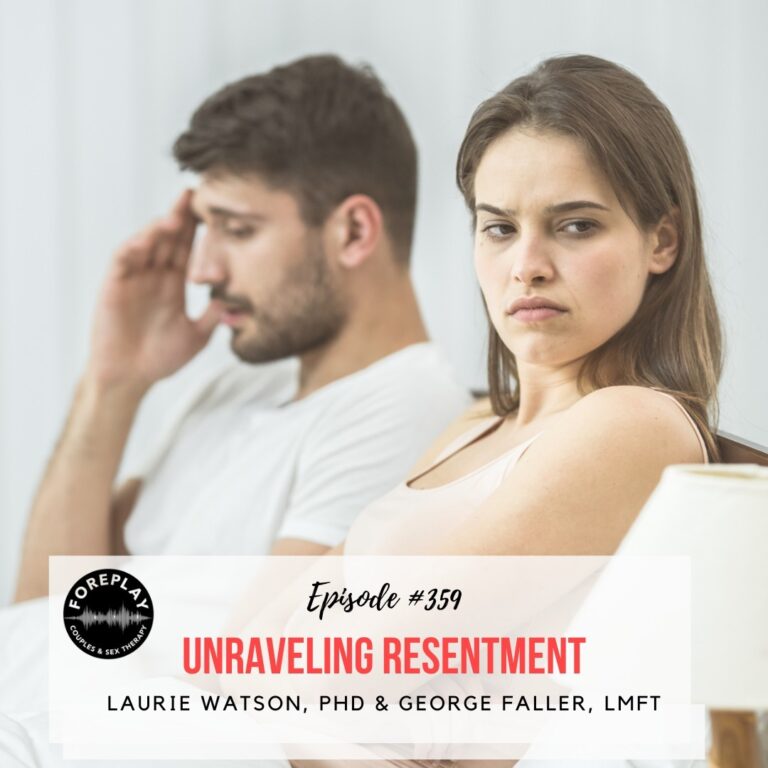
In today’s episode, we are discussing how to forgive what hasn’t been. Fights are more obvious times to work on forgiveness but what about the missed bids for connection and absence of touch? Join our hosts as they share how to have healing conversations about the lost connection. Laurie and George relay that this experience is grief and a deep pain that needs to be shared in partnership.
Often a conversation like this may activate the negative cycle as the hurt partner might fear further rejection and begin by criticizing. Their advice is to get into the pain and begin to ask your partner for their help to heal. As the listener, sex might have been off the table for a variety of reasons and you may notice a defensive reaction.
George shares something that works in his relationship, to take a pause and keep the focus on his partner. Healing is sequential and can’t happen all at once. Slow and steady, remaining focused on one partner’s pain can shift a couple into forgiveness as resentment from missed moments is heard, seen and cared for. What has been missing from your relationship that has caused you pain? Today’s episode will help you and your partner get started on the path to forgiveness.
Support the pod by supporting this episode’s sponsor!
Addyi.com — the only FDA-approved treatment for certain women with low libido.
Transcript
Ollie Advertisement [00:00:00]:
Do you ever wish you could show your dog just how obsessed you are with them? You actually can by giving them something to obsess over their food. Ollie makes fresh human grade meals tailored to your pup’s unique needs and their recipes are made with real meat, fruits and veggies. No fillers, no weird stuff, just the good things your dog deserves. And when your pup eats better, they feel better so they’ll have the energy to live their best life right alongside you. Ollie also offers On Demand Health so you can easily check in with the Ollie Health team and get peace of mind on your dog’s well being. Go to ollie.com BFF and use code BFF to get 60% off your first box. That’s o l l I-e.com BFF the best food for your best friend.
Advertiser Announcement [00:00:53]:
This holiday season.
Advertiser Announcement [00:00:54]:
There’s no better place to get cozy holiday gifts for all your people than Aerie.
Advertiser Announcement [00:00:59]:
From soft sweaters to everyday intimates and activewear, Aerie has the pieces made for the real you. And don’t forget to treat yourself too.
Advertiser Announcement [00:01:07]:
While you’re at it.
George Faller [00:01:08]:
You’ve earned it.
Laurie Watson [00:01:10]:
Find your nearest Aerie store or shop.
Advertiser Announcement [00:01:12]:
Online@Aerie.Com give love real.
Advertiser Announcement [00:01:19]:
This episode is.
Advertiser Announcement [00:01:20]:
Brought to you by Diet Coke. You know that moment when you just need to hit pause and refresh? An ice cold Diet Coke isn’t just a break. It’s your chance to catch your breath and savor a moment that’s all about you. Always refreshing. Still the same great taste Diet Coke. Make time for you time.
George Faller [00:01:37]:
The following content is not suitable for children.
Laurie Watson [00:01:40]:
How do we forgive our partner? Not for something that they did do, but for something that they haven’t done. Especially in bed, right? When they haven’t engaged with us. When there’s been maybe a sexless marriage or sex that is few and far between. How do we forgive that and go on.
Laurie Watson [00:02:02]:
Welcome to Foreplay sex therapy. I’m Dr. Laurie Watson, your sex therapist.
George Faller [00:02:07]:
I’m George Faller, your couples therapist.
Laurie Watson [00:02:09]:
We are here to talk about sex.
George Faller [00:02:12]:
Our mission is to help couples talk about sex in ways that incorporate their body, their mind and their hearts.
Laurie Watson [00:02:20]:
And we have a little bit of.
Laurie Watson [00:02:21]:
Fun doing it right g Listen and.
George Faller [00:02:23]:
Let’S change some relationships. Yeah, we hear a lot about forgiveness for what you did, but for what you have not done. That’s a different twist on it. All right, so what do you mean by that?
Laurie Watson [00:02:34]:
It is I When my father died, somebody wrote me a card who said, for all that was and for all that wasn’t, they wished Me, sympathy. And you know, parental relationships are complicated. And certainly when a parent dies, we have that evaluation period of the things we had wished we had had with them and the things that we wish we had not had with them. And I have thought about that a lot. I write it now almost on every card, sympathy card that I send because I think it’s so profound. But the same sort of thing, I think, in the bedroom, you know, maybe it’s not as profound as a sexless marriage. Maybe it’s just certain things. You know, you always wanted your partner to be able to give you oral sex or whatever, and they never were able to or, you know, misses and losses that have happened in the bedroom.
Laurie Watson [00:03:28]:
And I would say most people have experienced a part of this, you know, wishing for something in the bedroom that their partner was just never able to give them. And how do you forgive that and go forward? And certainly there are more profound losses than not to. And I’m thinking specifically of kind of sexlessness and how that’s so painful. And if you’re working on it and you want to get the ball rolling again, you know, there could be years to forgive of a partner not engaging. And it’s, it’s so painful. It really can feel like a betrayal. Sure.
George Faller [00:04:08]:
Well, I, I, I think we’re talking about neglect, right. Where you have a need and the need is not met. Right. And when any of us have that, it’s a loss, it’s a grief. Right. Your heart wants something, your body wants something. There’s a hope, and that hope doesn’t get met. So there’s, there’s a loss in that.
George Faller [00:04:25]:
So I do think, looking at it like grief, that’s saying this could have been different. Our relationship, instead of last two of having no sex. How different would we look if we were having sex during that whole time? We’d have a different relationship. I’d feel different about me. Like there’s a lot that we lose when we don’t get our needs met.
Laurie Watson [00:04:47]:
Yeah, that is so true. Just.
Laurie Watson [00:04:51]:
It’S also the compounding losses, right. Of, of if we were having, you know, this kind of connection, the other ways we would feel connected, maybe the way sex could have impacted our emotional connection, you know, and certainly we know there are many ways that people feel this outside the bedroom. Right. You haven’t talked to me. You never share with me. You know, we’re not strong because you don’t really reveal the inside of your world or you’re too critical of me. And so, you know, I haven’t Been able to trust you, to share with you. I mean, there’s a million things that this happens, but specifically today, I’d just like to think about the profound loss of a partner, not engaging sexually in ways where the sexual connection is really broken.
Laurie Watson [00:05:46]:
Yeah, I see this especially at. In aging couples, as the woman meets, reaches menopause, and the male maybe, you know, still has a lot of drive and, you know, has good erections and wants to keep going, and. And his partner is bowing out because she doesn’t have desire anymore. Sex is painful and she gets dry, and she doesn’t manage that well medically. And, you know, all of that, you know, I. I’m sure creates so much anger, but also underneath that, so much grief of, like, look at. We had a deep sexual connection. How is it possible for you to say, I’m just not up for that anymore?
Laurie Watson [00:06:31]:
Right. Like you said, I think, George, it’s neglect.
George Faller [00:06:35]:
If we’re going to use this example of a sexless couple, both of them are losing something. Right. It’s the person who maybe wants it more is feeling a rejection and loss. Well, what does it feel like for the person whose fault it is that doesn’t have the libido or they’ve had cancer and now they don’t want to have sex? Like, what I’m saying is it’s all. It’s a mutual forgiveness that kind of has to happen, right? Yeah, but you’re right. The frustration is just the unfairness of it. It’s like when you get married, nobody envisions having a marriage where you’re not having sex, and yet 20 of couples find themselves in this position. So there.
George Faller [00:07:13]:
There must be good reasons for it. But our body is not going to like that. Right. It’s going to let us know this. Is this g.
Laurie Watson [00:07:20]:
Mm.
Laurie Watson [00:07:22]:
You know, I think. I think almost anything can be healed. I mean, and there are certainly circumstances that it’s not healable. You know, maybe cancer or disease states or things like that, or an accident.
Laurie Watson [00:07:40]:
You know, sometimes sex does. And. But there would still be grief and maybe even anger. And. And I guess what I think is, does the sexual connection have to end even in those circumstances?
Laurie Watson [00:07:54]:
You know, there might be ways to care for your partner. I mean, certainly most of us. Most of us have had sex on days when we didn’t feel desire, but we’re taking care of our partner. We’re acting out of love. I’m not talking out of duty or because I have to, but out of love to meet the need of my partner. So I I have a lot of hope for this, but I. I think that. And I think the good thing is, you know, that when we even start from a place of love, many times our own body catches fire.
Laurie Watson [00:08:30]:
We do enjoy it. You know, the oxytocin that is released when our partner has an orgasm and we’re naked with them, that. That’s still a spillover effect. Right. Being naked with our partner, we have an upper release of oxytocin, which makes us feel good. So there’s something in it for us.
George Faller [00:08:49]:
It’s why we do this podcast. I mean, we know, and the research is crystal clear that when you’re not having sex, that’s a threat to your emotional bond. Right. A big important way of connecting is not being met. So, you know, and I think most people have wind up being sexless. Sexless comes from good intentions. Like, they just don’t want to get hurt and rejected or have it not work or feel like they’re failing. Like, they try to avoid the immediacy of what could happen bad in the encounter, but they don’t recognize the cost of that in the big picture of playing it safe.
George Faller [00:09:23]:
And not taking that risk just means that distance is just growing.
Laurie Watson [00:09:27]:
Yeah, so true. And I think there can be sort of a creep effect, right? You know, you can get busy in life and, you know, maybe you’re raising kids. One person’s taken an ssri, an antidepressant that suppresses libido, and pretty soon it’s just like, you know, is it really that important? And now months have gone by and.
Laurie Watson [00:09:56]:
Months go by, and it’s years that go by. And.
George Faller [00:10:01]:
Every couple I’ve talked about that, sexless are always shocked. Like, how did they get here? It’s not like something usually big that happens. It’s an insidious process that kind of takes over over time. They’re like, I can’t believe it’s been two years. How did we get here? And then it starts to feel insurmountable because there’s so much time that they don’t know where to start again. Right?
Laurie Watson [00:10:25]:
So true.
Laurie Watson [00:10:26]:
That’s why I’m going to Quince. From their Mongolian cashmere sweaters, which, you know, I love to the Italian wool coats and everything is premium quality at a price that actually makes sense. I am giving every son of mine one of their cashmere scarves. And I’m giving my daughter-in-law’s the cashmere sweaters, different varieties.
Laurie Watson [00:10:52]:
But I’m so excited.
Laurie Watson [00:10:54]:
To where it’s cold and I cannot wait. Quince has something for everyone. Every piece is made with premium materials, with ethical, trusted factories and price far below what other luxury brands charge. And their craftsmanship really shows in every detail. The stitching, the fit, the drape. It’s elevated, timeless, and made to wear on repeat. Find gifts so good that you want to keep them with Quince. Go to quince.com foreplay for free shipping on your order and 365 day returns.
Laurie Watson [00:10:57]:
Sweaters for the holidays because I’m going.
Laurie Watson [00:10:59]:
To where it’s cold and I cannot wait. Quince has something for everyone. Every piece is made with premium materials, with ethical, trusted factories and price far below what other luxury brands charge. And their craftsmanship really shows in every detail. The stitching, the fit, the drape. It’s elevated, timeless, and made to wear on repeat. Find gifts so good that you want to keep them with quince. Go to quince.comforeplay for free shipping on your order and 365 day returns.
Laurie Watson [00:11:28]:
Now available in Canada too.
Laurie Watson [00:11:29]:
And that’s Q-U I N C E.com foreplay to get free shipping and 365 day returns. Quince.com foreplay Remember our code, y’.
George Faller [00:11:41]:
And that’s Q-U I N C E.com foreplay to get free shipping and 365 day returns. Quince.com foreplay Remember our code, y’.
Laurie Watson [00:11:42]:
Foreplay.
Advertiser Announcement [00:11:43]:
Marshall’s buyers are hustling hard to get amazing new gifts into stores right up to the last minute. Like a designer perfume for that friend who never RSVP’d wishlist topping toys for.
Laurie Watson [00:11:53]:
Her kids who came too.
Ollie Advertisement [00:11:55]:
Mm.
Advertiser Announcement [00:11:55]:
Belgian chocolates for the neighbor. A cozy scarf for your boss, and a wool jacket for your husband that.
George Faller [00:12:01]:
You definitely did not.
Advertiser Announcement [00:12:02]:
Almost forget.
Laurie Watson [00:12:04]:
Marshalls.
Advertiser Announcement [00:12:05]:
We get the deals. You give the good stuff, even at the last minute, phew.
Laurie Watson [00:12:10]:
Find a Marshall’s near you.
Laurie Watson [00:12:13]:
I’m always like, but you just gotta break the ice. You know, you just gotta break the ice once, and then you’re not sexless anymore. You know, it’ll, it’ll, it’ll all kick in. Our bodies are wired to, to long for physical connection.
George Faller [00:12:32]:
And I think almost every time I’ve had that, I tried to push them to have it. They don’t have sex. So there is something about respecting how much muscle memory has been created to have gotten them to this point. And it’s, it’s, it’s what sounds like an easy fix. You have to go through the knots of these kind of emotional kind of block blocks that they’ve developed, you know, through the years.
Laurie Watson [00:12:56]:
Yeah, that’s so true. We, you know, at Awakenings, we have about 30 clinicians, and we specialize in couples and sex therapy. And we have a, we used to have a check in on Fridays for our biggest wins of the week. We don’t do that anymore, but on Fridays, bring it back.
George Faller [00:13:15]:
We need that, too. Success, right?
Laurie Watson [00:13:16]:
As therapists, I know, it’s so great, but on Fridays still, we have a chat together. And a lot of times, people, the one thing that gets sort of put on the board is, hey, I had a sexless couple who had sex for the first time this week. And we all just cheer, you know, because. And it’s such a exciting thing, I think, as a group, because we know how much work went into that both for the couple, for the therapist. And it’s, you know, we know it’s like it’s the, it’s the new beginning, right? They have sex again and it’s a new beginning because usually once you can get them to that place where they start to be sexual again, it does take over as a positive change. But I think one of the things that we’re talking about is not just how to overcome sexlessness, but how do you forgive when there’s been this long absence?
George Faller [00:14:12]:
And I like keeping us on focus, Laurie. See, I was wandering here and you’re trying to keep me on the straight and narrow.
Laurie Watson [00:14:20]:
Come back to this point, get back on the forgiveness. We gotta heal. And you know, how do we heal? Let’s come back after the break, George, and let’s help people systematically heal this injury. Right? It’s really an attachment injury. If you’ve wanted to be sexual with your partner and they have refused for many good reasons perhaps. But whatever it is, the betrayal, the anger, the rage, we have to heal that.
Laurie Watson [00:14:55]:
You know, I talk about this all the time. Frustrating low libido in women is a real medical issue that we’ve known about for over 75 years. And Addi is a clinically proven option to treat it if you’re feeling frustrated. Addi is the only FDA approved prescription pill for certain premenopausal women bothered by low libido. You might hear it called the little pink pill. Addi is the only prescription that’s been shown in clinical trials to help women have more interest in sex, more satisfying sex, and less stress from low libido. All women deserve to have the sex drive they want and deserve science backed treatments to help when low libido gets in the way. So visit Addi.com that’s A D D I.
Laurie Watson [00:15:38]:
Or talk to your doctor to see if Addi is right for you. Take back the desire you deserve with Addi.
Advertiser Announcement [00:15:45]:
Addi or Flibanserin is for premenopausal women with acquired generalized hypoactive sexual desire disorder who have not had problems with low sexual desire in the past who have low sexual desire. No matter the type of sexual activity, the situation, or the sexual partner, the low sexual desire is troubling to them and is not due to a medical or mental health problem, problems in the relationship or medicine or other drug use. Addi is not for use in men or to enhance sexual performance. Your risk of severe low blood pressure and fainting is increased if you drink one to two standard alcoholic drinks. Close in time to your Addi dose. Wait at least two hours after drinking before taking Addi at bedtime. Your risk of severe low blood pressure and fainting is also increased if you take certain prescriptions over the counter or herbal medications or have liver problems. Low blood pressure and fainting can happen when you take Addi.
Advertiser Announcement [00:16:25]:
Even if you don’t drink alcohol or take other medicines. Do not take if you are allergic to any of the ingredients in Addi. Allergic reactions may include hives, itching or trouble breathing. Sleepiness, sometimes serious can occur. Common side effects include dizziness, nausea, tiredness, difficulty falling asleep or staying asleep, and dry mouth. See full PI and medication guide including boxed warning@Addi.com PI or call 844pinkpill.
Laurie Watson [00:16:45]:
Addi, talk to your doctor to see if Addi is right for you.
Laurie Watson [00:16:53]:
Okay. In eft, we have an attachment injury repair model which is often used for affairs when we’ve been betrayed by our partner, acting out with somebody else. But really this is the same sort of thing, right? The rage, the pain, the betrayal of a partner leaving the sexual relationship not for a different person, but just leaving it, period, and not participating with you. It’s the same kind of. It’s. It’s the similar level of injury.
George Faller [00:17:31]:
Right? I think the heart of the repair model is saying forgiveness is.
George Faller [00:17:38]:
Right? And thank you, Joey. Maria, we’re not having sex. And I really want to put words to all the loss and the grieving that. That is like for two years to not have sex, to lose that part of myself, that part of us. I really need Maria to keep her focus on me, right? To put on her caregiving hat, to be able to kind of.
George Faller [00:18:16]:
Because what happens in these conversations is when one person triggers their hurt, it comes. Causes the other person to feel hurt and guilty, and then they get lost in their own hurt and guilt. And both people are struggling and neither one of them get any help. So the simplicity of the, of the, you know, forgiveness model. A lot of people say they’re sorry, but it’s really, I don’t want to feel what you’re feeling. So I just want to make this conversation go away. That’s not really an empathetic sorry. An empathetic sorry is I’m walking in your shoes.
George Faller [00:18:43]:
I’m feeling what you’re feeling. And because of that, I want. I don’t want you to be alone. I want. I want to come closer to you in your pain and in your loss. When I can look. When Joey can look in Maria’s eyes as he talks about his pain and see, reflect it back, his own pain. She’s getting what it’s like for him.
George Faller [00:19:01]:
They’re mourning together. His body starts to say, oh, she’s getting it. I’m not alone. And it starts to trust again.
Laurie Watson [00:19:08]:
Yeah, exactly. And the other partner, I mean, later down the road may be able to get the good reasons why the sexlessness started. And that’s helpful to see. But. But I think the person who is injured most by the loss of sex has to be seen first. Don’t you think?
George Faller [00:19:29]:
Yeah. And it’s hard to see if you’re lost in your own guilt. So sometimes we have to resource the person, the partner who’s going to be witnessing. Too often we make forgiveness a choice. And it’s really a process. Like, to forgive somebody, you have to feel them close to you and getting you. If they don’t. Should you really forgive somebody? There’s somebody, you know.
George Faller [00:19:51]:
If Laurie is not having sex and doesn’t explain why she’s not having sex, and there’s no plan to have sex, but she says, yeah, Joey, I’m sorry. It’s like, what does that even mean? It’s. It’s just words. Right. But if Laurie could start really getting, you know, what I’ve lost, and she might not have the answers, but at least she’s keeping her focus. And my brain is getting caregiving. It’s getting. It’s getting success with my pain, I think that’s the missing ingredient.
George Faller [00:20:17]:
It’s. Every time I feel this, I usually don’t express. I only express anger. You get defensive and like, it never. I never get help with what is at the heart of it, which is really this loss and pain.
Laurie Watson [00:20:28]:
Right? Exactly. Yeah. Certainly I’ve seen between my husband and I, you know, times and seasons where we’ve hurt each other. And I know what it looks like when he comes to me and he can feel what I’m feeling. You know, it’s. It’s. He’s not in shame. He’s not in, you know, kind of.
Laurie Watson [00:20:53]:
That process of apologizing or of.
Laurie Watson [00:21:00]:
Just wanting it. To go away, this conversation to go away. I mean, it’s almost like his eyes look different when he sees me and he sees what I’m going through. And I’m sure it’s similar for him, too. You know, when I. I’m not angry and I’m not placating, but I’m kind of seeing what it must be like to be in his place, even though I caused it. I think that’s what’s so hard in this situation is we’ve hurt somebody we love, and that. That feels really crappy, so we just want to get away from that.
George Faller [00:21:33]:
There’s a time and a place to deal with that hurt. Yeah, but in the moment of your partner, sharing is not the time to make it about you. I mean, I do this with myself in my own relationship. So many times I find myself, my wife sharing something or whatever, and I could feel myself going down the road of getting defensive, right? And I remind myself, I just pause and I say, hey, wait a second. This really isn’t about me right now. She’s coming to me because she wants me to know something about her. So I really imagine myself just saying, all right, take a, you know, take a breath. You’re good.
George Faller [00:22:07]:
She needs you to cross over the bridge and make it about her. Right. So I literally imagine myself kind of crossing over the bridge, resetting myself, trying to be curious and say, you know, what I was missing, really what you’re saying, so help me with that again, like. But I reset my focus to say, this is really about her, right? And. And this is the place that needs that focus. Because if. If you’re going to feel safe, we’re talking about loss and pain. And like you said, I mean, I could feel my heart hurt even as you described, like, what is it like to forgive what you’ve.
George Faller [00:22:38]:
You never received that your heart has always wanted? Every time you think about, I’d love to have sex, I would love to try to do this, I want to kiss. And it’s like, you don’t get it. There’s so many rejections that accumulate in that place. You know, there’s a lot. And then it’s not just the pain then it’s the. You got to make sense of the pain. And there’s resentment, and then there’s shame. Maybe you deserve.
George Faller [00:22:59]:
There’s just so much, much in this place that never gets the light of day, of your partner’s caregiving and empathy. So that. That, to me, is what a gift when you can give that to your partner, and when you can. You don’t have to trust us. You’ll see. I loved how you described it with Derek. There’s something in his eyes, there’s something in his energy when he’s just focused on you and he’s in an open place and he’s kind of wanting to reassure and comfort. I mean, that is what we need to forgive.
Laurie Watson [00:23:27]:
So true. And again, George and I are more on the same page now with caretaking. But you said it again, and I think that’s important, is we’re putting the caretaker hat on as we listen to our partner. It’s not our turn yet. Those things, those reasons that we have had, maybe for not being sexual or all our side of the conflict definitely needs to be processed. But the person who is hurting the most at this moment is usually the person who has. Who is in loss and in grief. And they have to be attended to first or they’ll never kind of be able to come back to you and see, oh, that’s why you didn’t do it, or that’s what was going on with you.
Laurie Watson [00:24:11]:
You just can’t solve everything all at once. It’s sequential.
George Faller [00:24:16]:
And I feel sad. So many people have been taught, like, forgiveness is a choice, and they don’t see the relationship dynamics that make forgiveness really work. Well.
Laurie Watson [00:24:25]:
Right.
George Faller [00:24:26]:
You could try to make a choice to forgive, but if every time you talk about it, your partner can’t focus on you, you never get help with what’s hurting you, your body’s not going to forgive. And even if you’ve said you have. Right. It’s. You really do need your partner. You need success with your feelings, vulnerability for you to actually start to forgive and let this thing go and feel like, hey, you know, it sucks. I wish it didn’t happen, but my partner does get me, does see me, and.
George Faller [00:24:54]:
That counts.
Laurie Watson [00:24:55]:
Yeah. And that’s the first place that people want to go. So if you maybe were the party that.
Laurie Watson [00:25:06]:
You know, withheld sex or couldn’t be sexual or something, it’s actually your partner’s turn to express their grief, their loss, their mourning. And you have to kind of stretch yourself. Like, what would it be like for a person who wanted to make love, who wanted to have sex, who saw sex as so critical to your relationship, to your connection, and suddenly they’ve been cut off. And, you know, that wasn’t the deal, that wasn’t the pledge, the vow. You know how frustrating that would be. You have to be able to see that from their perspective.
George Faller [00:25:43]:
Yep. And you’re going to get the same thing. You know, there’ll be a time when you need to talk about the good reasons why and the fears that you have and to get your partner’s care given to you, because both you deserve the same thing. But really focusing on the mission, who is the person sharing and who is the person that’s going to be the caregiver to respond? I mean, I do think when couples are intentional, they have a lot more success.
Laurie Watson [00:26:07]:
Yeah, I agree.
Advertiser Announcement [00:26:10]:
There are many memorable moments during the holidays. And those memorable moments are even better when they’re centered around a honey baked ham. Whether that looks like sneaking a slice of our signature bone in half ham with that irresistible, sweet, crunchy glaze before you serve it to guests. Hosting family and friends for the first time and wowing them with our new tender and juicy prime rib, or having a solo midnight snack of double cheddar Mac and cheese and green bean casserole. There’s no wrong way to holiday with the people you love most, because every bite is a celebration with the honey baked ham company.
Laurie Watson [00:26:39]:
The first Volvo car arrived in the US in 1955. Ever since, we’ve helped lead the way in safety innovations, making summer memories safe for generations. Celebrate 70 years with us. Visit your local Volvo retailer for the summer safely bonus event.
George Faller [00:26:54]:
And it’s how many thousands of times we see in our therapy office where one person tries to share their hurt and the other person gets defensive and then tries to share their hurt and then they basically both argue on whose hurt is more important. Neither one of them gets care given. And that’s pretty discouraging for both of them.
Laurie Watson [00:27:14]:
Yeah, yeah, I agree. I’m thinking of couples I know who have been sexless and.
Laurie Watson [00:27:25]:
There is so much pain and betrayal in that, and rightfully so. And in some ways there’s righteous anger, right, because they know sex is a bonding part of the relationship and has to be there for the union to be solid and to be secure. And I think about the other side of it sometimes too, though. The person who, you know, maybe has been traumatized.
Laurie Watson [00:27:54]:
And they haven’t been able to participate sexually because they’re not healed or, you know, they’re in pain or their libido is so flat, you know, that sex feels like cooking dinner. They too need to be seen. And we need to help them too, in this process, right? So that the couple can basically recover sex.
George Faller [00:28:17]:
They have their own version of. Even if you’re the guilty partner who’s kind of started the process of not having sex or you have your need and forgiveness for things that have not happened. Right. This is not what you envisioned either. Right. You have dreams, and I guess that’s the meat. A hopeful part is both partners. Why they’re hurting is these longings, these dreams just didn’t get met.
George Faller [00:28:43]:
And it’s okay to feel the pain of that, but they also tell us kind of what we need to heal. Right. It’s. What do those longings met look like? Right. Do you see me? Am I special to you? Do you want to be around me? Like, we all need this stuff to thrive.
Laurie Watson [00:29:01]:
Yeah.
George Faller [00:29:02]:
And it’s our body pointing us back to where we need to get to. You can have all the words you want, but you got to get back to enjoying each other, because that is the oxygen that makes these relationships thrive.
Laurie Watson [00:29:15]:
And sometimes the couple, you know, has had bad sex for so long that one person tapped out, but it’s like, we can’t change something that’s not happening. We could. We can only modify sex if it’s actually happening. We can talk about it all day long. But in order to get it to be different, they have to try different things so that it’s good. And, you know, they.
Laurie Watson [00:29:43]:
I think the thing about sex is it’s. It enhances emotional connection and oftentimes needs emotional connection to happen.
Laurie Watson [00:29:54]:
You know, so this gets so tied up in the emotional cycle, too. When couples are sexless and one person’s been injured, you know, they. They feel really justified in withholding emotionally. And they. They almost like can’t come forward emotionally because they’re bitter. You know, they’re just so angry, so bitter.
Laurie Watson [00:30:16]:
But then that just complicates it, Right. One cycle is complicating the other cycle. Now they’re not just disrupted sexually, now they’re disrupted emotionally. It can be a real tangle.
George Faller [00:30:28]:
Yeah. And a lot of these sexual withdrawals, listening. I think that’s good information too. If you can’t even access the loss of what could be. It just shows you how much time your brain is spending trying to avoid the bad thing. Like, when you’re trying to avoid the bad thing, there’s no room for longings. Right? But you. I guarantee if you sit long enough, you’re going to get those glimmers of longings, that part of you that says, yeah, there were times in our relationship where I actually enjoyed this, and I don’t.
George Faller [00:30:58]:
I miss those things too. To miss those things is really healthy, I guess, is what we’re trying to say. Right. In trying to protect ourselves from hurt, we. We don’t allow ourselves to miss what it’s really our right to experience in a relationship.
Laurie Watson [00:31:13]:
Exactly. Exactly.
George Faller [00:31:17]:
Well, now I’m depressed, Laurie.
Laurie Watson [00:31:19]:
I know it’s a really tough one, right, to forgive the things that didn’t happen. And yet I see it as a pathway. I see it as a hopeful thing that within that forgiveness, we can often get sex back online. It can be the rejuvenating, renewing resource that it’s supposed to be in a relationship. And I mean, sometimes even the partner who was sexless gets ready first and the other person has to kind of deal with the hurt, forgive their partner. And as we’ve talked about, forgiveness is a process. It comes especially when we can see in the eyes of our partner that they get it. They get how much they’ve hurt us and they really feel it with us.
Laurie Watson [00:32:04]:
And then we’re not alone in it, you know, because we’re often so alone and isolated in that place of having been betrayed. But this is a way to join up.
George Faller [00:32:15]:
So let go of those resentments, head towards forgiveness. Thanks for listening.
Laurie Watson [00:32:20]:
Keep it hot.
Announcement [00:32:23]:
Call in your questions to the 4Play question voicemail. Dial 833-MY-4Play. That’s 833-MY- the number 4Play and we’ll use the questions for our mailbag episodes all content is for entertainment purposes only and should not be considered as a substitute for therapy by a licensed clinician or as medical advice from a doctor. This podcast is copyrighted by Foreplay Media.
Laurie Watson [00:32:45]:
When it comes to holiday gifting, I want to give things that people really love. Beautiful timeless pieces that they’ll wear for years. That’s why I’m going to Quince from their Mongolian cashmere sweaters which you know I love to the Italian wool coats and everything is premium quality at a.
Laurie Watson [00:33:01]:
Price that actually makes sense.
Laurie Watson [00:33:02]:
I am giving every son of mine one of their cashmere scarves and I’m giving my daughter in laws the cashmere sweaters. Different varieties.
Laurie Watson [00:33:11]:
But I’m so excited.
Laurie Watson [00:33:12]:
And I am of course wearing cashmere.
Laurie Watson [00:33:16]:
Sweaters for the holidays because I’m going.
Laurie Watson [00:33:18]:
It’s elevated, timeless, and made to wear on repeat. Find gifts so good that you want to keep them with Quince. Go to quince.comforeplay for free shipping on your order and 365 day returns now.
Laurie Watson [00:33:47]:
Available in Canada too.
Laurie Watson [00:33:48]:
And that’s q-u I n c e.com foreplay to get free shipping and 365 day returns. Quince.com foreplay Remember our code, ‘Foreplay’.
Advertiser Announcement [00:34:00]:
All. Foreplay career changers including veterans and active duty service members. Your transition starts here. Go from GI to IT In a matter of months, become a Certified Cyber Warrior. With training at my computer, Career cybersecurity specialists are in high demand, offering IT pros great opportunities and a rewarding lifestyle while protecting our people, liberty and treasured institutions from cyber threats. Deploy your career in IT today at mycomputercareer.edu CWP in EliteComptia certification partner VA education benefits are available to those who qualify.