

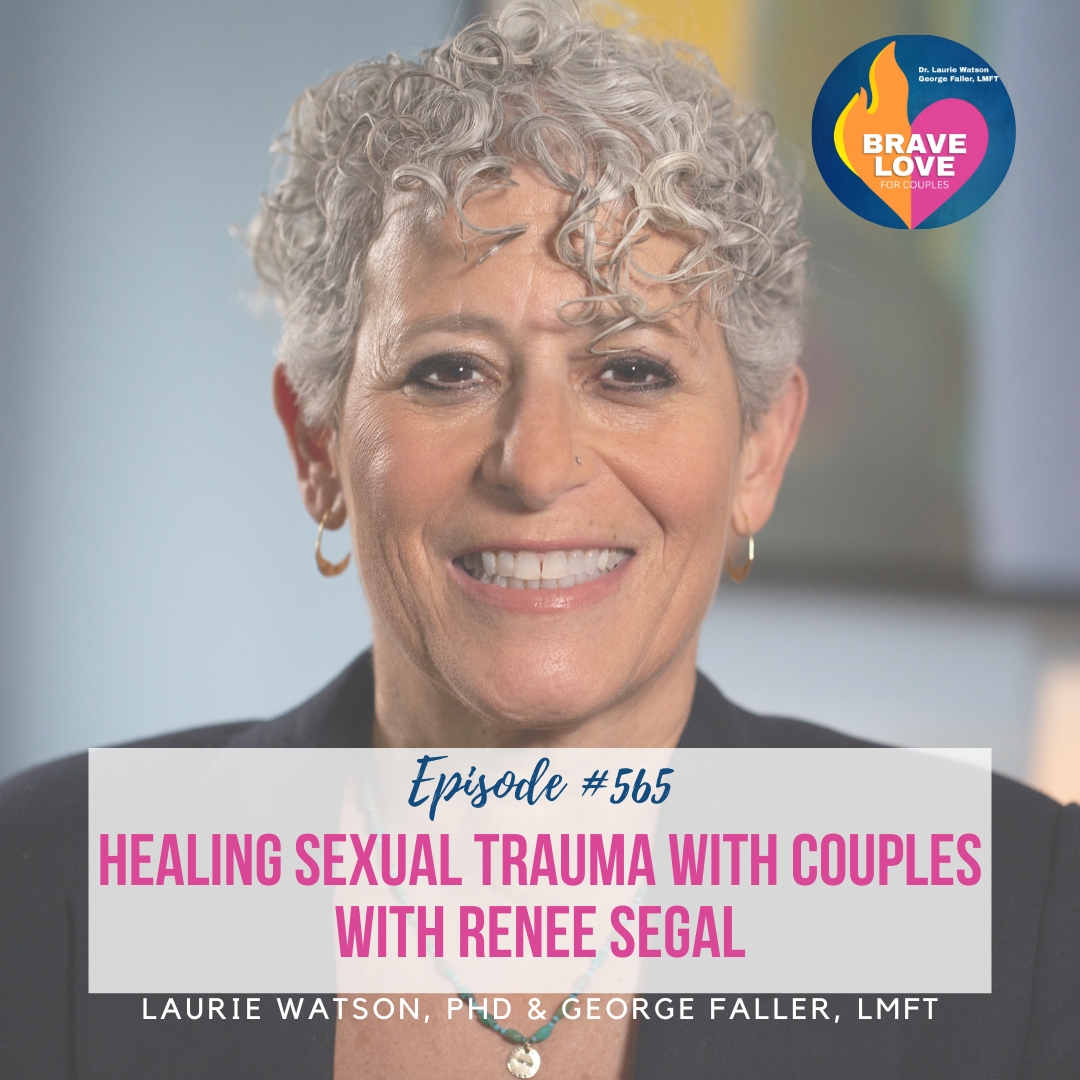
Trigger Warning: Welcome Brave Lovers! In today’s episode Laurie is joined by guest Renee Segal. Renee is the owner of Evolve Therapy in Minneapolis, MN. Renee is an EFT couples therapist and supervisor and has spent her career supporting survivors of sexual assault. We are responding to the recent news from Cornell University and addressing a topic that is not spoken about enough. 1 in 4 women, and 1 in 6 men are survivors of sexual assault. Sexual trauma can create myriad trauma symptoms for individuals including; dissociation, sexual avoidance, hypersexual behaviors and hypervigilance among others. Yet, this conversation often doesn’t get addressed between couples.
Laurie and Renee provide expert advice for survivors and their partners on how their relationship can help heal the sexual trauma. Safety, gentleness and compassion are the bedrocks of supporting a survivor of sexual assault. We ask that you take this episode in with care and reach out for support if needed.
For more on Renee visit: https://www.evolvetherapymn.com/
National Sexual Abuse Hotline: https://rainn.org/
Transcript
Laurie Watson, PhD (01:42.347)
Y’all, I am so happy today to have Renee Segal. She’s an LMFT, she’s a certified EFT therapist and supervisor. She’s the founder of Evolve Therapy in Minneapolis, Minnesota. For 17 years, she’s led a practice devoted to helping couples heal, reconnect, and restore emotional safety.
And she began her career in a rape crises clinic. And that inspired her to sort of an endearing, an enduring passion for helping people heal from sexual trauma. She’s known for her warmth, her insight, her engaged approach. Renee helps partners feel loved, chosen, and understood. And I am so pleased to welcome you. You we are also part of another group, Renee, for group practice owners, so we know each other well and our friends.
And I am so pleased that you decided to come on today to talk about this really difficult subject about the rape at Cornell. And I just also want to say you know thank you all out there who’ve been supporting our book Brave Love Great Sex it’s available everywhere and it’s it also has a chapter on trauma and rape. So please go ahead and pick that up.
Renee, hello. Thank you for being here.
Renee Segal (03:13.101)
Thank you so much. Laurie, thank you so much for having me. And as you and I have had many conversations, I’m always interested in talking about sexual trauma because it’s something that is not talked about enough and survivors need their voices heard. So I’m really I’m really grateful to have that you asked me to be on the podcast and I adore you. So Yeah. Yeah.
Laurie Watson, PhD (03:31.094)
Absolutely.
Laurie Watson, PhD (03:38.211)
I adore you too. Yeah, we we have fun together. And I am just you know, you were one of the first people I called when I heard about the Cornell rape case and when that came out because I knew you would know what I was feeling and get it. And I think there are so many women out there who are resonating with this case.
Renee Segal (03:44.651)
Mm-hmm.
Renee Segal (03:58.114)
Yeah,
Laurie Watson, PhD (04:07.206)
and certainly many, many women who are survivors of childhood sexual abuse, sexual assault. And I just want us to speak to them and speak about what we’re feeling about this case.
Renee Segal (04:22.925)
Mm-hmm. And so for me, w where I often say I grew up at a rape and sexual assault center. And so it was in S South Minneapolis near the University of Minnesota campus, and we have lots of colleges nearby. And so her story is not unlike what we saw walk in the door. So it’s so we ran survivor groups, we ran partner groups, and so
Laurie Watson, PhD (04:36.982)
Mm-hmm.
Laurie Watson, PhD (04:44.799)
Right.
Renee Segal (04:52.277)
I sort of felt like we it would be great to talk about because there seems like the people are poking holes in her story. I think the cultural norm is that the women have to prove that they were in fact non-consensual. and it’s confusing because in the wake of trauma they they’re the they act a certain way.
Laurie Watson, PhD (05:10.026)
Yeah, yeah.
Laurie Watson, PhD (05:19.796)
Right, right.
Renee Segal (05:19.923)
in in the immediate wake of trauma. And then what we see in our offices today, you and I, is something twenty years later, where often
Laurie Watson, PhD (05:29.414)
Often, often. Often, you know, the the thing I see the most in my practice is a person who was traumatized either in childhood or young adulthood. And then they get into a relationship and kind of the limerence of falling in love and all of that emotion, they’re able to overcome th those injuries for a short period of time. They have good sex.
with their partner. But ironically, within the safety of marriage, the trauma has a space to emerge. And unfortunately it does shut down sex. And and and both parties are often confused. Sometimes the woman doesn’t even remember, rarely, but sometimes she doesn’t remember or she hasn’t put it together that this is what her block is. And her partner, you know, often who enjoyed a sexual
experience with her and thought, wow, this is really great. This is part of why I’m marrying you, suddenly is kind of cut off from that sexual relationship. It can be so confusing. And if they don’t get help early to heal these areas, if they don’t learn how to be vulnerable with each other, tell each other the story and get on the same team, it it can ruin their sex life, right?
Renee Segal (06:51.841)
Right. Well, and I think that I love what you’re saying because I see that in my office all the time, where there was a previous assault and something happened and maybe the partner knows vaguely about it, or maybe they don’t. Everything is fine early on, and then life happens, and then something happens and maybe there’s an affair, maybe there’s something else that happens. They come to therapy, and then as part of that, they’re like, Well, wait, this has been
Laurie Watson, PhDa (07:10.699)
Yeah.
Renee Segal (07:21.389)
You know, maybe the partner’s been dissociative, or maybe the partner has been avoidant of a certain behavior during sex or something like that. And so so then the everybody is confused. And I I feel like we also need to speak to that because that is something that happens quite often. I wanna what the statistic that I learned is that one in four women have had some form of sexual trauma.
Laurie Watson, PhD (07:41.204)
Yeah.
Laurie Watson, PhD (07:48.779)
Mm.
Renee Segal (07:49.118)
I would say without a doubt, I have had well, over ninety percent of the women that I see have experienced some form of sexual trauma. And I don’t know if that’s similar to you or not, but that’s sort of the statistic that I see, just anecdotal evidence. But what about you,
Laurie Watson, PhD (08:05.128)
And well also I just want to mention we know men as well, our sexual abuse survivors too. Yeah, one in six. Yeah, I I can definitely imagine those statistics. And, you know, the the longer we go, basically, I think what we see is vulnerable people are exploited sexually. And it really troubles me that we’re kind of living in a culture that somehow or another
Renee Segal (08:09.609)
Yes, and that was I was taught one and six. Yeah. Yeah. Yeah.
Laurie Watson, PhD (08:34.654)
to belong to the greater culture is to denigrate those who are weaker and lesser, have less resource, look different, might be a different gender, you know, I just we’re living in a toxic culture for you know the minority population. And it’s it I I’m wondering if this isn’t what led to this
Renee Segal (08:58.047)
Sure.
Laurie Watson, PhD (09:03.73)
experience for this girl. We know rape on campuses have been has been happening a long time, but I think the most troubling aspect to me is trying to parse together like, okay, horrible. You know, at least it sounds like seven people, seven men accused of rape. And some of this has already been established as fact because of the student trial
I I don’t really know what they call it. Hearing
Renee Segal (09:36.077)
they how they adjudicated it early on. I think, yeah, and then there were fifty more that were sent to the
Laurie Watson, PhD (09:38.806)
Mm.
Laurie Watson, PhD (09:43.125)
That that’s the piece. It’s like how how and why would fifty other men stay silent when they’re getting a Snapchat about this? And you know every kid out there is glued to their phones. So we’re pretty sure most people got this. I don’t know if they approved, if they just didn’t value women, if I
I suspect that the power of belonging to the fraternity, to the group, overwhelmed them. And there was a lot of fear of, you know, if I report, if I call the police, if I go up there and say, Stop this, I won’t belong. I won’t, you know, I people will laugh at me, people will think I’m a pussy, think people will think, right, that
I I might be retaliated against, that I don’t belong to them. And I think that power of that like interrupted their moral thinking and it’s so troubling to me.
Renee Segal (10:44.365)
Mm-hmm.
Renee Segal (10:54.559)
Agreed. I think I think it’s it’s interesting that you’re thinking about those men. I think my mind is more with her. and and it’s a more I think we live in a culture that and you know, there’s lots of evidence of that it’s that there’s the hierarchy that’s going on and that this is sexual violence toward women and this has been happening for years and years and years and years and years and continues to happen.
Laurie Watson, PhD (11:00.714)
Mm. Mm.
Renee Segal (11:22.965)
And we don’t teach our boys because what we hear in the media is, and even I got my hair cut earlier this week and my hairdresser said thank you, and she said, well, what was she wearing? And I’m like, Why are that there’s there’s always the blaming the survivor and why are we not teaching the boys to speak up and to stand up? And I think that you’re speaking to the power of the longing. I think I just
Laurie Watson, PhD (11:30.762)
You look very nice.
Laurie Watson, PhD (11:50.581)
Yeah, and I, you know, regarding that comment of what were you wear what was she wearing, or was she too drunk, or was she really, you know, consenting and not drunk not drunk enough? I I I read a or I saw a meme or something that said, you know, if a young man had gone to a party and been sexually assaulted by seven other young men, would we have ever asked?
Renee Segal (11:59.428)
But did she want this? Yeah.
Renee Segal (12:06.221)
Yeah.
Laurie Watson, PhD (12:17.364)
what was he wearing or was he too drunk to consent or like we would have never thought about it that way. And I think to men to get a kind of hold of what that might feel like to be violated by so many people. Like what started out, you know, we have no idea how it started out and then ends up in this. I I’m sorry, but I don’t think any person is volunteering, you know, for gang rape.
Renee Segal (12:47.703)
Well, what I I wanna say, I wanna speak to something else, Laurie, that I think you’re hinting at that is really important. In the wake of trauma, a lot of times people, the survivor identifies with the perpetrators. And so and we know from the articles that that one of the men called to apologize. He was doing damage control, and very early, and I think within the first twenty four, forty eight hours, she said.
Laurie Watson, PhD (12:47.829)
Yeah.
Renee Segal (13:15.531)
We were all adults and this was consensual. And that is really typical because they initially will do this. Initially they they will identify with the perpetrator as a way to distance themselves from being a survivor and from being victimized. And so I think that that’s really I think that that’s that’s really an important piece of this.
And then as you can see, as they put together their story, and I think the media looks at this and they say they’re changing their story, but it’s because the memory is fragmented. And there is there’s this, and you and I both know there’s something in psychology called the victim perpetrator caregiver. And so there’s that triangle, and so they they instead of being a victim, they decide that they want to identify with the perpetrator. And then later
Laurie Watson, PhD (14:04.01)
I think this is a really I wanna slow down here because I think it’s an important concept that that we need to think about. So what you’re saying is when a person emerges from a trauma, their self can be fragmented, their experience and how they’re putting it together. and I think that, you know, there’s a lot of pressure.
Renee Segal (14:13.708)
Mm-hmm.
Renee Segal (14:24.461)
Their memories are fragmented. Yeah.
Laurie Watson, PhD (14:32.97)
This young woman was also under a lot of pressure as well for peer belonging, right? So maybe what she says in the beginning is different than her real experience of it. I I think that’s
Renee Segal (14:46.987)
And then the media changes it and says you’re changing the story. But it’s really her memory of it, which I think is like I think that that is that’s the complicating factor in this is that as she’s putting it together, she’s she’s remembering it. And I also read that she was having a terrible day. She had her wallet stolen early in the day. So she was gonna be the
Laurie Watson, PhD (15:09.782)
She wasn’t yeah, she wasn’t as resourced that day as she might have been some other day. Yeah.
Renee Segal (15:14.379)
No. Exactly. I think that you’re that’s really well said for you. I interrupted you, I’m sorry.
Laurie Watson, PhD (15:20.798)
No, that’s okay. Yeah. So as you think about her and her experience, you said that’s kind of really where your mind goes, especially in your experience as a longtime therapist dealing with this. tell me about kind of what you feel as you listen.
Renee Segal (15:32.151)
Mm-hmm.
Renee Segal (15:35.948)
Yeah.
Renee Segal (15:41.154)
Well, I think that a situation like this changes the person’s relationship to their body. And this is something that I think in the wake the immediate crisis of the trauma, they become dissociative and they generally were dissociative during the experience. We know she was on ketamine and all of these things. And I think that
Laurie Watson, PhD (15:48.758)
Mm.
Renee Segal (16:03.701)
Yeah. So that they’re they become dissociative, they become and these are just typical PTSD symptoms, hypervigilant, anxious, panicking, and they end up having an aversion to touch. They might have flashbacks, they might have intrusive thoughts, smells can bother them, and it’s so much damage. So it’s hard for them to Exactly.
Laurie Watson, PhD (16:19.157)
Mm.
Laurie Watson, PhD (16:25.952)
So much damage in every sensory kind of experience, from touch to smell to I I mean, I I think this is really important. I I I I really want to talk about this all the ways that the the person gets damaged, both in direct assault.
Laurie Watson, PhD (16:53.472)
I really want to talk about this. Let’s take one quick break and come right back. As we come back from break again, Renee, about what all the things are that a victim of sexual assault or molestation, what is the fracturing pieces to their senses?
Renee Segal (17:40.558)
So I mean I think that like I said, they they can they they tend to wanna avoid that behavior. They might avoid sex, they might avoid sexual i stimulation, they might feel nauseous, they might feel stomach pain, they’re gonna have flashbacks, they might freeze. some some survivors talk about just the feeling of their body, the wetness of ejaculate d feeling disgusting. And so this can cause them to be dissociative during sex. and so and then even feeling like sex is an obligation, feeling like you’re doing it for somebody else. I think a lot of this
Laurie Watson, PhD
Mm-hmm. So they they get completely removed from their own erotic self, right? They’re for them, they they don’t even have that piece almost sometimes, depending on how early the sexual molestation or sexual assault comes. They may not have even developed an eroticism yet. And all of these pieces
Renee Segal (18:32.193)
That can happen or and we see this too is that they become completely hypersexual and they want to reclaim their sexual and then they might use and we saw that and what we had what what I saw at the the sexual assault center was a lot of people who had multiple experiences of rape and so because they’re putting themselves in in they’re they’re not I don’t want to ever blame them
Laurie Watson, PhD (19:10.41)
Mm-hmm.
Renee Segal (19:17.825)
But they are not taking care of themselves. And so they have this appall they engage in risky behaviors. And so, so there’s there’s I think that the other thing that we really need to talk about is the shame that many of these survivors feel. And I think that when they go to the police and they start talking about it, the onus is on
Laurie Watson, PhD (19:21.941)
Mm.
Renee Segal (19:42.28)
the survivor to say I was raped and it wasn’t unconsensual versus believing them. So if someone you know came and robbed your home, you don’t say to them, Well you left your door open. Well you have house. How come they came in? You have windows. They broke your windows. We don’t blame the survivor of any of this only in this type of situation. And so I think that that Yes
Laurie Watson, PhD (20:05.812)
Yeah. Rape is an exception. Rape is an exception where we blame the victim.
Renee Segal (20:10.709)
Right, we brain the survivor. And so I think the thing is is that they don’t and that’s very often why they don’t report it, because the onus is on them to prove it. And so it’s very hard. And even the rape the rape exams are traumatic for them. So I think there’s I think this is why we have very often
Laurie Watson, PhD (20:28.457)
Absolutely.
Renee Segal (20:33.289)
It’s so confusing for them and so they need there’s not a clear roadmap about how this looks. It’s just very confusing. So when you’re sitting with people in the wake of this and I had many times where people would come in and they would be just in the wake of that, they they would be so confused, in the in the immediate aftermath of that. So
Laurie Watson, PhD (20:35.711)
Mm-hmm.
Laurie Watson, PhD (20:55.722)
Yeah, so you were helping people in acute trauma, just having survived rape. That’s amazing. That what an I what a gift you must have been. What do we say to the people now, the couples who are listening? I mean, first we’re we’re with the women who have been violated. And we get it and we we want you to have healing. We want you to be able to reclaim your erotic self.
Renee Segal (20:59.297)
Right. Yes.
Renee Segal (21:10.061)
Right.
Renee Segal (21:16.747)
Assuming mm-hmm.
Renee Segal (21:22.327)
Mm-hmm.
Laurie Watson, PhD (21:25.472)
We’re also with the partners of these women, right? Who also are hurt by prior assaults and molestations. I mean, they are often desperately hurt and kind of cheated out of that lovely free flowing sexual relationship that they came into the relationship wanting and needing.
Renee Segal (21:25.549)
There’s it.
Renee Segal (21:29.185)
Mm-hmm.
Renee Segal (21:47.17)
Right. And I I love what what you said. I love what you said because sometimes we see these folks, at least today, I see these I used to run groups for the immediate aftermath for the survivors and their partners. But right now I see folks and you do as well, and probably more than what I see, is that helping them understand
And sometimes that partner doesn’t want to share what happened to them because of the shame. And but it needs to come out. And many times what happens is people say, my God, they might have put it away and were like, No, it’s I wasn’t raped. It wasn’t they sometimes people call it an unfortunate incident or
I have people say an unwanted sexual experience. And so they need to understand what happened to them, frame it in that way, and then understand their trauma triggers. When I’m touched in this way, it causes a trauma, and to be able to communicate that to the partner without pressure. And so I what I would say to the partners is let the survivor share as they feel ready.
And listen without judgment.
Laurie Watson, PhD (23:07.37)
And oftentimes, I mean, this is a conversation that is well served in therapy, you know, because there’s a safe person who who sort of escorts you through this conversation in ways that both people feel heard and understood. Because I I think both parties in a long term relationship do need to hear the full story and
Renee Segal (23:11.849)
In therapy. Mm-hmm.
Laurie Watson, PhD (23:33.427)
Also, together manage the way that story and that injury has hurt them, you know, both parts. But I I love what you’re saying. I mean, I think having a person who is compassionate, who we love, who’s an attachment figure, listen to our story with empathy and care and being on our side can really, really help the healing. And I know there are partners out there who say, I would love to hear, and my partner won’t talk.
Renee Segal (23:50.74)
Mm-hmm.
Laurie Watson, PhD (24:03.222)
I get it. But many times with help or therapy, the person will open up. And it’s difficult because, in some ways, they relive just by touching it in memory and recounting it, they relive those powerful, scary emotions. But if you are there and you can do it slowly, it can bring enormous healing to them to be seen, heard, loved, held.
Through that. And then they need to make adjustments sexually. That in the beginning, right? If a flashback comes, they need to know what to do. Instead of pushing through and her numbing out to continue the sexual act, she needs to say, Hey, I’m in a flashback. And they need to stop that moment. It isn’t stopping forever, it’s stopping that moment.
Renee Segal (24:42.218)
Mm-hmm.
Laurie Watson, PhD (24:58.878)
And tell her partner and then do the thing that would make her feel safe. You know, I often recommend that it’s the head-to-heart exercise where a woman who is triggered puts her ear to her partner’s heart because a heartbreak a heartbeat regulates us. As human beings, listening to a heartbeat regulates us. And so she can come. Yeah, I talk about that in the book. She can
Renee Segal (25:02.943)
Exactly.
Renee Segal (25:08.141)
I love that.
Renee Segal (25:19.564)
Mm-hmm.
Mm, you talk about that in the book. Yeah. Love that. I love that.
Laurie Watson, PhD (25:28.022)
Come back into her body, come back into her presence. She doesn’t need to numb out. She doesn’t need to go forward to make somebody happy. She can say no and still be loved, right? And that is so powerful for her to be able to do that. And we wanna have go ahead. No, it’s okay, go ahead.
Renee Segal (25:41.303)
Exactly.
Renee Segal (25:45.112)
Can I add one thing? Yeah. I interrupted you. I wanna add I wanna add one thing. I think that dissociation is so common among the survivors. And so the last thing we want you to be doing is dissociating during sex. So that’s where they have to be able to say, I’m in a flashback and stop the action. And if the partner is loving and supportive, that is so healing for that partner.
And the partner needs to get support themselves. I think, I think also expanding the ideas of intimacy in those moments, at least initially, holding hands, gazing at each other, laughing together, whatever those intimacy kinds of things. So that I think the goal, which you’re saying, and I love the head to heart because of the the heavy beats, which helps ground her,
Laurie Watson, PhD (26:17.632)
They do. They do.
Renee Segal (26:42.465)
But I think that it’s it’s really like for for her to feel like I’m loved, I love what you’re saying. I’m loved even if I’m not giving sex. and I wanna just say a little thing to the partner. Yes.
Laurie Watson, PhD (26:56.488)
I’m wanted. I belong to you. We belong together. I don’t have to appease you. I don’t have to use my body anymore to make you happy. Right? I I can in this moment stop and have a voice, whereas I me might not have had a voice in the assault or the relationship that was assaultive or the molestation. This time I can. And of course we want people to be able to reclaim full eroticism eventually.
Renee Segal (27:22.422)
Yeah.
Renee Segal (27:26.529)
Right, which is and I think that I just wanna make a comment relatedly that sometimes if they’ve been you know, in trauma avoidance is part of a a trauma response. So that the she might be avoiding sex altogether.
For the man, of course, he’s cut off. And if he expresses his sexual desire as a need, it becomes an obligation for her, which is re-traumatizing for her. So I just want us a shout out that it’s like if we want to heal this, it needs to be gentle and not to press to hear the story from her, that she can tell the story when she’s ready.
Laurie Watson, PhD (27:45.886)
Yeah, terrible.
Renee Segal (28:07.423)
And that what it what it means to her, and she might not have to tell the story, she might just say, This is traumatic for me to touch when I’m touched in this way, or to do something like this. So, so that she’s in control. And that’s really what I I talk about is to let her have control, which I think is is really, really important. I think our goal is the same is to get to get them to get her to reclaim her sexuality and her
Laurie Watson, PhD (28:18.165)
Mm-hmm.
Renee Segal (28:36.479)
and and what’s going on. And I just encourage men to get their own support around this because it’s hard dealing with someone who’s been traumatized.
Laurie Watson, PhD (28:44.992)
Yeah, yeah. Or female partners as well. You know. right. No, I mean the the the partner who was traumatized or if she has a female partner as well. Men or women who are partnered to people who have been sexually abused or assaulted.
Renee Segal (28:47.745)
Yes, female yes, because again they have also been traumatized. they
Yeah.
Renee Segal (28:59.853)
Yes, and I wanna say one thing. Men who are sexually assaulted, I I just wanna make a comment about that. Men who are sexually assaulted usually women get support sooner because our culture supports that. Men usually I end up seeing them forty, fifty years old and then they they’ve come in and they’ve said, I’ve been assaulted. And
Laurie Watson, PhD (29:18.301)
Absolutely.
Renee Segal (29:23.379)
Or I had a rape situation and then they start to talk about it. So I think men are also also sexually assaulted and there’s a different type of shame that shows up with them. So that’s a Yeah.
Laurie Watson, PhD (29:25.503)
Mm-hmm.
Laurie Watson, PhD (29:33.557)
Yeah. And I I wanna go back to what you said. You you were saying you you want the woman to tell the story at her own pace, which I think is true. But we also wanna bear in mind that some people are not telling the story for twenty years and and you know, they’re hurt and they’re injured and it has repercussions in bed and their partner is a little mystified. So when we say we want it to come out at her own pace, we mean
Renee Segal (29:42.592)
Yes.
Renee Segal (29:54.998)
Right.
Laurie Watson, PhD (30:03.732)
within a a reasonable time frame. And I think that I mean, I y framing sex as a need, I need to have sex
Renee Segal (30:07.179)
Yes.
Laurie Watson, PhD (30:16.33)
in order to feel good, or I need to have sex in order to you know, feel happy. I think that’s different than I need our relationship to be sexual. I wanna get through this with you, right? A a marriage is a sexual ar arrangement, an agreement, you know, and I understand you’ve been terribly injured and I’m here to support you. And I’m gonna go to therapy with you and give you time. And I don’t ever want you to feel in one single incident
Renee Segal (30:29.045)
Right, right.
Renee Segal (30:38.335)
Exactly. Exactly.
Laurie Watson, PhD (30:46.048)
That you have to have sex with me in that moment. If you’re triggered or you’re having a flashback, or I’ve done something like kiss the back of your neck and it triggers you, let me know. We’ll stop. We’ll come at it another day. But I think overall, you know, we believe in healing, in full healing, that people can restore and can have an erotic life after this, and their partners can
Be with partners who have been sexually abused or assaulted and, you know, in a healed way. It doesn’t have to last for 20 years. Please get help.
Renee Segal (31:21.293)
Mm-hmm. That’s so well said. That’s so well said, Laurie. Because I think when it’s framed as, you know, the when it’s framed in that way, I need us to heal from this. I need us to have this in our relationship. It’s one thing. Let’s do this together, versus you need to do this for me. it yes, this is a totally different message. And so I think
Laurie Watson, PhD (31:41.226)
Right now.
Renee Segal (31:46.476)
To the partners out there, the the partners need to get their own support around this because this is a quite they are definitely, definitely impacted. and then the survivors have a journey of their own. And so it’s it’s complicated stuff. it’s really, really complicated.
Laurie Watson, PhD (31:51.147)
Yes.
Laurie Watson, PhD (32:05.48)
Exactly. Renee, it’s been lovely to talk with you on the podcast. Lovely to talk with you every day that I get a chance to. But you bring so much expertise to this because of your experience both as a therapist and EFT therapist and supervisor. And having the, you know, early beginning of your career in a rape crises center is amazing.
Renee Segal (32:06.049)
Yeah, yeah.
Renee Segal (32:15.207)
Yeah.
Laurie Watson, PhD (32:34.548)
I just thank you for your passion about healing trauma and how you’ve brought that to the world, how you’ve brought that to us today on the podcast. And I want to say thanks for listening, y’all.
Renee Segal (32:45.729)
And you know what? I wanna say, Laurie you are I love listening to the podcast and I love how you are just a steward of how important sexual relationship is in a couple. It’s so important.
Laurie Watson, PhD (32:58.838)
Thank you. Thank you for being with me.
Renee Segal (34:33.505)
Laurie, I am so excited to be here. You are a longtime friend of mine. We’re in a group together, and you and I have done walks and talks about healing sexual trauma. And I love that you put sexual trauma in your book. I think that that’s great. And I’m just excited to talk about this topic, which I’m really passionate about, is healing sexual trauma with couples. So thank you so much for having me.
Laurie Watson, PhD (34:59.604)
You’re so welcome.


