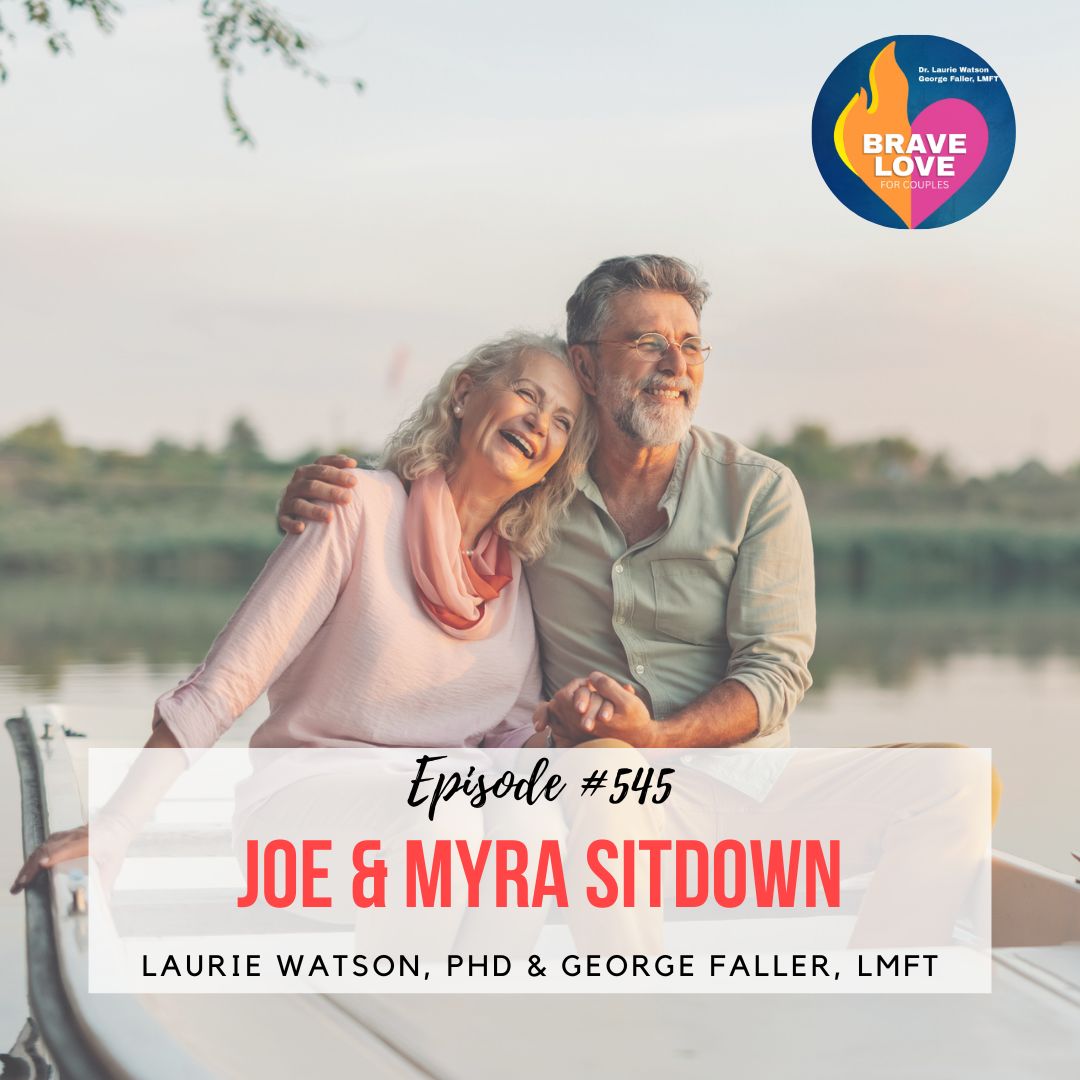
Welcome Brave Lovers! In today’s episode, we are joined by a couple live in the studio! Join us as we welcome long-time friends of Dr. Laurie, Joe and Myra. They share with us their forty-year love story and the role that physical intimacy and emotional closeness have played in keeping their bond strong over the years. Joe and Myra talk about friendship being a foundation of love, how they navigated the difficult caretaking years, and keeping their attraction and desire alive. Turning towards each other, a strong belief they could weather the storms and even sharing vulnerabilities with each other to this day have created a strong and secure connection! Make sure to listen in and download this episode to hear from a real set of Brave Lovers!
Order a copy of our book Brave Love, Great Sex coming out on September 15th. Available for pre-order now!
Please support this episode’s sponsor (and help the pod!):
Uberlube.com — The lubricant Laurie has recommended for 20+ years! Use the code BraveLove for a discount!
Transcript
Laurie Watson, PhD (00:26.606)
We have a special treat today with Joe Dew and Dr. Myra Teasley. They are a married couple who are dear friends of mine and have volunteered to talk about their sexual story. And we’re so happy to have you here.
George (00:33.702)
Yeah.
Joe And Myra (00:52.434)
We’re glad to
George (00:52.57)
Welcome, welcome, welcome. Be careful what you wish for.
Joe And Myra (00:55.506)
I was just thinking that.
Laurie Watson, PhD (00:55.97)
That’s right. Okay, that’s our intro. And then we will begin and we’re going to say a little pimp about our book and then we’ll start talking to you.
Joe And Myra (01:09.52)
Okay.
Laurie Watson, PhD (01:11.896)
We have special guests and just a reminder that September 15th is the book published date, Brave Love Great Sex, same as the podcast. just welcome all of you to find it on Penguin and Amazon and wherever books are sold right now. You can buy a pre-order. You can pre-order for us.
George (01:34.266)
Joe and I are already pre-ordered the book. So let’s get on to seeing what they have to say.
Laurie Watson, PhD (01:38.35)
Joe and Myra have been listeners of the podcast and also, again, Derek and my dearest friends for, gosh, 15 years, you think? Yeah, yeah, longer. Wow. Yeah. And Joe and I were talking the other night and he said, you know, why don’t you have couples on? And I’m like, yeah, but who would come on? I’d have to find someone. He’s like,
Joe And Myra (01:51.9)
Yeah, more. Longer.
Laurie Watson, PhD (02:06.882)
We would. I’m like, Joe, that’s amazing. then Myra. There was some alcohol involved in that decision.
Joe And Myra (02:10.171)
There was some alcohol involved, I will say.
Joe And Myra (02:18.755)
Yes?
George (02:20.016)
I mean, that is, that’s one of the big things we talk about here.
Joe And Myra (02:22.597)
hahahaha
Laurie Watson, PhD (02:23.534)
Yep. So, you know, we thought about having you kind of tell a little bit about your story and the sexual changes that you’ve had over your marriage and kind of why you begin. Joe is a journalist and he’s also a caretaker for their son Bryson. Bryson’s a young adult now who has cerebral palsy and is the sweetest young man alive.
Myra is a retired OPGYN and that’s actually how we met, right? We met through our works. Yeah.
Joe And Myra (02:53.745)
That’s.
Joe And Myra (02:58.501)
Yes. Yeah.
George (03:01.606)
Yeah, I just want to thank the two of you for showing up and sitting in these chairs to tell your story because so many people listen to Laurie and I, they’re like, yeah, they’re just experts. That’s why they talk this way. It’s like, no, actually we’re all in this mess together. So it’s such a gift to have a regular couple show up that has the same struggles, but the same longings, right? The same powerful drives that all of us have. So that’s why doing this.
Joe And Myra (03:14.779)
you
Joe And Myra (03:25.969)
Yes. Well, thank you. Glad to be here very much. wanted to do it because I feel like your guys, your podcast has helped me. It’s helped both of us, but helped me particularly understand more about women and my wife and how sexual intimacy and physical connection can make a real difference. it felt like many of could that.
Laurie Watson, PhD (03:47.214)
ciao!
George (03:51.602)
Well, how? It’s in the juicy details, right? mean, it sounds pretty inferior, but what are you actually talking about here,
Laurie Watson, PhD (03:51.829)
that’s lovely.
Laurie Watson, PhD (03:58.318)
What did you learn from us?
Joe And Myra (04:01.234)
I think I mean to be honest that so Myron I dated for eight years before we married so we had a physical sexual relationship for a while before we were married and was Connected I mean we were well connected and I mean for me and in your 20s a lot of it’s about the lust you know you see your wife or your girlfriend or your partner and you’re immediately got a kind of a zing going in your body and
A lot of things in your mind get crowded out by the idea of being alone with or somewhere physical. And, you know, it’s just kind of, in those days, for me, was, lot of it was about the physical connection and the physical attraction. And then, of course, all these years later, we’ve been married for over 40 years and I just hit 70. So, world’s a little different in terms of our physical life and our sexual life. But it’s always been, for me, it’s always been an important element of being together.
Myra was my best friend before we got married. And I’ve got friends, and I love that she was my best friend, but I also need kind of the physical intimacy. That’s what makes that relationship different than any other that I have with anybody else. And so I want to hold it until we move in.
George (05:13.457)
It’s a great place to start. So much of what we’re trying to get men to not apologize for kind of how they’re made, right? That you as a 20 year old had this amazing ability to get instantly turned on and so focused and into your partner and like life doesn’t get much better. Like that’s a strong force that often get misinterpreted as, you know, just wanting an orgasm, but doesn’t, you know.
often recognize how central that is to safety for you in the world and how you feel connected. And you know, what I hear you saying is you have a best friend, you always knew that, but there’s still something different about these moments with your best friend than just everyday regular conversations.
Joe And Myra (05:56.761)
Absolutely, absolutely.
Laurie Watson, PhD (05:57.912)
And I love that you began with such a strong friendship foundation. I I think that’s amazing, especially in this era, right, where people are using dating apps and they don’t know somebody from Adam. This was a blessing to you guys who were in kind of a smaller town and knew each other, actually. And then you didn’t start dating right away, though. You started dating a little bit later, right, in college. Yeah.
Joe And Myra (06:10.403)
Mm-hmm.
Joe And Myra (06:24.505)
Yes, it was after that. We knew each other in high school. We went to different colleges, but in the college years, we went from friendship to romance and then to the relationship, as I said, that eventually led to marriage. But yeah.
Laurie Watson, PhD (06:35.201)
Mmm.
Laurie Watson, PhD (06:41.004)
Nice. Nice.
George (06:43.569)
and you’re dating a doctor. So how is it on your end, the early days of the relationship, Myra?
Joe And Myra (06:49.871)
Well, I mean, we were friends and.
That was just sort of this background relationship that I had. And I didn’t date a lot in college because I was in pre-med and that’s pretty intense. And that was OK because I was very focused on what I was going to do. But Joe was always there. And he was always this steady.
supportive presence. And I had girlfriends that would say, you know, he’s in love with you. And I was like, God, that is so gross. It’s like kissing your brother. Forget it. No, you know. And and then all of a sudden, I just kind of went, maybe I should.
pay attention to this person and really think about this, you know. And so then the relationship evolved and I went to graduate school and I went to medical school and Joe was 100 % supportive and 100 % there and knew, I think, as best as you can know on the front end what he was getting into in terms of my very demanding…
academic requirements in my very demanding career and he was like, we can do this, you know, we can do this. And so I think having that just foundation was
Joe And Myra (08:38.503)
I can’t even imagine my life without it. And I think even now, I’m just like…
Laurie Watson, PhD (08:42.03)
Mmm.
Joe And Myra (08:49.176)
It’s always there. It’s always going to be there. I mean, I have no doubt that whatever happens, we will get through it. And I think that’s because we are friends. And I tell young people, you know, when I’m squawking and they don’t really want to hear what I got to say, I always say you cannot underestimate how important it is to like your partner.
Laurie Watson, PhD (08:58.456)
you
Joe And Myra (09:14.626)
not just love your partner, but you really have to like your partner. You have to like being with them. You have to like, you know, that they’re quirky and they squeeze the toothpaste from the bottom instead of the, you know, middle, whatever. I mean, you have to really like that person to get through what life’s going to throw at you. And I feel like to a large degree we’ve lived that. Yeah.
Laurie Watson, PhD (09:14.719)
Absolutely.
Laurie Watson, PhD (09:37.088)
Yeah.
Absolutely. I see that. And I just want to say again, it’s it’s a story of friendship that evolves into romance. Whereas I think people think it has to be instant lust for it to be meaningful or for it to be right. be particularly from your perspective, it was like his steadfastness, his, you know, being there for you. Suddenly the light bulb comes on and says,
Joe And Myra (09:49.23)
Yes. It is absolutely.
Laurie Watson, PhD (10:09.696)
you maybe I could be romantically interested in this man.
Joe And Myra (10:13.73)
And I don’t know.
George (10:13.745)
Well, that’s what I wanted to say. How does it go from the light bulb to the bedroom?
Joe And Myra (10:20.16)
well, you know, early on, mean, you know, women in their 20s are as lustful, maybe not quite as lustful as men in their 20s. But I mean, it was pretty lust field, you know, and particularly for
Laurie Watson, PhD (10:32.683)
Mwahaha
Joe And Myra (10:38.53)
Well, the whole time we dated and then the early years of our marriage, we lived in two different places because Joe was working in one place and I was in school or in residency in another place. so there was this whole.
you know, absence makes the heart grow fonder. So we’d have these times when we could both very much focus on our careers and our responsibilities. And then we’d come together every other weekend or whatever. And, you know, I mean, there was a lot of lust. And, of course, that changes as time goes on and life, you know, gets a little bit more realistic. But in some ways, I think
That was different for us than the day-to-day intimacy of living together and that, how that leads to sexual intimacy and lustfulness. And we didn’t have that very often.
And who knows if that’s a good thing or a bad thing. We got through it, obviously. And then you get older and your whole sex persona changes. You get married, you have responsibilities, you’re working all the time, you’re tired. We’ll get into that, I know. But you know.
George (12:10.383)
I feel like I want to translate that word, lust, if it’s okay. Cause I think so, it’s pathologized as, know, this, this whatever our brains think of it being dirty or lustful and like, isn’t it so healthy that you have a physical longing for the person you love and you don’t need them and you miss it you want to express that. mean, that is so beautiful to me. You know, that was long. Yeah, that’s love and action right there. Right.
Joe And Myra (12:16.547)
Yeah.
Joe And Myra (12:32.528)
Yes. It’s drive. It’s a drive.
George (12:40.017)
All of them, because there’s a physical element, like we’ve, we’ve turned it into this word that I don’t think captures what, you know, that, that, that bond that you’re talking about expresses itself. It’s so passionate and alive. Like you said, that’s love and action. You, you miss this person. Here you are. And you started off with a foundation of that. You’ve had, know, your early years had this strong, consistent, physical kind of.
Joe And Myra (12:56.036)
Yes.
George (13:04.173)
intimacy, and then the friendship piece emotionally outside the bedroom. you know, you were seeing a good example of secure attachment, right of this. And I’m sure we’re have challenges that can fracture that stuff, right. But that’s, that’s, I mean, you’re blessed to start off with.
Joe And Myra (13:12.014)
Yeah. Yeah. Yeah.
Joe And Myra (13:19.982)
Yes, absolutely. Absolutely blessed. No doubt about it. Yes.
Laurie Watson, PhD (13:25.516)
And I just think, you you’ve been married for 40 years. The research actually has changed so much in that time. And now, you know, we know that sexual attachment and emotional attachment is equivalent, that people need both to feel secure, maybe in different proportions and differently at different seasons of life. But both of them are so important to create that secure bond.
Joe And Myra (13:53.698)
Absolutely. Absolutely true. mean, there’s no doubt that the thing that hasn’t changed for me is I absolutely need the physical connection and the intimacy that sets us apart from all other people in my life. need to draw security from it and I draw reassurance and kind of get geared up for the world after spending time alone with her. So, yeah, it’s important.
Laurie Watson, PhD (14:07.496)
Absolutely.
Laurie Watson, PhD (14:17.006)
So beautiful. Tell us about the slings and arrows of life that maybe came in and how your sexual connection changed and struggled.
George (14:30.799)
or the overlap right between the emotional and the sexual, right, how those two impact each other.
Joe And Myra (14:38.969)
So the slings and arrows and the way that emotional involvement can change dramatically is before, in the early days of our marriage, once Myra was done with medical school and then residency, we didn’t have kids then and we didn’t really have any real.
demands on us other than career and whatever else we wanted to do. So we had a lot of times where we would be working intensely for a long time and then we would go away together and just be together for four five days and not really have to worry. And then as Laurie knows, later in our life compared to most folks, we had a son and when he came, he was born early with a lot of problems and some disabilities.
Laurie Watson, PhD (15:11.307)
Amazing.
Joe And Myra (15:27.201)
And so we kind of hit a space where we were in our physical life, not to sound like I’m blaming that, we became estranged somewhat because of so much emotional upheaval and so much uncertainty around our son. I think we just spent some. exactly. exactly. Overwhelming exhaustion is one of the things I remember feeling.
Laurie Watson, PhD (15:44.908)
Yeah, yeah, so much fear and exhaustion, right?
Joe And Myra (15:56.11)
in the early months and years of Bryson’s life. Well, and I think you guys, I mean, you’re both parents, so you know that, you know, sometimes it takes all your emotional bandwidth to get through the parenting piece, you know, like, especially, you know, when your children are little and they have constant needs and, you know, we had this child with
Laurie Watson, PhD (15:59.427)
Right.
Joe And Myra (16:25.315)
disabilities and a lot of unknown. know, like, how is he going to turn out? How was our beautiful self-centered life going to be fractured by this, you know, little person that we’re supposed to love and nourish? so I think for any, probably most young parents,
You know, you’ve only got so much emotional bandwidth and if that’s consumed by taking care of your child, there’s not much that you have left to give your partner, sadly. I mean, you know, and so you really, and we all know that, we tell young couples that, but it’s really hard to live it. And you…
I think we were those people. It was all we could do to get through the day and do what we had to do work and take care of this child. And so our relationship with each other was never in danger, but it was not a priority. It was there. It was the framework and everything else had to happen.
Laurie Watson, PhD (17:36.27)
Mm-hmm.
And you’re speaking, you’re speaking, you’re speaking, I think, to so many people out there who are struggling. I mean, I think you guys had to struggle more because of Bryson’s disabilities and special needs. But, you know, so many young parents out there are saying, yes, yes, somebody’s speaking the truth. It’s so hard during those years to stay connected when we’re tired and we can’t
George (17:39.813)
what would it sound
Laurie Watson, PhD (18:07.512)
think past putting the kids in bed and then we just want to drop into bed ourselves. So I think you’re really saying something that’s so important. And we know that actually for most couples early, you know, the years that they’re raising small children is the lowest time of satisfaction in marriage. Yeah.
Joe And Myra (18:25.869)
believe that absolutely yeah yeah and I mean and and for us I mean we had a fair amount of help you know we had tremendously supportive family they weren’t here but they were available you know if we needed them they would come and we had you know we had a nanny when Bryson was small that was like a Monday through Friday you know eight to five presents for him
And yet we still had those same.
We had those same demands and those same centers of exhaustion, emotional exhaustion.
George (19:05.797)
think both are true, right? This time is so exhausting because it’s a transition from Uber amount of time for each other to no longer having that and not feeling like a priority, having to shift that. You know, and you’re also introducing this new creature into the world that you love eternally. So there’s something amazing about this time too that’s also part of story, but help us understand like what did the distance do to the two of you? How did that impact your relationship? How did it impact the bed?
Joe And Myra (19:14.735)
Yeah.
Joe And Myra (19:35.833)
So, mean, for us, for me, the way it impacted things was that, like I said, I described it as a period of kind of a physical estrangement. A desert. We were still seeing each other in the house and in life, know, talking, dealing with things, concentrating on Bryson, concentrating on all the things everybody has to do to make life work every day. And we just were not in a place of
Laurie Watson, PhD (19:47.722)
Ha ha!
Joe And Myra (20:04.611)
being physical together. weren’t talking. I couldn’t get Myra to talk to me about the sexual side of our life or the physical side of our life. And so for me, in that kind of stretch, it felt like, you know, like what the hell’s going on? I don’t, I mean, it’s kind of, we always been able to connect. So why can’t we connect through this? so for a few years, it just kind of felt like I couldn’t know what she was thinking.
And so, you know, if you’re a guy and you can’t figure out what your wife’s thinking, a lot of imagination can come to play and you start thinking about, this happening? Is she done with me or has she lost interest in me or is she feeling her own ideas? You know, is something changed in that fashion? And so you just kind of, like we said at the beginning for us, because we were started out as great friends, you just kind of keep thinking, we’re going to work our way through this. We’re going to come out on the other side.
and it’s gonna be good again, whatever that means, it’s gonna be good again. But right now, it’s difficult as hell. It just absolutely ties you up and not. And the only, the truth.
George (21:13.499)
you talk about that? Could you talk about that with her? Just how, you know, disconnected or how you doubted, you know, maybe your attractiveness to her, or maybe there’s something wrong with her that express itself and anger.
Joe And Myra (21:27.448)
So I think I tried to withhold the anger. If I felt angry, I tried to basically hold that to myself, know, express it in another way with a friend or just deal with it in private. And I sometimes expressed my frustration to her in privacy when it was just me and her and we had a few times to talk. And so I did express that to her, but we did have stretches where I couldn’t get her to talk in the way I hoped she would.
And so I’m not trying to throw her under the bus. It just, it left me too many times to my own devices and my own way of thinking. mean, you know, like what is going on and not being able to answer that. And so I try to be a faith, man of faith. And so, I mean, I spent some time in prayer. One of the things I remember praying was in all these times, I wanted to keep that lustful, emotional feeling we talked about earlier.
focused on her. didn’t want to look at other women with this kind of lust in my desire kind of meeting when I was looking at somebody else. And so I just tried to focus on those kind of things. And then the rest of the time, you know, we’re focused on life, hanging out, doing things we got to do for him and everybody else.
George (22:43.067)
I so appreciate you just kind of letting us into a window of that experience. Like I think it’s so common. Like when we’re being rejected, do we try to make sense of it if we can’t talk about it? It usually our anger is what’s wrong with our partner. And the fear is what’s wrong with me? Like she want me anymore. I mean, this is some of the most vulnerable moments in our lifetime to kind of have something that you need and not be able to get it and not know why.
Joe And Myra (22:58.859)
Yes.
Joe And Myra (23:08.044)
Yeah. Well, and I will say, you know, during that time period, when Joe did try to talk to me about this, my first response was anger, you know, like, how can you think I’m not perfect? And
Laurie Watson, PhD (23:10.606)
it.
Joe And Myra (23:31.016)
I’m 100 % sure there were many times when I shut down, 100 % sure. And I think one of the times that I remember kind of a light bulb going off was Joe saying, if this is what our marriage is going to look like.
This is really just two friends living together in a house, taking care of a kid, getting through life. This is not a marriage. This is two friends. And I thought…
This is not what I want and this is not what he wants. And so I need to work on myself. And I tried really hard, probably not fast enough or well enough, but that was an impactful way for Joe to let me know his needs without me feeling blamed.
And he wasn’t ever blaming me, but that’s how I interpreted it because I was not providing what he needed. But when he couched it in those terms, I got it.
Laurie Watson, PhD (24:54.318)
I gotta just say, you were so disciplined, Jo, to think and so thoughtful about what you wanted with Myra, you know, that you wanted it only with Myra. So you, you know, focus that direction and you were thoughtful about, don’t want to blaster, but of course there’s frustration. And Myra, I understand that.
George (24:55.291)
Fun.
Joe And Myra (25:19.502)
Mm-hmm.
Laurie Watson, PhD (25:22.444)
that injury that you talk about, like when somebody comes toward us and says, I’m unhappy in this way, there’s this like, you know, I’m working as hard as I can. And what do you mean it’s not good enough? You know, just that, that, that, I’m not somehow or another perfect for you, just as it is. We’re struggling. We’re under this big load. And it’s just kind of this sense of they, you know,
worry, you know, you know, I’m doing everything I can. suddenly my partner says they’re unhappy with me. It just, it can be really hurtful. And I appreciate though, that you kept listening to him and somehow or another found in what he was saying, even though it was a push you found for yourself. Okay. This isn’t what I want either really, you know, and then decided to think about it for yourself.
which I think so many couples in the negative cycle just loop and loop and loop. It’s like, well, you do this and you didn’t do that. You know, it’s back and forth and back and forth. But you took in what he was saying and it let it touch your heart and and let it question you, not just Joe’s need. But what do I want to? You’re right. We need a marriage that is more physical, more sexual.
Joe And Myra (26:43.339)
Yeah. Yeah. Yeah. And I mean, think. Go ahead,
George (26:48.241)
And that’s why I was curious just sitting in that chair, you know, and that’s the thing, our body remembers these places. know, I see as Joe slows down and, you know, he touches that place that was dark, right? And you can feel the emotions starting to come to him, right? And I’m curious, how does that touch you? I was just sitting in a chair when you see that kind of hurt side of him show itself.
Joe And Myra (27:16.855)
Well, I think.
I don’t want to be the person that’s causing that. I mean, I am crazy about this guy. I mean, he is such a good human and such a good friend and such a good dad and such a wonderful husband. I am crazy about this guy. And so I don’t want to be the person that’s causing that.
George (27:46.204)
which is what you did, right? Which is, I wanna know more, right? How you learned to kind of fight for your own sexuality in a way that brought it back in a more kind of really important way. And I’m just trying to, like when Joe feels that kind of bad feeling, and of course you don’t want him to feel that way, like.
Joe And Myra (27:48.384)
Yes.
Joe And Myra (28:10.125)
Right.
George (28:12.315)
Do you reassure that feeling? mean, can you kind of speak to that side of him? I mean, I get not trying to trigger it, but know, life inevitably, right? So when…
Joe And Myra (28:24.117)
Yeah. I don’t know. I hope so. Maybe Joe’s a better person to answer that. I don’t know if I’m. So I think a couple of things were going on around us that played into that. Not only our son, but along the way, we both agreed that the best thing for our son was for me to stop working in the world and make him my job and make her the breadwinner, which has added stress.
which I understand is added stress. so that was another layer. And then the other part that was kind of going on with that was like not realizing at the time that part of what used to be our life was now changing in a way that was never going back. And I don’t mean the sexual part as much as I mean kind of the day-to-day life, the plans you were making, the way you were looking at life was told in this kind of changing dramatically.
quicker than you might have expected it, brought on by these kind of events. And so the frustration for me was those times when it was just me and her alone, and my reassurance and my security was in that physical, intimate, me and her only time just evaporated. And so I…
I knew that I was putting pressure on her, but I didn’t want to put pressure on her. I just wanted us to figure out a way to do it together to get to the other side.
George (29:50.63)
Yep. I got you. And that’s why these moments are cool. I think really important for our listeners that even though this is many decades ago, it still lives within you. Right? So when you touch that and you know, you two have such strengths, but trying to figure out what that part of you needs that felt pretty discouraged and rejected. And, know, and Myra so quickly when she sees it, makes her feel bad and she wants to do things differently. So you don’t feel that way. Right. But
Joe And Myra (30:00.993)
yeah.
George (30:20.155)
That might make her get caught up in what’s going on with her to not know how to actually be present with that feeling. That’s a lot that just feels down and discouraged. So I’m curious sitting in that chair. What do you think might help that part of you that just feels like, damn, even decades later, I can feel my tears come up when I touch this place. shows how much of an impact it had on you. Like, what do you think?
Joe And Myra (30:29.388)
Yeah.
George (30:45.039)
Besides having sex again, which you did, and that’s kind of solved a lot of this problem. What do you think that sad party kind of would need?
Laurie Watson, PhD (30:50.19)
Ahem.
George (30:55.889)
Like just some reassurance or, yeah.
Joe And Myra (30:56.919)
See.
I may not answer your question, but I was going to say for me, think.
You know, I had this huge bucket in my life that was work. I had a very demanding career. I was the breadwinner. a, you know, not hugely competitive person, but competitive enough person that, you know, at work I wanted to get good numbers. I wanted to, you know, make my quota, you know, be a superstar. And I wanted to be the best physician that I could be.
And you know, that’s a pretty big bucket to try to fill. And so all my energy went into that. You know, there was a smaller bucket that was my child, an even smaller bucket that was Joe, an even smaller bucket that was the rest of the world, you know. And so I think…
What I had to realize was that I have to figure out how to more equalize those buckets. I’ve got to figure out how to either make these other buckets bigger and still do my big bucket job, or
Joe And Myra (32:27.614)
I’ve got to let some big bucket stuff go and I’ve got to elevate these other two things. And I don’t know that I did that terribly beautifully or terribly adequately, but that was my internal conversation in my head was that I need to give those things as much energy as I give my work life.
Laurie Watson, PhD (32:50.734)
And it’s, mean, I can see this decisions, this the decisions and kind of the decision points that you needed to make. seems like there was a moment before you had to go through this sorting process and figuring out what you were going to do about it, that something impacted your heart about what Joe said, that you’re like, OK.
I need this to change for him. I need this to change for me. And just wondering if like when you maybe feel that again, what was that like? Like where did it hit you? And this is our weird therapist question, but like where did it hit you inside your body? Even when you were like suddenly the lights turn on, you see Joe.
You see his heart. You also say, this is not what I want. Where is that living in you? Can you remember that moment when he comes to you and says that?
Joe And Myra (33:57.773)
Yeah, I think it kind of hits you in the gut. mean, you know, it hit me in the gut. You know, one of my early thoughts was, can I even do this? know, am I? I mean, because, I mean, we all bring our baggage, right? We all bring our baggage to any relationship. And I’ve got plenty. Joe knows all of it.
Laurie Watson, PhD (34:02.606)
Mmm.
Laurie Watson, PhD (34:12.813)
Hmm.
Laurie Watson, PhD (34:19.383)
Yeah.
Joe And Myra (34:25.804)
And my thing was, am I emotionally equipped to do this? Am I a big enough person to do this? Am I a good enough person to do this? Am I?
Joe And Myra (34:40.2)
Am I going to be able to do this? Am I going to be able to do be this person? Yes.
Laurie Watson, PhD (34:44.456)
Mm-hmm. Am I enough? Am I enough? Yeah. Yeah. And that’s in your gut.
Joe And Myra (34:50.25)
Yeah. And not enough enough to of what he wants, but also am I just enough of a person, a good person to do it? You know, and those are hard conversations to have with yourself.
Laurie Watson, PhD (35:01.698)
Mm-hmm. Mm-hmm. Mm-hmm.
Laurie Watson, PhD (35:09.614)
They’re so intimate, right, to think inside, like to question that, to worry about that, and so brave to actually look that question square in its face and say, am I enough?
George (35:25.455)
to take energy away from all these areas where you know you’re enough and you’re thriving in and make you feel good about yourself. And you got to take attention away and put it towards this place that you don’t like and don’t want to look at it. Yeah, that’s, that’s a, mean, it shows your love for him. and for that part of you that was, was disappearing, right? And you chose to fight for that, which is, you know, why you where you’re at today, you know, you’re a bottle.
Laurie Watson, PhD (35:40.867)
Mm-hmm.
Laurie Watson, PhD (35:46.872)
Yeah.
Joe And Myra (35:47.456)
Yes.
Laurie Watson, PhD (35:54.06)
And Joe, did you know that Myra was struggling in such a deep way with her own sense of self? Like this question, am I enough?
Joe And Myra (36:04.461)
So I don’t know if I knew she was struggling with that. knew that, so one of the things I knew about Myra was, so the way I looked at it, she grew up on a farm. They all worked super hard to achieve what they needed to achieve. One, know, keep the farm running, keep the family going, that kind of thing. And then she carried into education, you know, school, grad school, med school, residency, this kind of work ethic of this is my to-do list and I won’t sleep until it’s done.
whatever it is and however long it takes. And so once we got on this side of life with Bryson and kind of being estranged in that, one of the things that I realized in my way of looking at her was that Myra, kind of her whole work ethic was, I can’t really give myself fun or pleasure or enjoyment, however you want to describe it, until all my work is done.
Laurie Watson, PhD (37:00.099)
Hmm.
Joe And Myra (37:00.396)
It kind of felt like to me like well your works one your works never gonna be done look how long your to-do list is and to One of the things that I remember every once in a while saying to her As a way that I wanted her to remember was that it was like how about on the bottom of that list you put? Have sex with Joe so that like somewhere down the list When you picked everything else off you hit that one and you’re like, oh, yeah, that’s right. I’m supposed to have sex with him and so like
Laurie Watson, PhD (37:19.342)
hahahaha
Joe And Myra (37:28.448)
let’s make it a work thing rather than a play thing kind of deal. And then I think the other thing I learned kind of as we were coming out of that when she would start talking about certain things is on the financial side of life, she wanted us to have a certain amount of money in savings and that was going to give her a certain amount of security that she lacked. So I’m like, we got to get that money in safe. I was like, what other elements do we have to do?
to make her feel much more the way I used to see her or whatever it’s gonna take. I didn’t know that kind of question about am I enough was going on inside her. Because remember, I’m a guy, so I was in my imagination and in my own kind of trying to figure it out. I remember one time, in the middle of all this, this is over several years, she left the house and she’s like, I’m going up to the drug store. And so like three hours later, I called her and I was like, are you okay?
Laurie Watson, PhD (38:09.472)
Hmm.
Joe And Myra (38:26.828)
She’s like, yeah, I’m good. just did. She had gone to some other store, but when she got back, I was like, I don’t want you to take this wrong, is there somebody else? Are you having an affair or are you looking for something different? Because I went to the drug store for a few minutes. But the other side of it was once we started being more connected again and more physical again, one of the things that I started thinking about was
How can I make this so pleasurable she wants to come back again? It’s like, what should I do as partner and lover and husband that again sets us apart from all other relationships we have in a way that she wants to get back to that? What do I gotta do here?
Laurie Watson, PhD (39:01.11)
Mmm.
George (39:11.899)
This is… Yeah.
George (39:16.709)
This is again, so helpful just to see this universal story. know, Myra’s talking about how she gets put in the role of, Hey, this is a problem. My husband’s not happy. I got to figure this out. And we wind up having sex for our partner, right? Out of like, it’s the right thing to do, right? Which is training the body not to really want to have sex when it’s done out of pressure and obligation. And then you’ll describe what somebody pursues. Like I want to just perform so well and make this work and magic and fireworks.
Joe And Myra (39:32.384)
Yeah, that’s what it felt like.
George (39:45.764)
I get so focused on her and her enjoyment that I kind of lose my own sense of self sexually as I’m pursuing the other person. mean, this is like Laurie’s story, my story. This is everyone listening is some version of this story, right? Which is such a gift you’re giving our listeners, right? But I do want to just kind of back up a second because I’m curious when you hear new things, like even now, when you hear Myra say like, I don’t really know so much of your struggle that you fought so
heart against these insecurities. Like you felt really bad about yourself. Like we never really talked about that. Like how does that touch your heart now Joe, as you just kind of see that kind of internal struggle.
Joe And Myra (40:26.507)
I mean, in two ways. One, it touches me to not have realized that or been able to understand it. Because, I mean, as you mentioned, part of that was like, you know, part of my focus is on me. I mean, a lot of my focus is on me. It makes me realize too much of my focus was on me. And the other part of it is, like, I think for me, when I hear that, what’s the thing that got us through? Well, the thing that got us through was we were deeply connected before we ever thought about
a committed sexual relationship or a marriage. it’s, I gotta believe that connection that started so long ago, that foundational connection got us through that, even though I didn’t recognize that insecurity and struggle that was going on within her and was thinking about it more in terms of, my own wants or my own ideas or my own kind of way of thinking.
George (41:19.889)
love how you, how much you make sense of these things. You try to understand it and you know, that’s, and I just want to invite, because all our listeners, it’s never, it’s never too late, right? To kind of revisit these places and to speak into them, right? So what would you want to say that are part of her that you didn’t know that, you know, felt really bad about herself? You you saw the struggle, you were caught up in your own stuff, so you couldn’t see it, but what would you want to say that I’m part of her now?
Laurie Watson, PhD (41:19.907)
Mm-hmm.
Laurie Watson, PhD (41:49.56)
part of her that says I wasn’t enough. I’m not enough maybe.
Joe And Myra (41:49.734)
I guess.
Yeah, I mean, I think I would say, you know, one, you’ve always been enough for me and two.
You know, I’m sorry that I wasn’t there in the way that you needed me to be. But it’s a reminder, you know, we got to keep reconnecting. I don’t mean just physically, but keep reconnecting as humans in a way that we can avoid those kind of things or bring them to the surface and just lay them out there and let’s work through it together. We’ll figure out a way to get through it if we put…
George (42:26.895)
love your tears. I mean, it’s so appropriate to be sad in these moments to say this was a sad moment for both of your nervous systems. And even as you tell your story, your body goes back to those places. So to just turn to her and say, feel sad that you felt sad. Right? That’s what didn’t happen in that moment. That man for you, Myra, is again, you just see his tears for you in this place.
Joe And Myra (42:33.457)
Yeah, absolutely.
Joe And Myra (42:38.526)
Absolutely.
Joe And Myra (42:49.739)
It’s a two-way street. Yeah.
Laurie Watson, PhD (42:58.318)
Do you wanna tell her now, You were always enough for me.
Joe And Myra (43:03.945)
You were always enough. You still are enough. You’re more than I can handle. In a good way. In good way. In a good way, dear.
Laurie Watson, PhD (43:08.17)
You
George (43:12.427)
Let’s look at part two next episode.
Laurie Watson, PhD (43:15.394)
Next episode. that’s that’s so beautiful. You know, I’ve got tears in my eyes because I love you guys so much. And I know how faithful you’ve been and how careful and thoughtful you’ve been for each other. And I just it’s been a privilege to have you and to open about open up about this this raw moment that you had and what was underneath it for both of you.
You know, Myra, the questioning, am I enough? Could I even be enough? And Joe, for you, just the sense of, you know, the longing that was frustrated and carefully brought to Myra and the sense of, I got to have this. This is so important. This is the way I connect to you. And when I’m not having this, you know, I lose that sense of connection and maybe wondering, you know, am I attractive?
Joe And Myra (44:03.689)
Yeah.
Laurie Watson, PhD (44:12.342)
Is there someone else? know, all the fears that we all go through when that sexual connection isn’t strong.
Joe And Myra (44:13.823)
Yeah.
George (44:20.281)
And I want to make that explicit because I felt my own sadness, Mara, when you said it goes both ways. Not only was I sad, but I know he was sad. Right? So can you share that with him? Like I see your sadness. Like I feel sad for your sadness too, because that didn’t get spoken to in this place.
Joe And Myra (44:20.331)
Sure.
Joe And Myra (44:30.794)
Yeah.
Joe And Myra (44:39.294)
yeah, and I mean, I will be the first to admit that.
I was.
Joe And Myra (44:51.177)
Not oblivious, but I was not tuned in to Joe’s needs or Joe’s pain or his self-examination.
George (45:04.785)
You too are good at taking ownership for the good reason.
Joe And Myra (45:04.989)
because I was mired in my own head. I was mired in my stuff.
George (45:13.009)
So what do want to tell his dad this now?
Joe And Myra (45:16.999)
I adore you. I adore you, baby. And I am so grateful that you stayed and that we got through it. I thought we would.
Joe And Myra (45:34.517)
Thank you. The other thing about it, guys, is mean…
Laurie Watson, PhD (45:37.358)
Whoa, whoa. Okay, we gotta like wipe our tears away this moment.
George (45:38.225)
Hold on, Joe, hold on. Yep, yep.
George (45:45.585)
What do you see in her face as, know, those tears are for you, right? I know we can talk about other things. How does that land for you to just see her being impacted by the place you were struggling?
Joe And Myra (45:51.21)
No
Joe And Myra (45:58.107)
I’m grateful. mean, I’m grateful I didn’t know that was going on and it touches my heart and makes me realize, you know, we were both in a deep struggle and I mean, I’m glad we’re on the other side.
Laurie Watson, PhD (46:12.646)
yeah.
Joe And Myra (46:14.153)
Really glad. will say, mean, Joe is. He was a journalist, so he’s a man of words and. He. I’m sure that. A big part of the reason that we got through any of this and any of our struggles and any of our hard times was because he can. Communicate about those and communicate.
well enough that I have to engage in the conversation even if I don’t want to and it might not be a pretty conversation but we can have a conversation because of you know he’s either forming it or he’s making sure that we’re going to talk about it.
more than I do. And so, you know, every relationship’s probably got that person who can…
Joe And Myra (47:28.698)
guide things and that’s good. I mean you need that because otherwise you both shut down.
George (47:37.19)
That’s, I think what’s so inspiring for me is I’m getting to know the two of you that for good reasons, you both had unmet needs during these struggling periods, right? Overwhelmed and didn’t know how to communicate and were drowning in your own stuff. Yet even decades later, when you could slow down and send a clearer signal and say, this is really hard. And the other person could be impacted by that and focus on that and say, I’m sorry.
Joe And Myra (47:52.926)
Yeah.
George (48:04.401)
I don’t want you to be alone. I see that sadness and I’m making the choice to come closer to you in that sadness, not defend myself and I’ll make excuses. I just want you to, I want to be with you in it. And you both just did that. Right? So, know, let’s take a moment to let that settle in. Like when needs are meeting met, like how cool is that? You know, for our listeners to kind of observe a process of when this is when we do this, right? When a need is met by caregiving, like our body feels the safety of.
Joe And Myra (48:04.712)
Yeah.
Laurie Watson, PhD (48:17.294)
Mm-hmm.
George (48:33.379)
So I’m just curious, Joe, if you like, what’s it like? Cause she’s kind of rubbing your back and rubbing your shoulders. She’s saying like, you know, you’re the most important thing to me. Like I didn’t see that in that moment. Like, can you take that in? Like, what does that feel like?
Joe And Myra (48:48.778)
Yeah, I mean, it feels wonderful. It’s one more, it’s kind of like one more layer of security that I feel in my relationship with her. know what I mean? Part of the long-term part of the relationship is I feel secure in this place. I feel trusted and I feel welcomed. And so that’s like what’s your description as you see her do it and we talk is kind of one more layer of good wrapped around that kind of security and that reassurance and that
Laurie Watson, PhD (48:58.559)
Hmm.
Laurie Watson, PhD (49:04.162)
Yeah.
Laurie Watson, PhD (49:07.842)
Beautiful.
Laurie Watson, PhD (49:14.606)
Mmm.
Joe And Myra (49:18.334)
connection and this kind of belief that we’ll endure in good and bad times in the future because of what we have in the past.
Laurie Watson, PhD (49:26.264)
So nice. Myra, what is your, that place when Joe says to you, you’ve always been enough and you said, I used to feel it in my gut. How does your gut feel to receive that he thinks you’re plenty?
Joe And Myra (49:44.808)
It’s a little overwhelming. And I will say I have always, always felt seen by Joe. I mean,
Laurie Watson, PhD (49:54.306)
Yeah.
George (49:57.423)
not in this place.
Joe And Myra (49:59.691)
Right and that’s because I didn’t communicate it and probably you know for a long time didn’t even realize that that was where I was coming from. But I’ve always felt seen and I’ve always known that he loved me warts and all. He’s seen them all. Experienced them all.
Laurie Watson, PhD (50:05.55)
Sure, sure.
Joe And Myra (50:30.13)
I’ve always, always felt that. And I wish that for other people, you know, I mean that that gives me.
Laurie Watson, PhD (50:38.03)
Mmm.
Joe And Myra (50:42.446)
foundation to get through anything and I think a foundation for us to get through anything.
Laurie Watson, PhD (50:50.54)
It’s overwhelming, it lays again another layer of the foundation to hear him say that even today, even though he says it and you know it, it cements that foundation further.
George (51:06.555)
And I think there’s a difference between you two do so much loving unconditionally for each other and then somebody like that is strong that you can just see, right? But this is sometimes count intuitive to kind of share the insecure parts that we don’t love in ourselves. Like we know the other part of us are loved, that’s the easy love, but it’s these places that we don’t really like in us that we really don’t want to share that, you know, it’s just little insecurities and not.
Laurie Watson, PhD (51:13.993)
Mmm.
Joe And Myra (51:24.894)
Yeah.
George (51:36.155)
big in a big picture, but when we can share that, like what I see the two of you doing now, like we can touch those places and also bring them forward and receive connection in those places. That’s pretty profound.
Joe And Myra (51:48.424)
Well, and I mean, you guys know this because you do it all day, you know, there’s
There is a freedom to exposing your vulnerabilities. Because you don’t have to keep them hidden anymore. mean, nobody wants to be consumed by their vulnerabilities, but.
They can’t be addressed if they’re brought to the surface.
Laurie Watson, PhD (52:18.19)
So true. true. Yeah. Thank you so much for sharing this with us, for sharing your journey, for being so vulnerable with each other and with us, with all our listeners. I think people are really going to be touched and encouraged mostly by, you know, you can get through the hard times. You can find each other again.
It’s lovely. Thank you. And I just I want to know Joe, just before we go, like two things about what you learned from the podcast about sex and women. What did you learn there?
Joe And Myra (52:50.579)
Thank you.
Joe And Myra (52:58.909)
So, I I’ll tell you that I don’t want to like make it a shameless plug, but really and truly, on this side of all that we were just talking about with y’all and you guys were getting us to share, one was, one time when you and I and Derek and Myra were together and we were having dinner and a conversation, I don’t remember exactly how I asked you, asked you question about the physical side of relationship and you…
gave me a book and you said you should look at some of it, you should read this. And I read different parts of that and one of the things I learned there and on the podcast was that the, kind of what I will call the pleasure zone for a woman is not a spot. You know what mean? It’s not hitting the right spot. It’s about certain parts of her physically and emotionally are connected in ways that the pleasure
is a lot more about an area and a space and a way of touching and connecting that’s beyond like hitting the right spot or hitting the right trick or the right way of doing it. That’s one of things that I took away. And then the other one was is that, you might not have said it in these words, but one of the things I learned and if I listen to some of the podcasts are is to be a patient man.
in that physical connecting space. That for a woman, there’s often more time involved than a man for a lot of aspects of it. Not just the climax, but everything related to that. And that patience will be rewarded in wonderful ways. Both for her and because you’re part of her, for you. And so I would say those two things particularly have really helped me in the way that I think about
Laurie Watson, PhD (54:29.294)
Mm-hmm.
Laurie Watson, PhD (54:48.641)
Hmm.
Joe And Myra (54:55.217)
my physical relationship with Myra when we’re alone and want to be intimate.
Laurie Watson, PhD (54:57.559)
Hmm.
I love that.
George (55:00.773)
It speaks love language, right? I’m in no rush. She had her hello with that one. but I want to, I also want to thank the two of you and Myra didn’t get to tell her story, which is an important one around how she was able to rediscover herself sexually. I think that is a story that a lot of women, you know, and men need to kind of understand. And so.
Joe And Myra (55:05.821)
Yeah, exactly.
Laurie Watson, PhD (55:08.34)
Yeah, take your time, girl.
Joe And Myra (55:11.61)
Right.
George (55:29.765)
Maybe you’ll come back another time, you know, but do to really, think what’s so hopeful for me and hopefully a lot of the listeners in Lori is like, this is a continuing story. It’s, you know, it doesn’t mean your sex has to go down with age when you’re willing to do what both of you doing here that you, it opens up doors to deeper parts of who you are and developmentally things change. And you know, that it’s just, it’s, an endless opportunity of growth and depth that you’re really kind of showing.
Joe And Myra (55:40.904)
Right.
Joe And Myra (55:50.355)
Okay.
George (55:59.569)
I’ll listen to this and I just want to thank the two of you.
Joe And Myra (56:03.399)
Thank you. Glad to share. Hope it helps somebody.
Laurie Watson, PhD (56:05.998)
Thank you so much. Okay. Brave lovers out there. Thanks for listening.
George (56:13.189)
Thanks for listening. Keep it hot.