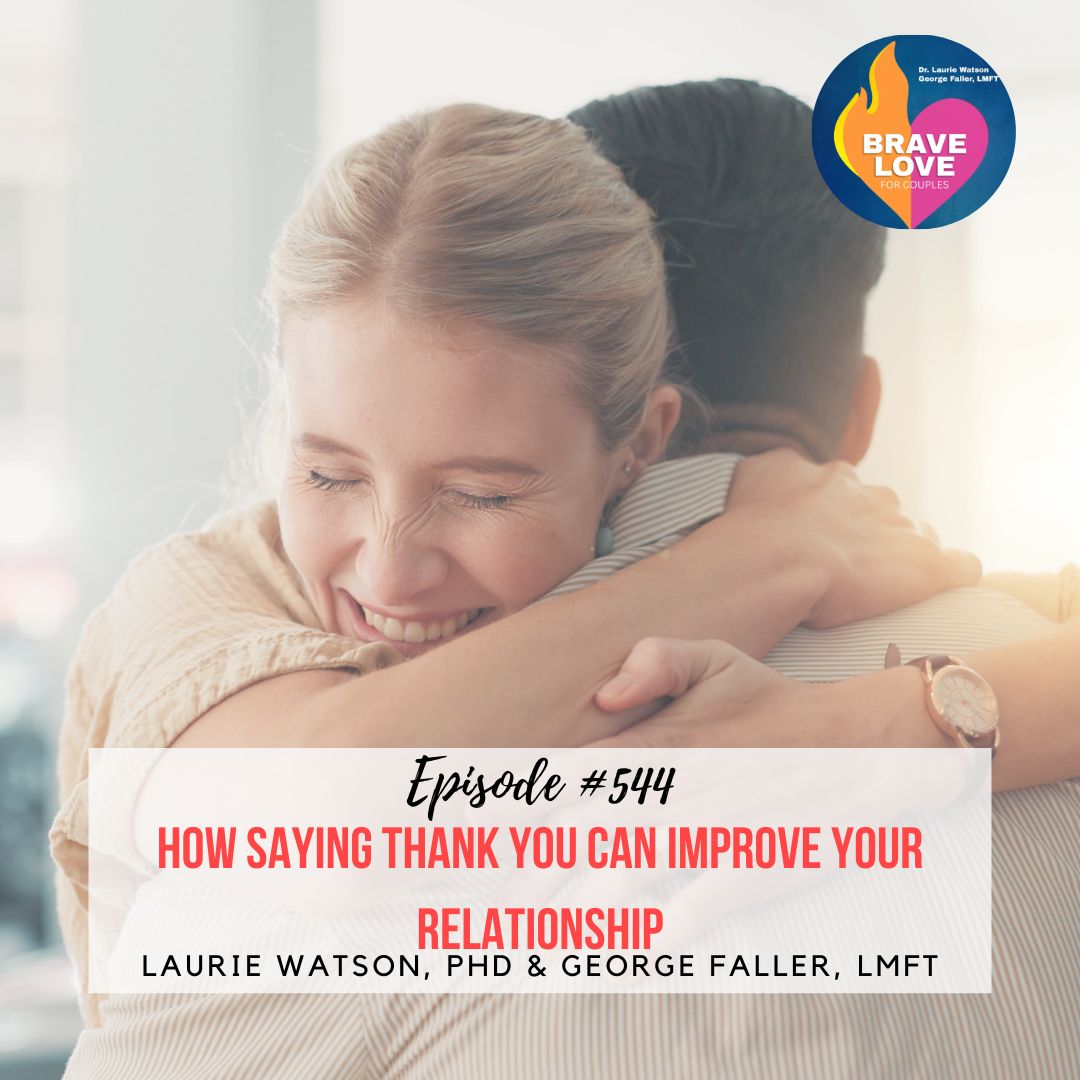
In today’s episode, we are talking to our Brave Lovers about the right way and wrong way to give thanks and appreciation to your partner. Saying ‘thank you’ has the opportunity to create closeness, connection and reinforce vulnerable expression. A casual, empty ‘thank you’ has the potential to disconnect, derail and seem like a dig.
Join us today as we walk you through the differences between thank yous and how to meaningfully show your partner appreciation especially when they are open with you. Thank yous, grow thank yous when they are working and bountiful appreciation in a couple relationship helps you buffer external storms. George and Laurie’s expert role play will guide you on getting ‘thank yous’ right in your relationship. Make sure to pre-order a copy of our book Brave Love, Great Sex for more on this!
Transcript
George (00:06.54)
A thank you is just a thank you, right, Laurie?
Laurie Watson, PhD (00:09.756)
Whoo, wham bam. Let’s talk about thank yous, the good and the bad, how it connects us or how it pushes us away.
George (00:20.366)
All right. Hello, everyone. Brave love, great sex. We’re getting closer and closer. Now we got to do all the publicity and excitement and create momentum. So kind of you’re our tried and true audience, our family, right? So we really appreciate all your support, spreading the word and just getting excited about this process of getting some really good information out there to people who desperately need it.
Laurie Watson, PhD (00:46.298)
Absolutely. Pup date, September 15th, book on sale right now. You can pre-order and that really helps us in September. So thanks so much. Okay, George, let’s talk about this. know, this how gratitude, how saying thank you, you know, can make a difference, right? It can strengthen our bond with our partner when they feel seen and valued.
But it can also reinforce distance if the way we say it is kind of a bad thank you, know, like that we actually perhaps let out our resentment or we’re just saying it perfunctorily, just saying it out of duty. There we go. Joe, help.
George (01:31.734)
Yes, that’s those empty thank yous and we get it so much in therapy. People do this great work and they finally get their need met and they’re like, thank you. And it’s like on to the next problem. Like, whoa, wait a second here. To really, really, a thank you is a good thank you, right? Is coming from a place of needs being met, of celebration, of really trying to install the positive. These are huge moments.
Laurie Watson, PhD (01:42.63)
Ha ha ha ha!
Laurie Watson, PhD (01:54.481)
Yeah.
George (01:59.532)
especially if we’ll take the time to kind of unpack them and give them the space they need to breathe instead of rushing onto the next.
Laurie Watson, PhD (02:07.013)
You know, I think that saying thank you is especially important when our partner has been vulnerable because that rewards the vulnerability with gratitude, with empathy, with appreciation. So that’s kind of what we coach people to do in session is when your partner finally comes forward with something that’s new to you and about the inside of their heart. We really want that to like you to take notice of that.
George (02:13.858)
Mm, yeah.
Laurie Watson, PhD (02:35.481)
And one way of taking notice is saying, you know, thank you. Thank you for sharing that with me. Even if perhaps it’s not the favorite thing to hear, if your partner is struggling to be vulnerable with you, a thank you is a way of reinforcing that they will want to open up to you in the future.
George (02:55.498)
Exactly. I mean, it could be either you’re receiving or you’re giving, but both sides need a thank you. And to me, that is what I’m trying to make explicit in my sessions to take the moment. If the thank you is coming from your own emotional system, that’s saying, yeah, I was nice, know, appreciate it. Not a lot to it.
Right. It’s very different than when we could reciprocate. Like you just gave me something, Laurie, that really made me feel good. And now this is my chance to give you back. Thank you. Thank you. Coming from our caregiving system that’s coming from a place that’s saying, like, you just changed my nervous system. We’re in a place I was alone. I now felt your presence and that shifted things that makes me feel good. And now I want to share this goodness with you. I want to know the power that your response has on me.
Right. I want to give you back a sense of feeling filled up, you know, so always feel like a real thank you is giving it’s like pouring out back to the person who’s just kind of giving you something.
Laurie Watson, PhD (03:56.304)
Right, it’s not just being polite. It’s saying, I get you. I take you in, right? And I’m so grateful for your ability to show me this part or to maybe be in tune with me, hearing me. I mean, all of that is so important to be thanked for.
George (04:21.538)
Yeah, I never used this language. So it’s always fun in the podcast to get more specific. But it’s like if it lets me Joey Maria, right? If if I, Joey, share this vulnerable place where I feel like I’m failing and I’m always alone and I want to be left alone because I don’t want people to think worse of me. So I hide these places and I take this brave risk and I say, yeah, you know, right before I walk away, I kind of feel like I’m failing, like I’m a loser.
I think Maria responds, go ahead Maria respond to that.
Laurie Watson, PhD (04:54.809)
Yeah, it’s like I get it. I get it that you’re you’re feeling this this deep shame kind of of who you are. And I’m so appreciative of you telling me about this. Thank you for sharing this because it really helps me understand you more deeply and what’s happening in those bad moments between us. I you know, I can make up all kinds of things, but I appreciate you kind of sharing. This is what you’re going through.
How’s that?
George (05:27.15)
That’s good.
Laurie Watson, PhD (05:27.983)
that make you feel valued, seen, like you matter to me, like we’re a team.
George (05:35.791)
Well, it’s you’re giving good care given, right? And, and now that Paul comes in my corner, right? Am I able to receive that care given? And if I am.
Laurie Watson, PhD (05:38.032)
Yep.
George (05:47.619)
then that thank you back is coming from now I get a chance to give care, give him back. If you think about Joey in this space, it’s like, I’m not alone. I’m having a little bit of success with this feeling. This person wants to know me there. Doesn’t want me to be alone, my partner. We’re kind of can face this dragon together instead of me facing it alone. Like that’s a big physiological shift of how we deal with anxiety and isolation or in relationship.
Laurie Watson, PhD (05:51.93)
Mm.
Laurie Watson, PhD (05:59.718)
Mm-hmm.
Laurie Watson, PhD (06:13.68)
Right.
George (06:13.74)
Right. So if I can take that in, if my body can feel a bit calmer instead of being alone, I have now have another nervous system to co-regulate. Like this is my chance now to help Joey put words to, you know, that shift. Can you kind of let let Maria know how important that is for you, how much her response means to you?
Laurie Watson, PhD (06:35.577)
Right. My thank you joins him. It honors his vulnerability. It comes over to his side of it. And now we want to know, can Joey accept her care, her caretaking of him, knowing that she does want to join him? Can he take it in and thank her back for her coming over to his side of the world?
George (06:59.594)
Exactly. Thank yous grow thank yous, right? When they’re working. And that’s where we’re for that momentum. That’s a positive, that’s the positive cycles. Nice. Yes, so let’s do it. Let’s now, let’s see how Joey could respond back with a genuine thank you that’s trying to appreciate the gift and give back to Maria who’s given to him.
Laurie Watson, PhD (07:05.31)
good little line. Good little social media line. Thank yous grow thank yous.
Laurie Watson, PhD (07:15.566)
Okay.
Laurie Watson, PhD (07:24.186)
Yeah.
Right, can he take it in? Let’s see.
George (07:30.74)
And if I can’t take it in, then that means it’s not the right time for a thank you. I’m going to have to work with mistrust and all that stuff. But in this case, let’s say I can take it. All right.
Laurie Watson, PhD (07:34.715)
Sure, Let’s show the good way first.
George (07:42.081)
So wow, Maria, that like, damn, that makes a difference. Like I can feel my stomach were usually intense, like just relax. And like I can’t believe the power of you coming towards me here. And like, I feel lighter and I just wanna thank you for that. mean, I never thought.
when I’m feeling so bad, I can actually feel this lightness. What a gift you’re able to give me. I mean, I am just blown away and so I have so much gratitude and it’s helping me also connect that like how you do this and a lot of other ways that I normally don’t pay attention to. But you try to come closer and grab my hand and it’s like, it’s like, feels like a new language I’m speaking here. Wow.
Laurie Watson, PhD (08:09.35)
Hmm.
Laurie Watson, PhD (08:23.601)
you
Laurie Watson, PhD (08:30.065)
Wow. That’s awesome, Joey. Thank you. Thank you for receiving my care, for listening to me, for believing me that I do care about you. You know, when I reach out for you, take your hand or even right now when I’m listening to you, sometimes I just feel like you, you’re so gruff. You just push all that stuff away. So I really appreciate this as something new between us.
George (08:59.968)
Nice. Thank you. Can you see how thank yous feed thank yous? Right now that Marie is telling me how much she appreciates it, you know, it makes me want to do another round of yeah, and I want to appreciate this more. I want to see these things I might normally miss. I like the way this is feeling.
Laurie Watson, PhD (09:01.007)
Yes, yes, you’re welcome.
Laurie Watson, PhD (09:13.989)
Mm. Mm-hmm.
Mm-hmm. Mm-hmm.
George (09:19.768)
Thank you for coming closer to me here. And again, we just get rounds of what we call in therapy. Thank yous that are trying to install positive emotion. It’s trying to grow islands of security, right? When needs are being met, we want to help people put words to that. They spend so much time putting words to when things are not working. I feel lonely. I feel sad. I feel rejected. How about we spend a lot of time.
Laurie Watson, PhD (09:36.891)
to us.
George (09:44.79)
when things are actually working. So people don’t think this is just magic and just like all the weather. It’s something that they do that leads to these feelings.
Laurie Watson, PhD (09:54.427)
Exactly.
Laurie Watson, PhD (09:58.194)
You know, I just went to a training with Sandra Taylor in Britain who did this whole thing on how we can kind of increase the positive emotions because we do spend a lot of time in our marriages, in our partnerships, focusing on what’s not working. And then when we have something that does work, it’s like we don’t blow it up in the same sort of way. And I think
This is just a mechanism to focus for a little bit on thanking from the heart, noticing vulnerability when it comes forward, noticing change, and then celebrating that with thanking your partner, showing gratitude, the hugs that come later. Sometimes when I’m working with a couple and they have a big moment that’s positive and
And there is that gratitude from the heart for the other one’s vulnerability. I actually will leave the room for a few minutes. I’ll go take a break, go to the bathroom, whatever, just so that they can have that moment alone and private to hold each other, hug, kiss, know, kind of come together. And I think you’re right. Noticing it, marking it changes the nervous system. You know, it’s terrible when you leave therapy and all you got is…
Yeah, we talked about all these problems and we feel just worn out, right?
George (11:25.262)
Yeah, I mean, we know our brains have a negativity bias. If we’re not intentional about about seizing the positives, then they’re to slip away. We’re to go back into kind of that yellow brain scanning. And this is when we get those green brains, it’s survival. But we get those green brains.
Laurie Watson, PhD (11:29.264)
That’s right.
Laurie Watson, PhD (11:36.943)
Yeah. It’s survival. It’s survival. We’re looking for this snake on the path. Go ahead. Go back.
George (11:45.511)
We want to get those, when we get those green brains, it’s really important to help people put words and gratitude. And we know this, we’ll talk about sexually when we come back from the break, like great lovers, just like people with great emotional bonds, they show a lot of gratitude, right? Cause they know how good it feels to get care given in places of need. So they’ve learned through practice that
Laurie Watson, PhD (12:00.753)
They do.
George (12:09.666)
This is how we celebrate it. And I think we need to learn from couples who have secure attachment. Like this is one of the key factors of secure attachment, the ability to express gratitude.
Laurie Watson, PhD (12:20.933)
Let’s come back after the break and talk about how this works in the sexual cycle.
Laurie Watson, PhD (12:28.891)
George, I had this couple that I was working with in an intensive and they kind of hit a new moment with each other. They had had sex, they weren’t completely blocked there, but things were needing to be changed. And one of the things that I noticed is that they didn’t really talk specifically about what they liked in bed. They had had, I mean, they’d been married for a long time, had had no conversation about this.
And this was where I paused them. I’m like, Whoa, listen, you guys, you’re saying things right now that you have not said ever to each other. That alone deserves something, right? It deserves you to notice this. And I asked them, can you thank each other for this specificity, this vulnerability, this new place that you are trusting each other with such deep erotic information?
And for them, they’re just kind of in the beginning, it’s a little deer in the head like, like what? Yeah, yeah. We’re so anxious doing this, we didn’t even realize that this is creating something good and positive and a new pathway between us.
George (13:44.567)
Yeah, and it’d be so easy if you don’t point that out and they’re intentional in trying to stretch it out that their brains mistrust will take them back into fears and worries and everything else. And we miss these moments, right? So really, I love that you were helpful in making them more intentional to say, hey, this is a big deal that you’re willing to.
have a conversation you’ve never had that you didn’t see your families have. Like this takes courage and bravery. What is wrong with taking a little bit of time to acknowledge that?
Laurie Watson, PhD (14:12.641)
Exactly.
Laurie Watson, PhD (14:17.527)
Exactly. And I think that especially in bed, right, I always say this is the place that you have to be the most careful because you’re going to be in bed with this person for a long, long time. It’s like this is the place that all of our good manners, all of everything that we’ve got needs to be online when we’re talking to each other. You know, as a pursuer, right, we can focus on
Okay, it’s been a while. Are we ever going to get into bad? And sometimes I think the thank you for a pursuer has to be, thank you for this moment. This was amazing. Rather than building on that. And then what happens? Or how can we make this better? Like that actually, those extra questions, that extra excitement kind of about the future diminishes the present moment, diminishes taking in.
the gift of sex right now. So as a pursuer, think biggest thing you can do in bed to foster the sense of success that your withdrawing partner has is saying, you know, that was awesome. Thank you so much for being with me. I loved being with you. Period. Put a period on that sentence.
George (15:37.177)
period. But notice that period again, that sentence is coming from caregiving in the moment. I love this experience. Thank you. That was amazing. Amazing is telling the other person the impact they’ve made on you. And so after you’re right pursuers go into that was amazing. You’ve never done that before you think you’d want to do more of that. And like before you know what we’re going into performance evaluation, critique, pressure, and all that stuff, which is about who
Laurie Watson, PhD (15:58.514)
And pressure and pressure.
Wait, wait.
George (16:06.988)
Right. It’s about the anxiety of the person that’s saying thank you. So it erases, it erases the thank you. It’s kind of like a, but right. It’s like, that was amazing, but you know, hopefully we can do more of it. And it’s like, when we introduce our own anxiety into it, it’s so different than keeping the focus on caregiving and actually giving to your partner.
Laurie Watson, PhD (16:12.231)
country.
Laurie Watson, PhD (16:29.919)
Can you hear me?
George (16:32.173)
Yes.
Laurie Watson, PhD (16:33.023)
Okay, and it’s all good? I just knocked the whole thing over. Okay, good. Sorry.
George (16:38.69)
That’s all right. I taught a good piece of what just keep rolling. Yeah.
Laurie Watson, PhD (16:41.373)
It just kept going. Okay, good. I’m glad it worked. Okay. Now I’m completely discapopulated. So what about the withdraw? How can we help the withdraw sort of give some reassurance, some gratitude when they’re like, okay, I’m the one who kind of had to be more vulnerable. I’m the one who had to give. Why would I be saying thank you?
George (16:48.66)
So that.
Laurie Watson, PhD (17:07.413)
I mean, certainly there’s fun things to say thank you for, right? Orgasm, touch. But how can we help the withdrawers see the gratitude?
George (17:21.134)
It gets the same gratitude is just an expression of needs being met, which roars have needs in this space too, right? So that they need to feel successful. Do they need to feel less pressure? Did like when those needs are met, how did they just genuinely say thank you? Like that was so different than what I typically experience or I was expecting. I’m expecting pressure. What is it like to not have pressure for a moment?
Can you just tap into the gratitude that says, know, the way we just did that was so easy. That felt so good. Thank you for just kind of just showing up in this space with me that allowed something new to emerge. You can feel that just sense of just calmness and elation that comes when needs are met.
Laurie Watson, PhD (17:49.013)
Jesus.
Laurie Watson, PhD (18:09.643)
I was talking with a withdraw, whose pursuer was present as well. And she was saying that, like for her, the space that she loves the most is morning sex because she wakes up, her body is already relaxed. You know, she has not yet, she said, I haven’t started the day in that machine where everything I need to get done gets going. I’m still kind of.
sleepy and relaxed. And I love to do it right then. But, you know, oftentimes we don’t have time. She called it, you know, you got nine minutes. It was a game they would ask each other, you got nine minutes. And that used to work for them when they were young. And now, you know, kind of exactly. I called it nine minutes in heaven, you know, just like, but she said,
George (18:55.874)
That’s three minutes longer than a lot of other couples, so not bad.
Laurie Watson, PhD (19:06.447)
For her, know, orgasm was possible, but it wasn’t always necessary. And that would hang him up a lot. Just like he was like, yeah, but I really want it to be good for you. And she was like, I really want to have sex during this time. I need you to hear me that this is my moment. This is like I can do this quite regularly, frankly. And I like it.
You know, I like it. And we had to work hard for him to be able to take that in because his brain was expecting her to say, I don’t want to have sex with you ever. That was the way he was primed. And so when she finally opens up and says, not only do I want to have sex with you, but I want to have it frequently. And this is the way I want to have it. And when I want to have it, you know, I mean, it was like this brand new great news. And
You know, we had to kind of convince him that it was okay to take that in, to say thank you. my gosh, she did so much work.
George (20:10.159)
That’s those moments of epiphany, those moments in session where you see something different, right? Where you see the cycle for the first time, instead of blaming each other, you start to blame the cycle. When you start to see the vulnerability underneath the protection, when you start to see these needs, like all of these are moments, what we call a reframe or a shift in meaning that really is an opportunity to install like the gratitude that’s that’s a shift away from the negative towards the positive.
Laurie Watson, PhD (20:37.503)
Yeah, and we really had to work at it to get him to take it in because he was primed to see the danger signals, to see the rejection, to believe that he wasn’t loved. And I would just say like some of it took her coming toward him, touching him. I she had to literally put her hand on his chest in order for him to start to feel anything because he was so numb in his chest.
George (20:38.551)
really being intentional.
George (20:49.657)
So.
George (20:56.452)
Yeah.
George (21:05.357)
That’s the main takeaway for me as I’m getting a little bit clearer talking about this. Can you, when you’re saying thank you, take a moment to say, where is this coming from? Is this thank you coming from my caregiving system that’s focused on my partner and just wants to pour out of me into them this love that I’m feeling? Or is this thank you really about me and me wanting to make a point about something? So let’s just give an example of that. want to.
Let’s be Joey and Maria. And I want to do a bad thank you, which is just a common thank you, right? It’s just a way of, making it more about me than you and see the difference between that and what we did earlier.
Laurie Watson, PhD (21:35.774)
Okay.
Okay.
Laurie Watson, PhD (21:43.679)
Okay, I want to show Maria being vulnerable and then get the bat. Thank you. How’s that?
George (21:49.283)
go.
Laurie Watson, PhD (21:52.113)
Okay, baby, I just want you to know, you know, I’ve been really stressed lately, but I do want to connect with you. I do really feel that. And if you can just be okay with me being with you instead of, I don’t know, having some big experience that that would really help me.
George (22:14.115)
Yeah, I just want to thank you for initiating talking about these things, because normally you don’t really talk about this stuff. And it would be helpful for me if we had more of these conversations, because it’s hard for me when we are not able to talk about this.
Laurie Watson, PhD (22:33.035)
So, so first it started out great. Joey was, it felt very genuine, like he was hearing her. But then he brought the pressure, right? The pursuer pressure, the complaint that we don’t have these conversations enough and I need to have them. Yeah. Okay. Let’s do it the right way.
George (22:53.143)
My thank you was more focused on me than on you. Right? That’s what kind of ones are happening. And that’s, that’s not great timing for the person who’s in a vulnerable spot. Like if you’re going to give a thank you, can your thank you stay focused on them? You could always get to you a little bit later on, inserting you in that moment is going to be bad timing.
Laurie Watson, PhD (22:57.535)
That’s right.
Laurie Watson, PhD (23:12.177)
Exactly, because it’s going to wind up feeling disingenuous, like you didn’t take it in and then put a period on it. So thank yous, especially if you’re a pursuer, think about it. You got to put a period on the end of that statement.
George (23:19.949)
Yeah. Take.
George (23:27.853)
Let’s do it quick. Let’s put a period on. Take two.
Laurie Watson, PhD (23:29.427)
Okay.
take two. Okay, so Joey, I’m really tired these days. I know we got to be together and I do want to be with you. I don’t know if you can hear that, but I just don’t want sex to be a really big deal. So can we can we just kind of come together and see what happens instead of, I don’t know, planning it and making it a big thing?
George (23:56.568)
Wow, yeah, I mean, thank you for that. Thank you for sharing. It feels so important that, you know, you’re standing up for you in a way that’s beautiful. And I want to know more about you. And I just I feel so much gratitude that you’re letting me in because I do want to know more. And there’s so much to you that’s deep and really cool.
Laurie Watson, PhD (24:22.795)
Great, So, up in bed?
George (24:26.863)
I’m gonna notice how I kept my focus on Maria. And I didn’t make anything about me. My thank you is really, this is a great opportunity. She’s let me in. This is what I’m looking for. How do I stay focused on the mission? Because my heart does appreciate this and I does want more of that. So if I train myself to just keep it focused on the person, it’s a lot easier to stay in this good thankful instead of the bad thankful.
Laurie Watson, PhD (24:44.201)
Sure,
Laurie Watson, PhD (24:55.115)
That sounds good. Can I just offer one little criticism? But when you were like, I do want to know your deep thoughts and stuff like that. I’m like, man, I’m still it’s like now I got to keep talking about it. I’m the withdraw. It’s like, I got to keep talking about it. You know, good enough. But I know that I know those with drawers out there heard that. So I just want to say, yeah, yeah. But he’s getting it. He’s getting it. Okay.
George (25:12.355)
Well, we’re striving for good enough, not perfection, right? Good enough.
Laurie Watson, PhD (25:24.299)
Put a period on it with the thank you, please let it come from your heart if you’re a pursuer. And if you’re a withdraw, you wanna take in the gift of vulnerability from your partner. And when you give the appreciation, it has to come with that sense of gratitude that connects you. This is good one, it’s tough.
George (25:49.549)
Yeah. Well, thanks for listening. Have brave love and.
Laurie Watson, PhD (25:54.107)
and great sex!