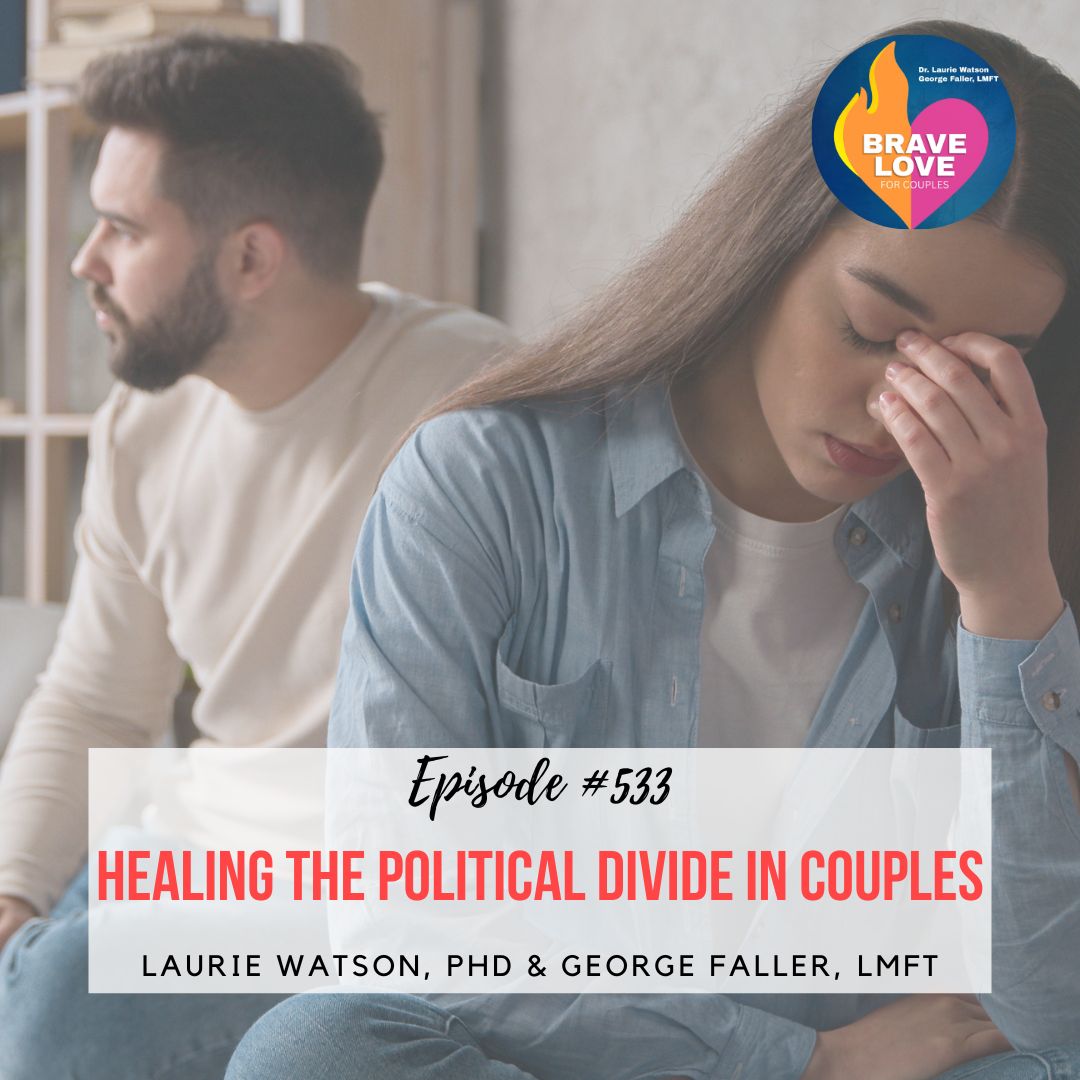
In today’s episode, we are joined by Dr. James Hawkins, certified EFT couples therapist and trainer from The Joshua Center in Arkansas. Listen in as we tackle the tough topic of how to bridge the current political divide in partnerships. We are seeing the effect of division rampant in relationships across the nation and we come together here to discuss why this is happening from an attachment lens and how we can begin to ease the tension.
Listeners will take away how the cycle shows up, attachment fears that drive deep seeded disconnection and actionable steps to start finding common ground. Our relationships are a great source of strength and we are far more alike than we are different. We hope you join us today in this important discussion and be brave in beginning to step closer to the ones you feel far away from.
You can find Dr. Hawkins online at www.dochawklpc.com and on Instagram at @doc_hawk_lpc where he discusses more on these topics!
Check out this episode’s sponsor (and help the pod!):
Uberlube.com — Laurie’s favorite personal lubricant!
Transcript
George (00:26.226)
Let’s talk about what we’re not supposed to talk about, politics and how politics have become an attachment threat in the household.
Laurie Watson, PhD (00:36.824)
Yep. This is a tough subject right now, and we are joined by Dr. James Hawkins. He’s one of our respected colleague of ours, and he’s a relational expert. He’s a trainer in EFT. He works at the Joshua Center in Arkansas, and he really helps both individuals and couples build stronger, more secure connections. And part of his heart, why he comes to us today, is to heal.
George (00:43.912)
Thank you.
Laurie Watson, PhD (01:04.368)
really the world and the way that we approach our certain differences in politics and give us a way to do this with vulnerability and hearing each other in a new way. So James, thank you so much for being here. Appreciate it.
James Hawkins (01:24.846)
Yeah, thank y’all. It’s an honor. know, I appreciate, you know, I want to give y’all just to know your flowers, but I appreciate your bravery to lean into this because I’ve thought about this and how do we facilitate this conversation. So I’m just, I’m just once again, proud of y’all for being a brave space. Look at that, making a play on your new name now, right? For just being a brave space to have courageous conversations. So, cool.
Laurie Watson, PhD (01:43.429)
Yeah.
Thank you. Thank you. Yeah, exactly.
George (01:50.276)
It’s pretty tragic and we’re all couples therapists who are trained to hold multiple truths and to be a bridge and help people kind of find and tap into kind of these deeper needs that are pretty universal in all of us. And yet we see a topic like this literally so polarized that it’s breaking down families against many couples that actually people are breaking up over kind of this. shows just what a hot.
Laurie Watson, PhD (02:10.79)
Yeah.
James Hawkins (02:11.214)
Yeah.
George (02:17.648)
topic, you know, how tied it is to our values. So let’s dive in.
Laurie Watson, PhD (02:20.11)
Yeah. I remember George, you know, fairly long ago said, you know, I’d love to sit with Trump and Hillary Clinton and just work with them, you know, and it’s like, I don’t know if you still feel that way, George, if you could do that in this hot climate or not.
James Hawkins (02:29.355)
Yeah.
George (02:34.632)
I still do. wrote about that in true connection. And, you know, we have to have a target of what it would look like being able to repair. mean, that’s what’s really, this is James’s line of entering the fray, right? The acronym for a failed repair attempt yet again, that’s basically this space. People keep having the same failed conversation over and over and over again. Nobody’s listening to each other, hearing each other, feel frustrated, shut out.
James Hawkins (02:38.787)
Yes.
Laurie Watson, PhD (02:39.437)
it.
James Hawkins (02:47.244)
Hmm.
George (03:04.392)
And you know, we know what negative cycles do and your negative cycles have taken over the space.
Laurie Watson, PhD (03:08.73)
Yeah, yeah.
James Hawkins (03:09.346)
Yeah. Yeah.
Laurie Watson, PhD (03:12.56)
I guess I am at.
James Hawkins (03:12.94)
And I don’t want to be trite here, but like I like that George, because what happens is we keep looking at it as I’m bad, you’re bad, we’re bad. And no one’s saying the cycle we get caught in, that’s what’s bad. Cause I think it takes people who probably hold their positions for very good reasons. If we can get down to it and explore, there’s probably the underlying longing and hope is beautiful and probably something in common. But today in the climate we live in is our bodies can’t
take the threat of hearing you out to hear your longing, we have to kick it out. then good, like as George would say, right, good intentions don’t convey in the negative cycle. And then we just end up seeing each other as like monsters and horrible. And if I give over to your position, it’s going to lead to the end of the world or it’s going to lead to the end of existence of people I love and care about.
Laurie Watson, PhD (04:01.634)
Exactly. I mean, I think for many of us, there is like this, you know, deep fear when we think about the other side’s position, you know, deep, deep fear of annihilation for either side, right? Annihilation in some way. So we can’t listen. We can’t even get curious about why do you feel that way? And I, what I imagine like,
the best conversation would be, okay, what do you feel? Why do you feel? But also knowing that person well enough underneath to know why this threat hits them individually. Like what in their history, what in their being, right? What’s the underlying issue for them that they’re holding this so stridently?
James Hawkins (04:44.256)
Ooh.
James Hawkins (04:52.91)
Yes, that’s good, doc, because it does. is something, too. It’s almost like how we do when we do the whole tempo part. So help take me in. What is it that makes this thing so valuable to you? How did it become so personal? Because it is an attachment thing. For all of us, we think about, you ask people about some of their political affiliations. Because let me even say this, too. Because people, think the word politics is so triggering. And it brings up a big picture.
Laurie Watson, PhD (05:08.165)
Yeah.
James Hawkins (05:20.642)
But I was talking to a friend and mentor the other day, he’s a James. He says, you know, we talk about politics and we think about the content and things that we see on the news. But he says, actually, if you break politics down to its essence, it’s about a conveyance of values. So what we’re really talking about here is, is can people talk about what they value, what they’re concerned about, what they want for the world. That conversation feels a little bit different even for me, just to switch from the word politics to values feels different.
Laurie Watson, PhD (05:20.655)
Right.
Laurie Watson, PhD (05:40.932)
Yeah, exactly.
Laurie Watson, PhD (05:49.456)
Mm-hmm. Mm-hmm.
James Hawkins (05:50.606)
Because if I want to go into it, because I think when we say the word politics, what comes up for me is everything also that’s loaded into outside the couple system. So I think when you say politics, now you start seeing political figures, see headline news, you see all the things that you see on Facebook. And now what it feels like is like you have maybe the see.
Laurie Watson, PhD (06:00.314)
Yeah.
James Hawkins (06:13.974)
in a romantic relationship, you might have two or three people, whatever, but then you have all these outside forces and entities that have now, in a way, been brought into the emotional bond and in some ways into the sexual bond because you’re carrying all those other systems now in, in the representations. then, but we’re talking about the representations, but we’re not talking about the value. It makes me think about George’s Irish proverb, right? Everybody talks about the drinking, but not the thirst.
Laurie Watson, PhD (06:24.283)
Mm-hmm.
Laurie Watson, PhD (06:36.367)
Yeah.
James Hawkins (06:42.158)
So we could not, and I hate to say these names right now, but like, I’m not trying to be triggered, but I just want to like load the moment. You know, people talk about Trump, but then let’s talk about the value or whatever the thing is, right? We could talk about Kamala or Biden or whomever, but then, like, what is it though? Is it just about them? Or, what I want to hear, what’s your value? I don’t want to just hear about your person, but what is your value? What’s your hope? What’s your fear? What’s your concern? I want to hear you, my person in front of me.
Laurie Watson, PhD (07:05.926)
Mm, mm.
James Hawkins (07:09.582)
And couples can’t have that conversation because not only am I talking to you, but what about all those people that you now feel like to me you represent? Now I’m arguing with them through you and I’m not even talking to the person I love anymore. I’m talking to the people I hate and that I’m afraid of.
Laurie Watson, PhD (07:18.02)
Mmm.
Mm. Mm-hmm. Mm.
George (07:25.682)
when I set up these conversations and I can think about in my relate, my son has a different political party than I do, right? So we have this dynamics in my family, just like all families have some form of dynamics, right? And I love that you said, like be curious, what are your values? But for me to be curious about my son’s values, I actually have to pause my own values.
I think that’s the hardest thing to do. Right. It’s like, I start hearing something that he says that hits my values. And then I immediately interrupt to try to kind of explain to him my values. And, know, there’s no caregiving system being brought into these conversations. Both sides are activated and trying to, you know, threatened and wanting to be heard. And no one’s wanting to be heard. So really add in structure to these conversations. Like if you’re going to ask somebody a question about their values, you got to like walk over that bridge.
James Hawkins (07:51.381)
Oof.
James Hawkins (08:04.396)
yes, George.
Laurie Watson, PhD (08:09.99)
Mm. Mm-hmm.
George (08:19.964)
keep the focus on them for a couple of minutes so they can answer that question so you can get to know them better. And I find to do that, you really got to do the work of holding your own stuff.
Laurie Watson, PhD (08:28.865)
Mm-hmm. Mm-hmm.
James Hawkins (08:30.19)
And by the way, the good thing in that George what I think happens to people with the best of intentions is You have to know who you are first and what you bring into the conversation That’s the key part is are you even clear about your values? But also how do you know your tells when maybe you feel threatened in your values and That’s okay. And the reason why you need to know that is so that way you can take some pause on some autonomy
Laurie Watson, PhD (08:52.356)
Mm-hmm.
James Hawkins (08:58.88)
and empowerment over self. I think in this conversation, even me, even though I can talk about it nicely with you all, sometimes I feel my body get hijacked and my brain gets hijacked and I go primal because I see a threat that needs to be addressed. But what I don’t see is I label my partner as a threat, but George, you did something, but like, hold on, hold on. This is a value of mine that got disturbed and it’s okay. It just because they have a difference of opinion doesn’t mean I lose my existence.
I think that’s what really gets triggering people is if I allow space for what you’re saying, it’s putting my very, whether they know it or not, in their brain, I think the emotional center of their brain gets hijacked and they feel like they’re about to be annihilated if they let the other thing exist.
George (09:47.305)
I’m laughing because I know my self. I get louder in the conversation. My son tells me, he’s like, dad, just because you get louder, it doesn’t mean you’re making your point clearer. I’m like, that’s pretty good. Yeah, that’s pretty good awareness of part of why we get threatened when I wind up doing.
Laurie Watson, PhD (10:03.462)
That’s lovely.
James Hawkins (10:04.343)
gosh, I need to see that. I need watch George with his voice and hear like some of George reflect it back to him. That’s good.
Laurie Watson, PhD (10:10.207)
Mm-hmm. Mm-hmm. Yeah, that… using your own words against you.
George (10:10.523)
Yeah.
James Hawkins (10:16.974)
Me and Dr. Watson, we want to sit back and eat some popcorn and watch this.
Laurie Watson, PhD (10:22.886)
For sure. It’s hard though, right? When somebody we love is so radically different. I think your question of taking it personally, what do you value? You know, versus arguing about the state of the union. You know, I think for me, the ugliness of the conversation really on both sides of the aisle.
James Hawkins (10:38.222)
Mm-hmm.
James Hawkins (10:42.402)
Mmm.
James Hawkins (10:50.606)
Mmm.
Laurie Watson, PhD (10:51.49)
name calling, denigrating of people, know, designating groups as less than the other group. I just, that triggers me so much. And I, you know, I have heard it in my party and, you know, I’m not saying only one party’s doing it. I think both parties are doing it. But inside, I’m,
James Hawkins (10:57.39)
Mmm.
Laurie Watson, PhD (11:19.992)
I really am experiencing a great deal of fear right now, just a great deal of fear. And I feel extremely powerless and helpless. I don’t really know what to do about this. And sometimes I don’t really talk to many people about it. I post a few things on Facebook when I get really mad.
James Hawkins (11:30.945)
Hmm.
Laurie Watson, PhD (11:48.87)
You know, and I know that that doesn’t, I mean, that doesn’t really help many people. I have a couple of running conversations with some of my Facebook friends. One of them is very different than I am. And I really know her. You I love this woman. And I’ve known her for most of my life. And she feels very differently. And I do deeply understand her value. And for whatever reason, we have harsh words
together, but we remain respectful of each other. And we privately send loving messages to each other, like, how’s your family? All this stuff. I don’t know. And I think some of it is probably maybe it’s even more her than me, but she’s open. And she says to me, you’re the only one who will talk to me about it.
James Hawkins (12:43.002)
Mm-hmm. Yeah, you know, here’s the one of the things I want you, so, yeah, I think I need to make this point clear. Not only do I think, I want couples, because I know that’s part of our focus here is to help couples in this, but I think I also want the couple as a unit or the relationship as a unit to recognize they’re also caught up in a cycle beyond themselves. Because I think the current climate right now,
the way it’s positioned, it feels like on both sides, this is the part that really breaks my heart, maybe concerns me here in this moment. It feels like it’s okay to have your values and your views, but also here’s the concern even within camps is I feel like people are punished if they in any way deviate from the group that they’re a part of. That’s what concerns me that becomes dangerous. Cause now even in each camp,
Laurie Watson, PhD (13:32.855)
Mm, for sure.
James Hawkins (13:38.808)
to say, hey, I was having this conversation with this person, they made this point or whatever. And then even the in group will punish you, but we think this and we do this and we do that. And then even the person now, while they’re trying to connect to their partner, they have this other entity and group that’s telling them you’re doing something wrong, you’re doing something bad by even listening to them and hearing this. So people like now they’re so like, where do I belong? Where do I find safety? I wanna be with my partner.
I mean, I’ve even heard this from somebody. said like, me and my partner outside of politics, man, we were friends, we were close. But then when all this political stuff came up, I feel like I lost my best friend because I wanted to, I’m struggling with some of these things and maybe some of my views are evolving and changing, but now I’m hearing how my partner rages at the TV. So now I know my body says I can’t go there. I can’t talk to them because look at how mad they are.
Laurie Watson, PhD (14:27.568)
Mm-hmm.
James Hawkins (14:37.592)
So now I’ve lost the person who would be, because think about this, also I want to frame this, it’s not all bad. Do realize, I remember when I was doing my PhD, one of the assessments I used to evaluate, it was called the Pairs Assessment. And in the Pairs Assessment, they wanted to evaluate all these five different forms of intimacy. And one of them was intellectual intimacy. And it’s the intimacy of being able to talk about your worldviews and what shapes you and what moves you. That’s a very enrich…
Laurie Watson, PhD (14:37.71)
Yeah, exactly.
Laurie Watson, PhD (14:50.909)
Mm Yeah.
Laurie Watson, PhD (14:56.164)
Right.
Laurie Watson, PhD (15:01.414)
share ideas.
Right? Right.
James Hawkins (15:06.2)
thing for a couple that could be by the way, couldn’t that be sexy and erotic, right? I think Emily Nogatski talks about that in her book, like, for her to talk about some of these ideas and research that she’s doing, it gets her and when her partner can join in with that, it gets her going, right? Exactly.
Laurie Watson, PhD (15:09.817)
Yeah.
Laurie Watson, PhD (15:19.844)
It’s exciting. It’s exciting. want to go back to something that you were talking about. I think it’s so important, James. Yeah, sure.
George (15:26.758)
Laurie, can we take a break and come back and do this?
We’re on 15 minutes, so let’s just bring it in now. All right.
Laurie Watson, PhD (15:35.406)
Okay. To help Joe, let’s do that. Okay, James, this is so great. Let’s take a minute. We gotta get our sponsors here, who we’re so grateful for, and then let’s come right back.
James Hawkins (15:49.742)
Hmm.
Laurie Watson, PhD (15:52.934)
James, I want to say something that you were talking about, it really struck something in me. And that’s both the nuance of who we are even within a group, right? That we have, maybe we don’t swallow everything hook, line and sinker, that we actually have differences with our own party. But what happens, right, is this broad stroke. It’s like, you are this, therefore,
James Hawkins (16:05.602)
Mm-hmm.
James Hawkins (16:14.392)
Mm-hmm.
Laurie Watson, PhD (16:22.626)
I believe you think all these things and we generalize what we know of the group and we project that onto the person who is different than us. You think all these things, therefore you’re just like them. And I think this is the root. This is the root of many bad things. It’s the root of racism, right? We see a color of a person and we generalize and say, this is who you are. It’s like,
James Hawkins (16:33.344)
Yep.
James Hawkins (16:42.286)
Mmm.
Laurie Watson, PhD (16:50.54)
Our brain does this for important reasons. We want to be efficient. And so we like think about things and we generalize experiences. That’s what makes it so difficult, I think, as couples to come together. We know in the cycle that.
Laurie Watson, PhD (17:09.796)
we know in the cycle because they’re generalizing all their past experiences with their partner, putting them in kind of one box that says this is how you behave, completely forgetting about the exceptions, right? The way that, okay.
James Hawkins (17:22.979)
huh.
George (17:26.376)
Finished, Marika.
Laurie Watson, PhD (17:28.036)
Yeah, completely forgetting about the exceptions. Go, George.
George (17:32.849)
I really want to, I like James that felt a little different. know, there’s so much emphasis on the other side and what the other side has to do differently, but really the pressure within the party to conform. there is no, that punishment and the canceling that happens if you don’t agree, right, really causes the rigidity within that party. It has so much focus on the other party, but how does within parties people actually
Laurie Watson, PhD (17:47.684)
Mm-hmm.
George (18:02.458)
encourage more flexibility. Like that’s how we grow anyway. that’s what’s absent in both parties. There is an encouragement for a lot of range within the party. That’s even worse than what the other party’s doing. What’s happening within the parties. I love that James and you’re kind of putting words that I haven’t thought about it that as much.
Laurie Watson, PhD (18:11.918)
Right, right.
Laurie Watson, PhD (18:16.261)
right.
James Hawkins (18:21.23)
And it’s dangerous because what you just said, and I love what Dr. Watson’s saying, what you’re saying, George, because it can feel like people get stuck in this cycle of conform and cancel. Conform and cancel. Conform to us, cancel them. Conform to us, cancel them. And I know people might not like to hear it this way, but I do feel that that’s what’s plaguing, particularly right now in the American political system. And now I can say that very pejoratively and judgmentally, but here’s also the human part of it.
Laurie Watson, PhD (18:22.563)
It’s dangerous.
Laurie Watson, PhD (18:32.324)
Yep. Conform and cancel.
James Hawkins (18:51.138)
because everybody’s trying to find, well, maybe this is where I have a bias, but I’ll say this. I think many of us as people, we’re just trying to find safety. That’s what the main part. We’re trying to find safety and make sure that, and I think many of the people I see on, matter politically, and I think they’re also trying to make the world a better place. I really believe that. Even with the people I disagree, I can see underneath like, you want to feel safe.
Laurie Watson, PhD (18:59.76)
Mm-hmm. Mm-hmm.
Laurie Watson, PhD (19:12.038)
Sure, sure.
James Hawkins (19:18.638)
And you want the people that you love and care about to feel safe. And you want to see the world flourish. we just, just the parties have a different way. But then it’s like, so conform to us and cancel them. And that’s the only way it can happen. So I have to lose myself and destroy you in order to somehow find safety in existence. our body, and our body and our brains know it’s not true, but none of us, think we don’t feel brave enough to say it doesn’t have to be this way.
Laurie Watson, PhD (19:21.83)
Hmm.
Laurie Watson, PhD (19:31.396)
Mm-hmm.
Laurie Watson, PhD (19:37.624)
and belonging, right?
Laurie Watson, PhD (19:46.842)
Right, if we can.
James Hawkins (19:46.926)
Because everything we’re out, it has to be this way.
Laurie Watson, PhD (19:49.816)
If we conform and cancel, we belong somewhere. There’s a very powerful need in humans to belong to something bigger than themselves. And this gives us a sense of identity where we’re safe in a herd. And to be a little different in your own herd is your own herd may reject you too. You’re already worried that the other herd doesn’t see you.
James Hawkins (19:54.69)
Yeah. Yeah.
James Hawkins (20:02.733)
Yes.
James Hawkins (20:14.99)
That’s right, exactly.
Laurie Watson, PhD (20:18.414)
let alone your own herd. how can we talk in any sort of nuanced way that, yeah, I hear you, James, such an important point.
James Hawkins (20:24.181)
Exactly.
James Hawkins (20:28.182)
And doctor, I love how you even said that. Even the way you said it, it sounded like as you were just, you were telling something that was the truth, but I could feel the sadness and then the grief. Like this is a cycle. This is a cycle you all. And I want to sit like, and maybe I’m this person. Sometimes I get frustrated and you know what it comes down to for me, it’s not even an ally. I want to blow the whole system up. This is as it is. It’s not working. And I’m like,
Laurie Watson, PhD (20:52.28)
It’s not working.
James Hawkins (20:53.678)
Fool me once, shame on me, fool me. You know, like, no, this isn’t, maybe that’s just where I get, that’s where my kind of like attachment, fears and protection goes up. It’s like, blow the whole thing up, it ain’t working. And I wanna go to one more part about identity. And I’m not trying to mention, I just wanna give people credit, somebody I look up to in this conversation, his name is Justin Gibbony, and he runs, I don’t know what it is, an organization, it’s called the Ann Campaign. And let me just be clear about this route, like for Justin Gibbony,
Laurie Watson, PhD (20:59.046)
Mm-hmm.
Laurie Watson, PhD (21:06.905)
Okay.
Laurie Watson, PhD (21:18.458)
Mm-hmm.
James Hawkins (21:22.028)
He’s coming at it as a black man who is informed for him. He’s informed by a Christian worldview for him personally. But I like this point that Justin Gibbeney makes. He would say, he says, I am not a Democrat. He says, I I choose not to let it become my identity because if I make it my identity, then the party no longer has to work for me. Because think about it. Think about the human science. The moment you say I am, now it’s personal.
Laurie Watson, PhD (21:28.803)
Okay.
Laurie Watson, PhD (21:43.238)
James Hawkins (21:50.198)
And now for anybody to make a comment, you’re talking about me. You’re not talking about, and he says, it should be a tool. He says, the parties are a tool that I use, but they are not who I am. Because at that moment, because they are a tool, all of them can be questioned. Even when I exist within the group, the group can be questioned because you’re just a tool. You’re not who I am. And so what’s happening, I think to couples is, this is who I am.
Laurie Watson, PhD (21:52.558)
Mm-hmm.
Laurie Watson, PhD (22:01.455)
Mm. Mm-hmm. Mm.
Laurie Watson, PhD (22:08.036)
Mm-hmm.
Mm-hmm.
Very wise, very wise.
James Hawkins (22:19.67)
It’s not what I value, it’s who I am. And I know that could be a very fine line and something sensitive there, but it makes it different when it’s like, want to talk about what you value. I’m not trying to threaten who you are. Right? I want to hear about what you’re thinking.
Laurie Watson, PhD (22:20.037)
Yeah.
Yeah.
Laurie Watson, PhD (22:26.736)
Yeah.
Laurie Watson, PhD (22:32.162)
Mm-hmm. Mm-hmm. So beautiful. Wow. So beautiful. Because now we can talk about what do we need? What do we want? What are we voting for? Not, vote this way because I am this way. That puts ourselves in a box. Right? Yeah. Yeah. Yeah.
James Hawkins (22:43.734)
Yeah. Yeah.
James Hawkins (22:48.512)
Yeah. Yeah. Yes, exactly. You nailed it, Lori. Right? Like, yes, I’m a black man and I know historically the black people vote Democrat and all this, but hey, you know, if I’m going be honest as a black man, I feel at times I’ve been betrayed by both parties, if you’re being honest. Right? Because if you go, I mean, I know some people might feel hard about that, but go do the history. Like, you know, like both parties at some ways have not done well on the racial conversation.
Laurie Watson, PhD (23:05.158)
Sure. Sure. Yes.
Laurie Watson, PhD (23:11.876)
Yep. Yep.
Laurie Watson, PhD (23:17.942)
Absolutely. Absolutely.
James Hawkins (23:18.37)
and they’ve been on the wrong side. Even though I hate when both parties want to pretend like it’s not true.
Laurie Watson, PhD (23:24.654)
Yeah, yeah, no, I can see that. Yeah, I mean, I, you know, I live in North Carolina, you know, which is a state where we’re deeply concerned with racial harmony, you know, even in my own clinic. And, you know, we we work hard here. We have one day a month that we have a discussion on cultural humility, trying to understand each other. It’s a difficult conversation.
We started out with a bang and it was very difficult. But we’re trying. We’re trying to understand each other, trying to work because we’re the healers in our state, right? And if we can’t talk and be together and understand each other, how are we gonna heal people, couples who are so divided, people who are broken from our system, who are hurt by our system?
James Hawkins (24:03.95)
Hmm. Hmm.
Laurie Watson, PhD (24:18.106)
you know, how can we understand them if we can’t even talk about it with each other? I, yeah, tough.
George (24:25.988)
It’s helpful for me to, to globalize it sometimes. And, you know, this isn’t an American problem. mean, we, James, sometimes I want to blow this up, but everywhere I go on a planet, there’s a form of this happening in every single country. Right. And we also have to appreciate some of these issues are complex and they’re good reasons, abortion, immigrate. You take them all. They’re not easy solutions. They’re complicated solutions. And people on both sides really have.
James Hawkins (24:33.166)
Yeah.
James Hawkins (24:39.886)
and
James Hawkins (24:46.318)
That’s right.
George (24:54.758)
valid points, you know, when there is a respect and there’s not even room to discuss these things within your own party, like how the hell are we ever going to get there? So, know, I love Lori that, you know, there are a lot of people pushing like we’re trying to do to at least have a conversation. My experience when you have a conversation, especially with people that have different viewpoints, you feel a bit safer.
Laurie Watson, PhD (25:04.592)
Right. Right.
James Hawkins (25:05.698)
Right.
George (25:20.636)
You know, you start to recognize, Hey, you know, we’re both struggling with this. Those common themes underneath that we’re not feeling safe, our values are threatened, the longings for something better are there. I mean, I think there’s so much more and that’s not being cliche that kind of unites us, but there’s no space for that really to come out. It does bug me when people hate each other and all of a they’re waving a flag, like we’re supposed to be united. Meanwhile, you haven’t lived a life or had conversations that actually express those values.
Laurie Watson, PhD (25:30.867)
Mm-hmm.
James Hawkins (25:39.679)
me.
James Hawkins (25:48.14)
That’s right. And I think that’s why we get stuck. Because I even like, I think about this, I can sum it like with the EFT process. And also I like the quote from Emily Nagowski’s book, Coming Together, about for her, like what is, I think she said, the best predictor of sexual intimacy is does the couple have a context where they can talk about pleasure together? She didn’t get to talk about, tell me how, about the quality of their sex or tell me about this. She’s like,
Laurie Watson, PhD (25:49.37)
Yep. Yep.
James Hawkins (26:17.304)
Can they have the conversation? And I think that’s what’s broken down for us is we can’t really arrive at good solutions or sustained unified solutions because the most important element has been removed is conversation and how that ties to the EFT process. Think about what we do in stage one. We provide some level of stabilization to say, hey, we got to enter the chaos, calm the chaos, start trying to access some of the underlying emotion that people have disowned. Then in stage two,
Laurie Watson, PhD (26:30.608)
Yeah.
James Hawkins (26:46.69)
We restructure the bond to say, hey, I need you to not just pull away and shut down, but can you come in and can you engage? And can you soften in some of your pursuit? Then now, because we’ve restructured that bond and we’re not stuck in just a negative cycle, we’ve now created a positive cycle where there is some hope, where people can come forward with their fears and their longings. Then in the last eight, now we start talking about solutions. But you see, just going back to what George said, we had to set the context where the conversation can happen.
Laurie Watson, PhD (27:06.404)
Yeah.
Right.
James Hawkins (27:14.772)
now we can start talking about solutions. And many of these things, we’re trying to solve things without any sense of understanding. And we’re trying to do it in chaos. And the conversation goes off that then sends us all the way retreating into our protection.
Laurie Watson, PhD (27:16.911)
Yeah.
Laurie Watson, PhD (27:28.004)
Yep. I want to just offer for our couples out there, you know, some points of how hard it is, we know, when you’re divided, a house divided, you know, maybe it’s not even always just your partner, maybe it’s your kids too, right? But we have to remember that the argument is not the enemy, that disconnection is the enemy, and that what we’re really fighting about is safety, identity, and belonging.
James Hawkins (27:40.686)
Yeah.
Laurie Watson, PhD (27:56.95)
And I think that beneath all these political positions is the attachment fear, right? And underneath those fears are, the world safe? The world doesn’t feel safe to me, or people like me don’t matter. My values, things that are important to me, are disappearing. And my way of life is under threat. So those are attachment fears. And I would say it’s like,
James Hawkins (28:12.142)
Mmm.
James Hawkins (28:17.102)
Mmm.
Laurie Watson, PhD (28:26.552)
try not to turn political difference into like being rejected. You know, I can disagree with your view, but I can respect who you are. That’s where we want to land. you know, this is just, we know this is a cycle. It’s the pursuit withdrawal cycle. You know, when we say, I don’t want to talk about it, the pursuer hears, you don’t care about me. And the withdraw is thinking, I can’t say anything right to you. I’m going to set you off and we’re going to be disconnected.
James Hawkins (28:45.356)
And I think it is important that.
James Hawkins (28:49.678)
That’s right.
Laurie Watson, PhD (28:56.038)
I’ve lived that one.
George (28:56.816)
And our leaders, unfortunately, have failed us. What they’ve done is they’ve encouraged us to become more defensive. Imagine being a couples therapist and saying, continue to be angry. Don’t engage. Don’t talk to, mean, the encouragement to stay in defenses. It’s impossible to get to what’s really at the heart of the problem. Right? So we need better leadership. That’s why conversations, I just want to give a shout out to an organization, Braver Angels.
James Hawkins (29:01.262)
Yeah.
George (29:26.29)
that are all about facilitating conversations between parties. We need more of that leadership. We need more like therapist leadership out there that’s saying, wait a second, let’s have a conversation. Let’s try to take turns listening. Both people have good reasons for these values. We need to give the space and hold back those defenses instead of just people-legging people who make their living driving the defensiveness and divides.
Laurie Watson, PhD (29:46.63)
Yeah.
Laurie Watson, PhD (29:53.454)
Right. And James, aren’t you involved in a conversation in an organization on racism?
James Hawkins (30:00.0)
Yeah, it’s not super formal, but there was a time and shout out to Sue Johnson for sure, George, Ryan, they walked with me and many other people as well. Sorry if I don’t say your name, just forgive me. But yeah, it was called Healing Conversations and we’ll be doing another round of it actually in Baton Rouge, Louisiana. But it’s just a way to say how do we help equip people to have these kinds of conversations? And it’s just pretty much what we do in EFT.
Laurie Watson, PhD (30:09.594)
Mm-hmm.
Laurie Watson, PhD (30:21.414)
knives.
James Hawkins (30:29.558)
I try to help people see the cycle they get stuck in. I want them to see how what they bring into that cycle. And I remember one time me and George did a podcast together where we, we switched places and I had to sit and think about his position. And I looked George in the eye and said, Hey, so George, think this is what you’re seeing. I think this is what you’re concerned about. And when you see this and this is how you feel, this is what it makes you do. Am I getting that right? And then George reverses it around. That’s a humbling thing.
Laurie Watson, PhD (30:53.178)
Mm-hmm.
George (30:58.589)
Mm.
James Hawkins (30:58.626)
That’s hard. Think about that.
Laurie Watson, PhD (30:59.042)
It is. George and I do role plays all the time and we’re often taking different positions. It is hard. And I love that you guys did that. Yeah.
James Hawkins (31:05.934)
I’m not in this political conversation though. How hard is that to say? Because you’re, just think about that. Because if your brain says, I can’t do that, then that tells you, you probably really have not empathized and taken it in. Like, can you really look at the person and say, I think I see what you’re saying. I think I hear what you’re feeling. Am I understanding you?
Laurie Watson, PhD (31:17.21)
Yeah, I’m guilty here.
Laurie Watson, PhD (31:24.142)
Yeah, yeah, beautiful, beautiful. And we’re going to put the links to these organizations on our episode. But again, when is this occurring in Baton Rouge? James, can I be invited?
George (31:28.114)
that.
James Hawkins (31:36.714)
gosh, well, I’m sorry, you can’t really, because nobody, it’s a closed event. Cause it’s a few, I won’t even call them out. And I really appreciate what they’re doing. It’s it’s clergy, it’s some political officials. They all got together and said, we need help with this. We need to be able to do this. But hey, it could be coming to an area near you sooner or later.
Laurie Watson, PhD (31:40.461)
okay.
Laurie Watson, PhD (31:50.67)
Lovely. Okay. Yeah. Yeah.
George (31:52.712)
And I think while we…
Laurie Watson, PhD (31:55.61)
Okay, good.
George (31:56.265)
when we have these conversations, you know, and you see people maybe on the other side who are being hurt, it really does hurt. You know, so I just, I know the two of you and a lot of what you’re seeing is hurtful. And you know, that breaks my heart to see that too. And I, you know, I think that’s the only way through this is for us to hurt together in this. it motivates us to do it differently.
James Hawkins (32:19.66)
Yes.
Laurie Watson, PhD (32:21.828)
Yeah, beautiful. Dr. James Hawkins, Doc Hawk, as he is affectionately known, we appreciate you so much for coming on our podcast and speaking with us. I’m also going to link, if it’s OK, your YouTube that you did, your broken heart over what’s happening in the world and really a light as a pathway through.
James Hawkins (32:29.068)
Yeah.
James Hawkins (32:40.583)
yeah, for sure, yeah go ahead.
James Hawkins (32:50.435)
Hmm.
Laurie Watson, PhD (32:50.458)
I appreciate you so much.
James Hawkins (32:52.856)
Thank you doc and I think you helped me out here doc, you know, that’s what breaks my heart and what moves me. It’s not, I don’t really, I shouldn’t say I don’t care because I think the parties are both trying to represent something important that I see the good. But what ultimately gets me angry and breaks my heart is to watch the cycle because here I’m a veteran. I’ve served this country. I’m a third generation vet in my family. And so I feel like I am a patriot, right? Even as a black man, right? You know, and that’s a story to that.
Laurie Watson, PhD (33:03.855)
Mm-hmm.
Laurie Watson, PhD (33:15.206)
Wow. Yeah. Of course.
James Hawkins (33:22.646)
In World War II, German POWs would be treated better than him as a black man who served this country. But here’s what breaks my heart. This cycle doesn’t have to be this way. That’s what I just keep coming to it. The cycle doesn’t have to be the way it is.
Laurie Watson, PhD (33:27.94)
Yeah, so painful.
Laurie Watson, PhD (33:36.974)
Yeah, exactly. It’s such an important conversation to have that we can break the cycle. I mean, I have one last comment, and it’s like from an alien perspective. If the aliens were watching planet Earth and they’re seeing us, trying to make our planet survive and survive as a people, and they’re just like puzzled, like, why are these people fighting each other?
James Hawkins (34:04.078)
Hahaha!
Laurie Watson, PhD (34:05.732)
Like they’re all humans. They all have something to share and give and grow and love. And they’re like torn up. Like there’s just such a craziness to this perspective. Like I think we have to remember who the we is. The we is the human race. Right. Our good. All of us. The we has to be bigger than just me or you or my political party or anything or my race. You know, there’s a bigger we.
James Hawkins (34:16.91)
Mm. Yeah.
Ooh. Ooh.
George (34:35.568)
No I in team. I like it. Go.
James Hawkins (34:37.518)
Yeah. And that’s the complicated part because there is a bigger we, but that’s the part where I think people struggle. I think that’s one of like from the marginalized side spot is I tried to trust the we before and I got hurt or lost. Can I trust the we this time? But I, you know, yeah.
Laurie Watson, PhD (34:53.484)
Absolutely, absolutely. Yeah, I know. Okay, thank you. Thank you for being with us. Dr. James Hawkins, EFT trainer. Totally cool dude. Okay, love you man. Thanks for listening to us and we want you to enter this world.
James Hawkins (34:58.567)
procedure.
George (35:03.784)
lessons from.
James Hawkins (35:06.131)
Mmm. Thank you. Love you too. Appreciate you all.
George (35:13.97)
be prayed.
Laurie Watson, PhD (35:17.508)
Be brave. We need brave people in these times. And sex helps, you know, helps us all regenerate, refresh.