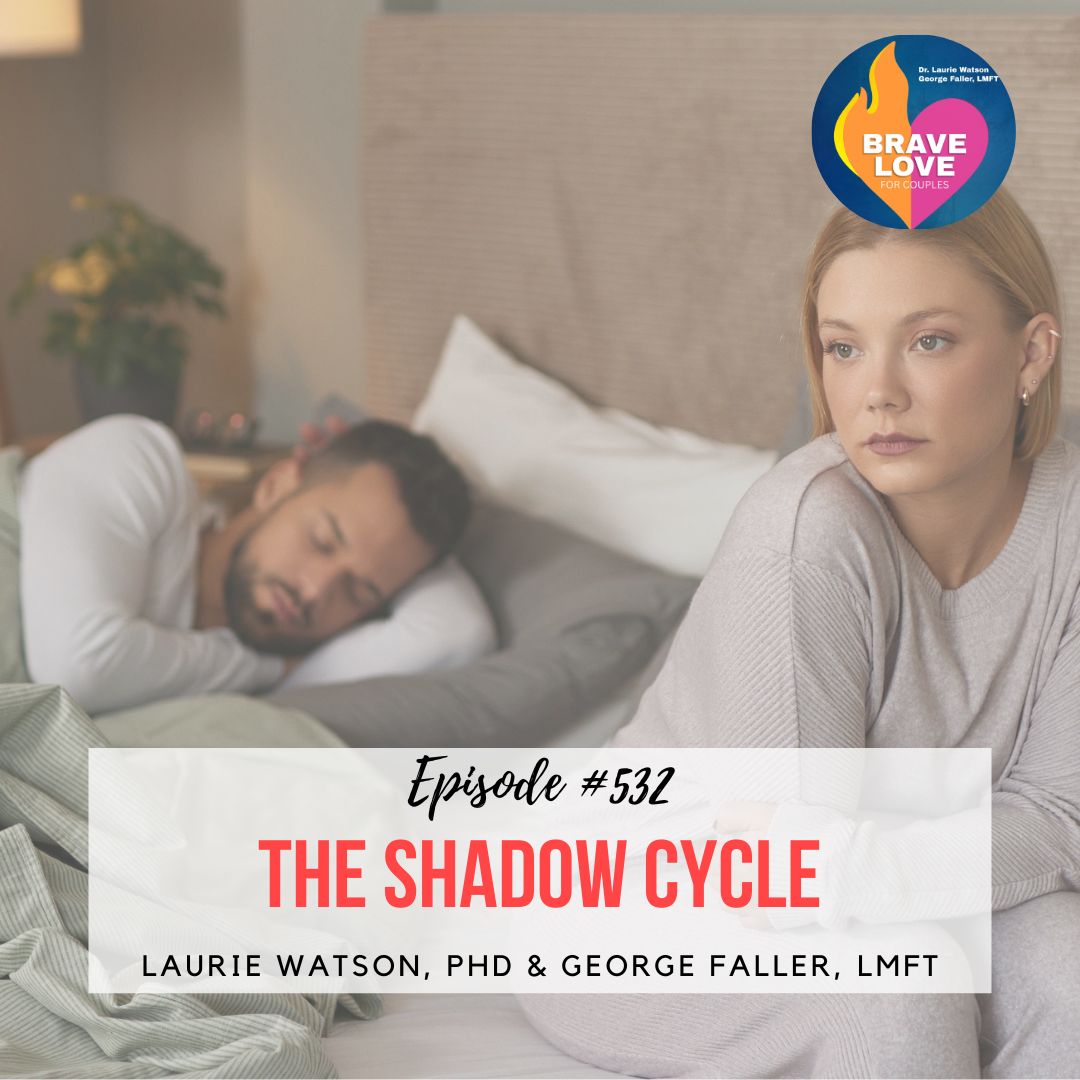
In today’s episode we are exploring the shadow cycle; how our partner’s experience often mirrors ours in a different cycle. Join hosts Laurie and George as they walk listeners through the five steps to explore and understand the shadow cycle.
This key exercise can help bring awareness to each partner’s perspective, slow down the negative cycles and use curiosity rather than defensiveness. If you and your partner keep getting stuck, make sure to listen and share to learn how to tap into each other’s worlds through a different and healthier lens.
Transcript
Laurie Watson, PhD (00:03.085)
Okay, George, how do we use the shadow cycle to deepen our intimacy, right? If we’re stuck sexually or emotionally with our partner, how do we use those feelings to understand where our partner is stuck?
George (00:20.302)
Shadow cycles, ooh.
Laurie Watson, PhD (00:22.867)
Ooh.
George (00:27.916)
Yeah, Laura, mean, Yep.
Laurie Watson, PhD (00:28.065)
Thank you all. Let’s pimp the book.
George (00:34.894)
Good.
Laurie Watson, PhD (00:35.447)
Brave Love Great Sex coming out September 2026. Amazon, everywhere books are sold. You’ll be able to find us. In fact, we’re going to post a link very soon once we have our book cover, which we’ve seen and like very much. Very exciting, very colorful. But we will post that link soon and you’ll be able to pre-order and we would so appreciate your support.
George (01:01.462)
and don’t limit it to just one. If I too give one to a friend, spread the word.
Laurie Watson, PhD (01:04.812)
Exactly, exactly. Give one to all your kids, if you have adult kids. Okay, so let’s go ahead.
George (01:14.222)
Might be the best gift you ever give. Oh, well, that’s not that crazy.
Laurie Watson, PhD (01:19.189)
Yeah, that’s what my family’s getting. That’s what my family’s getting next Christmas. Everybody gets a buck.
George (01:26.316)
Everyone gets a book.
Laurie Watson, PhD (01:27.563)
Yeah. OK, how do we use the shadow cycle? And can we talk about what the shadow cycle is so people understand kind of what we’re talking about?
George (01:37.302)
Yeah. We’re always talking about the emotional and sexual cycle. What happens inside the bedroom and what happens outside the bedroom. And so many people see them as distinctly separate things. And, you know, so much of our work is trying to help people recognize the heavy influence. You know, if you’re not helping out outside the bedroom, a lot of times that’s going to compromise someone’s ability to show up in the bedroom.
You know, and the flip side is also true, right? If you’re not, if things are not happening inside the bedroom, that’s probably going to compromise your ability to have some these outside the bedroom conversations, right? And so this influence between both cycles is really the heart of what our book is about and trying to help people get clear on what are we talking about? You know, they influence each other, but to really change both of them, you got to be targeted in these conversations and what you’re addressing. And we talk a lot about.
how normal it is. You think you’re talking about sex and then one partner starts talking about, I’d want to have more sex if you help with the dishes. And before, know, now we’re fighting over the dishes and like we bounce all over and you know, when we’re working with couples, we ask like, wait, what are we talking about? They’re like, I don’t know. We’re talking about everything. And it just, it gets confusing, right? It’s like we get lost in all of this. So a lot of our work in training is just trying to get couples and therapists to get more focused.
Laurie Watson, PhD (02:57.901)
Exactly.
George (03:03.654)
on, I, what are we working on now that we’re trying to make progress on? And how do we stop these movements away? But this podcast is a different idea. This is trying to say, actually, if we’re going to talk about the sexual cycle, how do we use what we say shadow? We’re saying the cycle we’re not working with. So in this case, it would be the emotional cycle. How do we use the shadow of that cycle? The influence of that cycle?
to actually deepen the work in the sexual cycle itself. And we’ll give examples of what that looks like.
Laurie Watson, PhD (03:38.465)
Yeah. Yeah, good, good. I think we need an example there. So let’s say I’m the sexual pursuer and there’s a shadow part in me that is my connection emotionally to my partner is impacting my frustration sexually as a sexual pursuer perhaps or a sexual withdraw, but let’s just take it one step at a time.
George (04:04.043)
Yeah. So.
Laurie Watson, PhD (04:04.341)
I’m the sexual pursuer. How can I think about my shadow cycle as impacting me?
George (04:10.221)
So let’s use Joey and Maria. That’s who we use in the book. So Laurie’s talking about Joey. He’s the sexual pursuer and you know, he’s the emotional withdraw. They crisscross. So when he’s in, we’re talking about the sexual cycle, he has no idea why Maria doesn’t want to talk about these things. Like how is sex going to improve if she always kind of doesn’t want to talk about it, rolls over, doesn’t want to engage. He gets so frustrated with her withdrawal.
Laurie Watson, PhD (04:12.351)
Okay. Okay.
George (04:40.127)
And, like, every part of him wants to scream. Like, can’t you see nothing’s going to change? If you keep doing this, you have to face this. You have to want to talk about it. He does not get her withdrawal at all. So again, using the shadow cycles, you know, we want to start off connected with that and honoring the frustration of that and the desperation of that, you know, and then I want to stretch Joey a little bit to say, right, pal. So it’s really hard to understand why she rolls over, why she doesn’t want to talk.
Laurie Watson, PhD (04:40.14)
Yep.
Laurie Watson, PhD (04:50.453)
Mm-hmm.
Laurie Watson, PhD (05:00.173)
Sure.
George (05:08.971)
You take it as her not caring, not wanting it. Right. So help me out here. Cause I know you gave me example the other day of a fight when you came home from work and the first thing you came home, she hit you with all these words. And like, was like, you knew where this was going to go in a bad place. So you walked away. Help me understand when you walked away, why were you walking away? So you be joy. How do you think you answered?
Laurie Watson, PhD (05:32.171)
Right, Yeah, he’d say I was overwhelmed. There was nothing I could do to make it better. You know, she just needed to work this out herself. And I, you know, I’m not going to say anything that’s going to change it. So why should I stay in that fight?
George (05:49.167)
Right, so you’re walking away wasn’t because you didn’t care. Well, you’re walking away is what you did to kind of keep the peace to stop escalation like that. Right.
Laurie Watson, PhD (05:57.481)
Exactly. And because I felt so helpless, right? I felt helpless at creating change, comforting my wife, doing anything that was going to make any difference. And I was just starting to feel worse on the inside. Yeah.
George (06:10.53)
Yeah. So again, I appreciate, I just want to honor the function of your going away. was about creating safety for you. Right. And that’s so often, you know, what I, I’m just opening up space for what’s maybe that’s kind of also what’s happening for Maria in the bedroom. It’s not she’s going away because she doesn’t care. She’s going away because
Something about staying engaged doesn’t feel safe and taking that space just like you do it outside the bedroom. She does it inside the bedroom to deal with the threat.
Laurie Watson, PhD (06:45.229)
gosh, George, this is so brilliant, right? Because you’re trying to get people to see that their experiences often mirror each other, perhaps in different cycles. But there’s a, we can just check our own body. Gosh, I’m feeling helpless. I’m feeling powerless. that’s what my partner is feeling. You know, that’s exactly what my partner is feeling.
George (06:58.168)
Exactly. And we know.
George (07:05.07)
we know that’s the power of these shadow cycles, right? We know what empathy is to really empathize with your partner’s position, not just understand it, but to empathize it. have to touch something in yourself that knows it. Right. So that’s what we can do in this shadow cycle. We can get them to touch something. I know what it’s like is Joey to roll over because I don’t, I mean, to walk away because I don’t feel safe. Once I’ve touched that and I’m feeling that.
Now, all of sudden I got to look at Marie and be like, damn, she’s doing the same thing. Right. And it opens up my empathy and caregiving instead of my defenses.
Laurie Watson, PhD (07:39.561)
Exactly. Exactly.
Laurie Watson, PhD (07:44.717)
So the idea is to really viscerally understand our partner’s experience. Check our own body. Right? Right there. We know what we feel so we can almost guarantee that our partner feels similarly probably in the opposing cycle. Right?
George (07:53.378)
check her own body.
George (08:05.806)
Exactly. What feels so foreign is actually not that foreign. If you’re willing to expand your frame, it’s very close. It’s identical. Right? And again, when there’s common ground, when you’re in something together, we know the body deals with that so much differently than being alone to deal with the threat. And this is just a way of bringing people together. It’s just like the cycle is it’s bringing them together to say, Hey,
Laurie Watson, PhD (08:12.287)
It’s actually identical. It’s identical.
Laurie Watson, PhD (08:29.197)
So true.
George (08:35.116)
It’s not either one of your faults. Can you see you doing similar things underneath it? You’re both threatened. You’re both just trying to survive that threat. Right. We got to learn to talk about that and come closer to each other instead of getting further away from each other.
Laurie Watson, PhD (08:49.129)
Exactly. Exactly. We have what I call ruby slippers. You know, it’s like we have the truth inside our bodies. We already have everything we need to understand our partner’s experience and to have empathy and compassion for their experience. We just got to examine our own like, okay, sexually, I feel frustrated. I feel blocked. I feel
helpless to get across my this how important this is to my partner. Gosh, they must feel the exact same thing when they’re talking to me about emotional stuff that they feel helpless that they feel blocked. They feel stuck in their bodies, right?
George (09:33.976)
I mean, that’s the good news. Humans have limited ways of dealing with threat. We’re not so different after all. The cycles make it seem like we are totally different beasts. Like, who is this crazy person I’m laying in bed with? This crazy person is you, a version of you, in a different way. And again, when we tap into that, I always feel like, all right, now we’re on the road to recovery.
Laurie Watson, PhD (09:56.555)
Yeah. that’s, I mean, I think that’s why you and I both think that a crisscross cycle is an easier cycle to resolve because we can share that empathic sense with our partner in our bodies. In a parallel cycle where maybe you’re the double pursuer, the double withdraw, it becomes a little more.
George (10:10.722)
Yes.
Laurie Watson, PhD (10:19.147)
difficult to imagine that our partner is feeling the exact same thing, right? I’m feeling attacked in both places. My partner, I never attacked my partner. I’m not telling them what they’re not doing. Is it good enough? So I can’t imagine that they feel what I feel. And the frustration of the double pursuer is like, they have no idea what it’s like to be blocked here, to have your needs, you know, blatantly talked about and never met. So how can we help?
in a parallel cycle people to see this principle.
George (10:48.29)
Well, yeah, I want to hold that. want to hold that. Let’s come back and let’s just talk about Maria’s version in the crisscross and then we’ll go into the parallel. All right.
Laurie Watson, PhD (10:59.787)
Okay.
George (11:02.848)
So let’s just do this for Marie.
Laurie Watson, PhD (11:05.173)
Okay, just second, Joe, just take that question that I have for George and put it into the second section so that we’re not holding anything. Let’s just, why don’t we start over, George, and you say, what I want to do is axe. That way it isn’t an interruption, it’s just a flow.
George (11:20.589)
Okay.
Yep. So what I want to do, Laurie, is let’s give Marie a little space to put words to, because it’s hard for her to understand why Joey’s so critical in the bedroom. Let’s kind of talk about, see if we could find some common ground. And then let’s talk about maybe when there is not, there’s a parallel process, right? And there is less common ground.
Laurie Watson, PhD (11:38.762)
Okay.
Laurie Watson, PhD (11:45.751)
Great, okay, let’s do it.
George (11:51.405)
All right. So we got Maria and we’re going to try to do the same thing. We’re using the shadow cycle to actually help make clear what’s happening in this case, the sexual cycle, right? So Maria, who is the sexual withdraw, the emotional pursuer in the bedroom, she does not understand Joey’s criticism. She does not understand how like
Laurie Watson, PhD (11:53.111)
So we got Maria.
Laurie Watson, PhD (12:05.195)
Okay.
George (12:19.278)
Can’t he see that that is putting more pressure on her? It’s making her less likely to want to have sex? Does he have nothing better to do than just be mean? what the hell’s wrong with him? Like, that’s so often what Maria feels. You know, so if we’re going to help Maria expand, we want to connect that that feels terrible and we know what the pressure is. And this is why Maria doesn’t want to have sex. This is…
Laurie Watson, PhD (12:36.404)
Exactly.
George (12:46.926)
The sex not worth having, right? If you’re forcing your body to be in a place, it doesn’t feel safe. And then you’re dissociating. there’s a whole, whole bad stuff coming down the pipeline for her. We get that, but you know. Right. So, but once we connect to that, you know, and I want to stretch her and again, notice how we’re being intentional, right? If I try to go right to give an advice when people don’t feel connected to that, probably they’re not going to be able to take it in that you have, have to, they have to be within that window of tolerance.
Laurie Watson, PhD (12:56.525)
Sure. Sure.
George (13:14.946)
Right? So say we’ve done that work with Maria. Now here comes a stretch. I’m going to be like, all right, Maria. So I hear you how hard it is, you know, it’s hard to even understand why he’s so critical, but maybe to help you. Like, I know you gave me example last session of, know, when you really wanted to talk to Joey when he came, you’ve been waiting all day for him to talk. This is so important. There’s so many longings there. It’s your way to connect.
And it’s like, you’re like, Joe, you won’t believe what happened today. Like, here’s your chance to get what you want. And all of a sudden he walks away. He’s like, yeah, sorry. Yeah. You know, I don’t have time. And it’s like, your head wants to blow up. It’s like, are you kidding me? Like at every party you want to run after me, like, what the hell is wrong with you? How am I supposed to have a relationship with somebody who doesn’t talk to me? Like you got an issue. Like you can feel that anger and protest, right. Which is just that your body’s healthy way of trying to fix this problem.
Trying to highlight that there’s something needs to change here. Like you can see how your body mobilizes and goes towards the problem.
Laurie Watson, PhD (14:17.511)
Absolutely, absolutely. This is the flip side of what you were trying to demonstrate with Joey getting so frustrated in the sexual cycle. Now you’re trying to talk about Maria’s frustration at being criticized, right? Tying it to her frustration emotionally when she’s pursuing him.
George (14:38.136)
The shift we’re trying to get is how they make meaning of the other person’s protection. She makes meaning that he’s angry and he just wants to put her down, right? He’s being critical. He’s telling her she’s failing. She doesn’t understand the healthy intent in it, which is to motivate change. It’s to be heard. It’s to get something good. So if we could get her to tap into how she does it in a fight outside the bedroom, she starts to say, wait, his intent is good.
The impact sucks on me, but the intent is good and it’s healthy. And if we can start tapping people into that, it changes their relationship to.
Laurie Watson, PhD (15:07.101)
Mm-hmm. Mm-hmm.
Laurie Watson, PhD (15:16.617)
Exactly. You know, this issue of making meaning of our partner’s intentions, right? We’re saying this is why they’re doing it. The meaning that we instinctively make in our survival mode is always negative. It’s always saying my partner is in some way uncaring, out to get me, hurtful, whereas we often see our own intentions as stellar.
George (15:31.523)
Yeah.
Laurie Watson, PhD (15:42.529)
You know, I know my intentions, right? My intentions are always good, always loving, but my partner, when we’re under stress, you know, most of the time we can see our partner as loving, but when we’re under stress, we see their intentions as negative and bad. And our brain takes that truth that we have made up and it accelerates our body’s escalation.
raising our blood pressure, accelerating our heart rate, giving us tension, which reinforces the truth, right? That this must be true because my body is reacting, telling me that there is something that is dangerous to be afraid of. It’s kind of a self-reinforcing loop when we make up this meaning, which we all do. But I do think that in terms of change,
George (16:35.982)
Yeah.
Laurie Watson, PhD (16:39.305)
meaning making is like the quickest one to change. It’s harder to deescalate our body to lower our pulse rate than it is to begin to wonder, is that really true? My partner doesn’t care about me? That they only want sex and don’t care about my feelings? Because that’s what I think Maria is saying to herself. My partner, all they want is sex, but they don’t give a rat’s ass about, you know, what I think about and feel.
George (17:06.894)
Yeah. And this is the shift. mean, the secret, the secret behind EFT is getting people to see things differently, right? That’s all kind of change that what you think your, your defensive brain sees is not caring or being mean is actually, you know, your partner’s attempts to survive their own pain. Like taking it less personal is the key shift that we need to create the space that then come up with new moves.
And the new moves would be about talking about the threat. Hey, you know, when I roll over, I’m rolling over because I feel like I’m failing and letting you down. That’s the vulnerability behind, or when I’m angry, it feels, I feel rejected. feel like you don’t want me that I’m not, you’re not attracted to me anymore. Like there’s not a lot of space for those vulnerable conversations when we’re going right into that negative view of.
Laurie Watson, PhD (17:36.233)
Exactly.
George (18:00.697)
So this is a way of really kind of mitigating those negative views of other. start to reduce that. We take it less personal apart. We still don’t like it, but we don’t attribute the same meaning that negative meaning. And now that starts to open up the safety in a space to really do it differently.
Laurie Watson, PhD (18:18.259)
Exactly, exactly. It’s so hard, I think, to get our brains online again when our body has escalated, when we’ve decided what our partner’s intentions are, the meaning that we’ve made of their intentions and why they did what they did. I mean, it really is a huge act of sort of in
of intention to change this whole experience by beginning to be curious and wondering, okay, my brain is telling me all you want is sex. You don’t care about me, about who I am on the inside because this last fight you ran away. Now you’re wanting sex. How does that make sex? It doesn’t make sense at all to me. And then to just pause for one heartbeat and wonder, is that the whole picture? Is that really the whole picture?
I can imagine and I think what you’re trying to get us to see in this episode is that they are actually feeling the same frustration that we are feeling. It’s a mirrored experience.
But it’s not necessarily that our inner experience is the truth. It is not necessarily the truth. There is a way that we trigger our partner, a way that they trigger us. And there is outside of that cycle a potential truth that our partner’s intention is good.
They want to have sex with us to get connected to us. They want to talk to us to get deeper understanding and more intimacy in our relationship. That’s the bigger truth.
George (19:46.382)
idea.
George (19:54.911)
Curious George. If I have any superpowers, that curiosity, and that curiosity is a sign of a green brain, right? So that’s what we’re trying to help. When you take your partner’s survival personally, it sends your brain yellow. And the good news about this conversation, we’re not expecting people to just stop doing these things, but at some point,
Laurie Watson, PhD (19:56.813)
Curious George
George (20:21.21)
Afterwards, this is how we initiate repair to say, you know, we did it again. You were critical and immediately my brain said, you know, this is bullshit. Is it unfair? And I walked away, you know, and I really, I wasn’t able to see what I can see now the next day that you were really just trying to bring something up that was hard to talk about because you want to address these things. And that’s a healthy thing for you to do. Can you see how taking your last personal, even the next day is good enough to start this repair process?
Laurie Watson, PhD (20:47.309)
So true. So true. Absolutely. I mean, that’s the good thing about being an adult, right? Is if we blow it in the moment, there’s always a chance for repair. Our partner can remember the fight too. You we don’t have to be perfect in the moment.
The second best thing is to be perfect in the second moment, to get curious, to say, okay, I thought about it, I expanded, I became curious. I realized maybe you’re just doing the best you can, that you two have good intentions for us to be close, for us to be intimate. I just couldn’t see that back then. And, you know, it was pressing on my weakness, the way we talked about it, both of us. You know, we didn’t get through to each other. didn’t, it wasn’t…
you know, in a way that both of us wanted to act. So let’s do have a redo. I want to listen to you, right? I want to hear what your need is here, what you’re really feeling. I’m going to just, in my mind, I’m going to hold that you have the best of intentions. You’re doing the best job you can.
George (21:54.817)
I like it. Second chance, that don’t work. Third chance, fourth chance. But when it does work, we know exactly what it’s going to look like. You’re going to see your partner’s behavior in a better light. That doesn’t mean he impacted and suck for you, but you understand the intent was very similar to your intent and you were just trying to deal with a threat. And if you could both identify that you could actually change that. You could learn a new move in that place.
Laurie Watson, PhD (22:19.806)
Yeah, so let’s review how people deescalate their cycle themselves. One, we want them to check their body. Two, we want them to realize whatever they’re feeling in their body, whatever frustration is going on for them, their partner is feeling it too, perhaps in the shadow cycle. And three, we want them to question the truth that they’re telling themselves, the meaning that they’re making up about their partner’s intention, right?
and open up and get curious about maybe their partner has another intention.
George (22:53.25)
Yes. And in those intentions that our partner doesn’t care why they’re walking away or a partner has nothing better to do than just pick on us because, you know, both of those attributions really don’t capture the truth of that person’s experience. again, once that starts to shift, it opens up all this space for them. What is the truth?
Once you want to be curious about exploring what the truth is and having your partner understand your truth. Now we’re on the roadway towards intimacy and connection.
Laurie Watson, PhD (23:29.973)
And this takes courage. This takes courage and risk to begin to believe that maybe our partner does have good intentions, that maybe they’re just doing the best they can, that maybe we’re in this thing together. It takes a lot of courage to do this work, to be vulnerable, to think about our partner’s perspective. That’s why we call it Brave Love, right? It’s so courageous, takes so much effort.
George (23:32.686)
Hmm.
Laurie Watson, PhD (23:57.579)
to put yourself out there and to begin to think about the other perspective.
George (24:02.296)
but that effort is so worth it because if we play it safe and we’re not brave and we just protect ourselves, we’re gonna get the results of that protection, which is the distance and the isolation. But we can kind of tap into our courage and say, hey, listen, I don’t know exactly where this is gonna end. I gotta step into this discomfort. But what we find there is the most priceless thing possible.
Laurie Watson, PhD (24:15.005)
Exactly.
George (24:26.06)
Right? Which is to kind of be held by the person we love, to not be alone and not to stress, to find connection in spaces we tend to find isolation and loneliness.
Laurie Watson, PhD (24:36.989)
Exactly. So y’all have some brave love.
George (24:43.19)
and great sex.