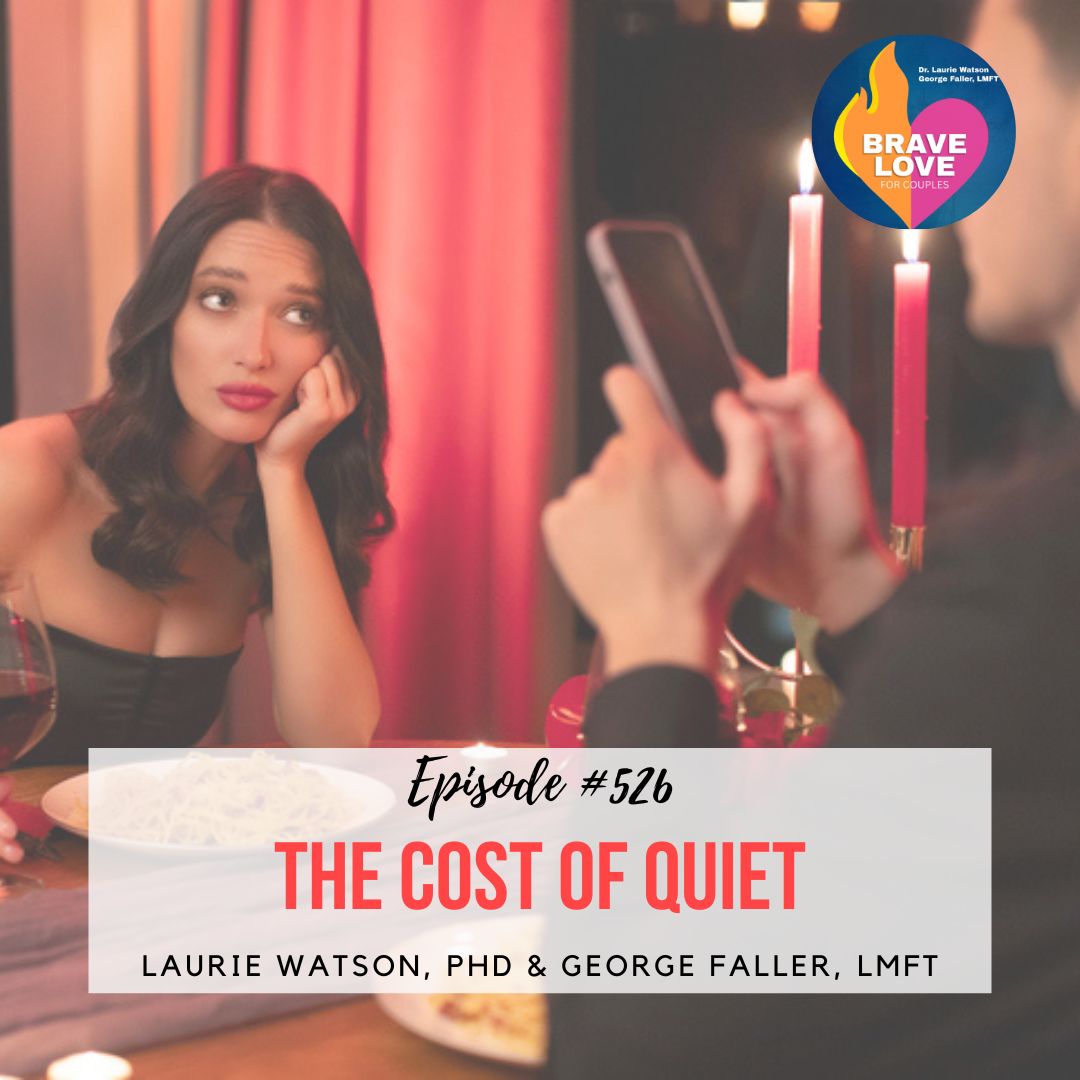
Welcome Brave Lovers! In today’s episode, our hosts interviewed couples therapist and author of the upcoming book ‘The Cost of Quiet’, Colette Fehr. Colette shares her wisdom and years of experience with us on the true cost of conflict avoidance in a relationship. She defines avoidant behavior as actions that prevent connection from yourself or your partner.
Colette bravely shares with us how the end of her first marriage led her to examine her own conflict avoidance and conditioning that quiet and keeping the peace was best but ultimately a silent relationship killer.
In her book, Colette shares the ABCs every couple needs to practice: Acting in the face of fear, Be vulnerable and Communicate assertively. If these aren’t skills you possess or are sometimes hard to come by, she reminds us that they can be strengthened through practice and repetition. The more we do something we are afraid of the less scary it feels!
Visit her website www.colettejanefehr.com to pre-order a copy and for more free resources on ways to improve communication with your love! Lovers be brave!
Transcript
Laurie Watson, PhD (00:29.218)
EFT therapist, LMHT, LMFT, and she is a new author of The Cost of Quiet. I want to talk to her.
George (00:39.473)
Yee-haw! Let’s do it.
Colette Jane Fehr (00:43.138)
happy to be here. Thanks for having me you guys.
Laurie Watson, PhD (00:43.986)
Collette, you know, we had so much fun the last times you’ve been on the air and I’m so proud of you. You’re doing so great. You’re bringing this new book out, The Cost of Quiet, How to Have Secure Conversations, and it comes out February 3rd, right? How to Have Hard Conversations That Create Secure, Lasting Love. And your publisher is, who is that?
Colette Jane Fehr (00:51.64)
Thank you.
Colette Jane Fehr (01:01.133)
Yes.
Colette Jane Fehr (01:08.94)
My publisher is the Putnam imprint of Penguin Random House.
Laurie Watson, PhD (01:12.818)
Woohoo! We are also with Penguin and so it’s very exciting and happy to help a Penguin author.
Colette Jane Fehr (01:20.472)
Yeah, we’re all in the family, right?
Laurie Watson, PhD (01:22.81)
We are, we are all in the family. So tell us about this book, The Cost of Quiet. Tell us about what it’s all about.
Colette Jane Fehr (01:31.878)
So quiet in this case is a euphemism for conflict avoidance. And we know as couples therapists, people don’t typically come in and say, hi, I’m conflict avoidant. Please cure me. That’s what I’m here for. But this is really a big part of the problem.
Laurie Watson, PhD (01:37.497)
Yes.
Laurie Watson, PhD (01:47.986)
All right.
Colette Jane Fehr (01:51.54)
that we’re dealing with regardless of attachment style, which I think people can often get confused. Avoidant behavior, as I define it in the book, isn’t even always silent. Sometimes it’s silencing yourself, but sometimes it’s bickering. Sometimes it’s criticizing. Sometimes it’s stuffing and being passive aggressive. I define this in the book as anything that prevents you or that you do as a coping mechanism rather than truly connecting to yourself.
and discovering what you feel and what you need and reaching for your partner from that place.
Laurie Watson, PhD (02:26.77)
Mmm.
George (02:27.988)
Yeah, I really like and there’s a Ted talk. What’s the Ted talks name title?
Colette Jane Fehr (02:32.681)
I called it secrets of a couples therapist.
George (02:36.21)
Ooh, who don’t want to hear the secrets. It sounds like a TV show we should do. Right. But I really, I think there’s a lot of emphasis on relationship dynamics and the impact of your move on your partner, but I really like how you’re highlighting, you know, the cost of words and spoken to self, not just to the relationship dynamics, right? How you lose your voice and the levels of engagement go down.
Laurie Watson, PhD (02:36.442)
Nice, nice, good title.
Colette Jane Fehr (02:39.246)
I know right
Laurie Watson, PhD (02:57.241)
Exactly.
George (03:01.298)
You know, it’s a slow death in a relationship and that, know, the power reclaiming your voice is really cool.
Colette Jane Fehr (03:07.224)
Thank you, and that’s exactly what it’s about is that ultimately the cost is self abandonment and what that does to you and your inner well-being. And I think this is such a common dilemma. In particular, I wrote the book for women because it was inspired in large part by my own experience and I’m a woman, but of course it applies to everyone. But I would notice these women come into my office who are very, very successful.
Laurie Watson, PhD (03:14.875)
Mm. Mm. Mm.
Colette Jane Fehr (03:35.074)
driven, intelligent, they’re certainly not quiet in other areas of their life, they’re assertive, but then when it would come to their romantic relationship, that desire to keep the peace and preserve your relationship and, well, if I’m not gonna get a good response anyway, then I start to even foreclose on taking the initiative to speak up. And I would see over and over again what happened to me in my first marriage in my office that
Laurie Watson, PhD (03:57.927)
Mm.
Colette Jane Fehr (04:03.593)
Eventually you start to say, I’m not going to say anything because I’m just going to get dismissiveness or defensiveness or we’re going to get into a dead end loop, you know, a negative cycle. And so then, yeah.
Laurie Watson, PhD (04:13.456)
Right? This was inspired, right, by your own experience, your own divorce, parenting. You you came to this out of your history. So that, I mean, that makes it even, I think, when you write about your own stuff, you know, it makes it more poignant.
Colette Jane Fehr (04:18.337)
Yes.
Colette Jane Fehr (04:33.801)
Yeah, thank you. agree. I agree. I set out actually to have a conflict avoidant marriage. I thought that was something to aspire to. yeah, yeah. And I became a couples therapist really because of my divorce. My ex-husband and I went to a marriage counselor who wasn’t properly trained to do couples work. We know being in this work how common that is.
Laurie Watson, PhD (04:41.17)
Thanks
Colette Jane Fehr (04:59.477)
Of course, the lay person doesn’t always know what to look for in a couples therapist. So we went to somebody who really didn’t have any couples training, kind of did more harm than good. And with what I know now, certainly. And I could feel something wasn’t right, but I didn’t know what wasn’t right in the whole process. And when I got divorced, I thought, you know, this is really important work. And I’m gonna go back to grad school and become a couples therapist to help people.
George (05:07.144)
Thanks.
Colette Jane Fehr (05:27.633)
the best I possibly can. And I had kind of played default family therapist my whole life. You my parents got divorced and I was very much the parentified child. I was kind of my dad’s therapist. And then I’d try to shield my mom’s anger and go between and mediate. So in some ways I was prepping for this work my whole life. because of their, you know, my dad’s a doctor, my mom’s a lawyer.
Laurie Watson, PhD (05:29.923)
Awesome.
Laurie Watson, PhD (05:49.916)
haha
Colette Jane Fehr (05:55.734)
I grew up in New York. My parents are both very smart and strong. And so there was no quiet, right, in my house. Now, of course, they were not communicating the way we’re trying to help couples communicate with that vulnerability and honesty and that really diplomatic assertiveness. But because of that, I thought the answer is these perfectly genteel marriages I see everywhere around me. You know, I grew up in Westchester.
which is right outside of New York City. George, I know you know that area well. But I went to all girls Catholic school. I didn’t have one friend with divorced parents. I didn’t have one friend whose parents fought in any discernible way. So I felt like the outcast. And I thought the answer is, I’m gonna find somebody who grew up in a family where nobody ever raises their voice or talks about anything. We’re just happy all the time.
Laurie Watson, PhD (06:48.69)
I think
George (06:50.706)
I’m chuckling a bit with the description of couples therapist, right? Because people just think like couples therapists. No, they, have those secrets that they’re just, you know,
Holding on to they know everything that’s happened in your relationship and you know little do people know there’s you know There’s so many different ways of seeing things and so many couple therapists don’t understand really what’s going on and we’re in this mess together It’s just it’s it’s it’s interesting to trust people just have going to a therapist and it’s a big decision Because if you have a bad experience
Laurie Watson, PhD (07:21.842)
Right. And I think that’s why we are touting EFT, because we know it’s research-based, it’s based on attachment theory, we know the training that people get, we know that EFT therapists can kind of hold two truths at once, they can see both sides of the story basically. So they can really help people. I feel for you, I too have gone to couples therapists who were not EFT trained and not very good and did some harm, really.
Colette Jane Fehr (07:49.098)
Yes, yes, and in this case, without outing anyone’s personal stuff that is no longer in my life, there were some very particular issues happening that required a certain kind of attention, and all of that was totally missed. And I can only imagine had we had an EFT therapist.
how differently it could have gone. Now, of course, I’ll never know if the marriage could have been saved. And we got together when we were 18 years old, and there were a lot of issues. And of course, the conflict avoidance piece was the part of my own journey that I realized, well, I’m playing a role in this, right? Of course, like so many people, I thought my partner was the sole problem. And I didn’t realize that I, too, was being conflict avoidant, and that I wasn’t communicating in this method that I outline in the book.
Laurie Watson, PhD (08:41.362)
Tell us about this idea that you have. What does quiet quitting in a relationship mean?
Colette Jane Fehr (08:48.513)
So it’s so funny too, because all of a sudden I’m seeing this everywhere. And I started writing this book three years ago and thought I was so brilliant in coming up with this analogy that you don’t only quite quit your job, you can quite quit your relationship. And now it’s really come to the forefront. you know, when you give up, first of all, my fundamental present premise is that it is healthy for us as human beings to connect to ourselves.
to know what we’re feeling, to know what those emotions are telling us about what we need. That’s the whole point of our emotional experience. so it, yes, exactly. Something that I did not really understand. I thought when I was younger, I don’t need anyone, right? That hyper individualism, that that was the watermark to reach.
Laurie Watson, PhD (09:23.69)
Mm-hmm. And needing is healthy, right? Needing others, needing people is healthy.
Colette Jane Fehr (09:42.1)
And just as you said, it is normal to need people, to need comfort, reassurance, support, to turn to our partners in times of emotional distress. And so this is normal. And it’s also healthy to be articulating what we feel and need. This is, I believe, fundamental to the human experience. So I think it affects our physical health and our mental health when we’re not doing that.
And so when people start to feel frustrated, and as EFT therapists, we know they’re often stuck in these reactive dead end loops where the partner isn’t the problem, the issue isn’t the problem, it’s that they don’t know how to talk about it yet, but they often don’t know that that’s why they’re stuck until they come to therapy or read a good book or whatever that may be. And so eventually they start to feel like nothing I do works, right? So.
Laurie Watson, PhD (10:32.945)
Right.
Colette Jane Fehr (10:33.717)
I don’t wanna get a divorce, I don’t wanna blow up my whole life, so I’m just gonna kind of stop trying. And I can understand that, and I think there are certain circumstances that are very complex where people aren’t going to get their relational needs met and the cost is too great to leave, and perhaps that form of quiet quitting, a self-preservation. But much of the time, these things can change, and when we stop…
coming forward with any kind of vulnerability or emotional energy. Not only do we chip away at the relationship, but we really chip away at our essential selves.
Laurie Watson, PhD (11:11.282)
So true, so true.
George (11:14.768)
I like the, I’m an acronym person, so I like your ABCs. Trying to give our listeners and kind of people reading your book, just tools, right, practical tools. you know, this people resign themselves giving up. So help us understand your ABCs.
Colette Jane Fehr (11:32.374)
Yeah, so trying to make this, you know, at the end of the day, it actually is all really simple what we’re trying to do. It’s just not easy. And trying to make this accessible by distilling this information, the complexity of what it is to be a human being. So the ABCs are really acting in the face of fear. And this is something so fundamental as EFT therapy is a huge part of what we’re doing is trying to.
Laurie Watson, PhD (11:39.762)
Mm.
Colette Jane Fehr (11:58.548)
shore people up to take the risk, even to be willing to disclose something. If you’ve never had a safe person to share with in your life, or if you’ve constantly been told what you feel is wrong or too much, right, or punished for what you share, then of course this doesn’t feel safe to do in your adult romantic relationships. And it doesn’t feel safe also because we know we’re wired to connect and therefore anything
even the tiniest look on our partner’s face of tension or a raised eyebrow signals a threat. this is actually, yeah, danger. Exactly. So this is a huge part of it is just the willingness to act in the face of fear. And of course, paradoxically, we know that the more you do the thing you’re scared of, the easier it becomes. Much of the time, the anticipation
Laurie Watson, PhD (12:34.994)
Danger. Danger, danger.
Laurie Watson, PhD (12:50.716)
Yes.
Colette Jane Fehr (12:54.207)
of how this is going to go is far worse than the thing itself, even if your partner doesn’t receive you in the perfect way.
Laurie Watson, PhD (12:58.556)
So true.
Laurie Watson, PhD (13:02.308)
Yeah, I love that. And it is so difficult to do this thing. We are scared of it. And the outcome, what I see in my office is so beautiful when people risk that vulnerability. I’d love to come back after our break and talk a little bit more about sex and vulnerability and sex and how you see perhaps women, there’s a cost to their quiet.
Colette Jane Fehr (13:28.599)
Yes.
George (13:30.447)
Alright, she’s still gotta go through B and C. Yep.
Colette Jane Fehr (13:32.767)
Yeah, and I can do it quickly. I can do it quickly. Yeah.
Laurie Watson, PhD (13:33.124)
Oops, I forgot. No, no. Okay, let’s do that over. Okay. Can you bring us in, George? Just say that. Just say, wait, we got to get BNC.
George (13:37.384)
No, no, it’s okay. Just go, we’ll start with B on the way back. It’s fine. Yep.
Colette Jane Fehr (13:39.629)
you
George (13:43.806)
Yeah.
George (13:47.157)
There’s so much good stuff to talk about, right? We definitely want to get into sex, but we want to also finish the B and C and I’m going to throw a D in there too. you know, the A is, know, I’d written that down. Acting in a face of fear, which is, know, you got to be able to face it first instead of running away from it. Listen to what’s the B.
Colette Jane Fehr (13:51.821)
Of course.
Laurie Watson, PhD (13:53.446)
Oops, I’m sorry.
Colette Jane Fehr (13:59.636)
in the face of fear.
Colette Jane Fehr (14:07.383)
So B is being vulnerable. And just like Lori said, we see in our offices most of the time when people are really vulnerable and clear, when we can get beneath all that surface reactivity and all of the story in our head, the guck that just stresses us out and fills our head with falsehoods and lies, that the partner is really receptive. Vulnerability invites vulnerability.
It’s wired into us, our mirror neurons. When somebody really invites us in by saying, you know, I was so frustrated and angry and I had this story that you were out to get me, but beneath all of that, I was just really hurt and so scared that you don’t value me and you don’t love me anymore. You’re going to leave me. Right. It’s really, really tough. Not that it can’t happen, but it’s really tough to meet that with, you know, F you. It just doesn’t usually go that way. So you got to be willing.
Laurie Watson, PhD (14:59.003)
Yeah.
Right? We feel tender when somebody is vulnerable, right? There’s a human part of us that wants to take care of our partner. And so that’s what pulls us in is that vulnerability is born or birds in the other person the wish to care for us. And that’s the connection piece. It’s sort of magnetic.
Colette Jane Fehr (15:12.714)
Exactly.
Colette Jane Fehr (15:22.931)
Exactly. And you really make it easier for your partner to take the risk to do the same. You know, so it creates a beautiful thing between two people that we see all the time in couples therapy. I think this is the reward of the work. And then of course, C is communicate assertively. And this is a big thing for me. And I think it’s a big thing for women because we know from recent research.
that when women are assertive, we’re often framed as difficult. Men are assertive, it’s like, wow, he’s really impressive. So unfortunately, we still got a little way to go with this. And I think the lay person still misunderstands assertiveness and mistakes it for being aggressive. But I define assertive as really being honest and clear. And that to me, the key component there, the third component is being kind.
Because when we hold on to ourselves and we’re calm and we’re regulated, we’re at least in our window of tolerance, and we say, you know, this is what I think and feel, and we say it with tact and diplomacy, that gives us the best chance possible to be heard. And this is the place where we’re honoring ourselves rather than self abandoning is through that assertive communication. And I like to use the simple old school assertiveness formula, you know, when you…
I feel because here’s what I need, right? And what you need in the moment. And I really try to explain in this book that sometimes maybe there’s a behavior change you’re requesting, but much of the time we need comfort and reassurance. And it really comes down to that more than anything. After that, if the problem’s solvable, you’ll figure it out. But we’re often…
needing something that we’re not naming and that’s what I want people to get to.
George (17:18.804)
I would give a shout out to a lot of men that if you don’t really know what it is you need or you’re feeling, it’s really hard to find your voice and be assertive. So I think this is very common on the other side of the street too.
Colette Jane Fehr (17:33.102)
I agree, you’re right, you’re right. And I define in the book, the whole process of communication I use is called self-connected communication. And I pull a lot from EFT, of course, and I’m also a certified EMDR therapist. So I did a lot of parts work through EMD and ego state therapy and have found that very helpful. And then some IFS, IFIO stuff, but really without, you know, throwing out a thousand acronyms at the end of the day, it is…
Exactly what you said, George, that I think makes this successful is that we have to really go inside and connect to ourselves. And it’s so true that if you slow down and get still, even just for a couple of moments and ask a question directly inside, I like to just put my hand on my heart and close my eyes and ask my inner child, ask my vulnerable parts.
you know, what do you need? What are you feeling? What would you wish for a loved one right now? Because sometimes it’s easier to think about what we might offer to somebody we care about than ourselves. You get answers if you’re willing to listen, whether you call that your intuition, your inner wisdom, I call it the sage self, right? That we have the answers already, we just need to slow down and tune in.
Laurie Watson, PhD (18:47.954)
I love that. I love that.
George (18:50.514)
I was listening to your Ted talk, I had my own D in my brain that once you get to this point of asking for what you need in an authentic way, you really still got to be ready for the defenses, right? That the partner might get triggered because they hear in the message they’re failing and then they want to make it about themselves. And then you’re not getting the care given response. And this is usually where couples miss each other. know, so if you have a plan for it not to work, just like you have a plan for it to work, you know, I think that yeah.
Colette Jane Fehr (18:54.017)
Yeah, tell me.
Colette Jane Fehr (19:13.783)
Yes.
Colette Jane Fehr (19:18.763)
I do. Yes, and I think that’s critical. So I call it in my book, the metaphor I used for these responses you’re describing is the Bad Partner Communication Report Card, which is three Ds and an F. The most common responses that you might receive, which I define as defensiveness, dismissiveness, distancing, and fixing. The things that are so common that don’t feel good.
George (19:31.71)
Yeah.
Laurie Watson, PhD (19:42.576)
Yeah. So true.
George (19:44.446)
guilty of all four them.
Laurie Watson, PhD (19:47.73)
Three Ds and an F.
Colette Jane Fehr (19:49.63)
Yes, yes, and exactly. It’s so human, right? Because it’s so hard to hear feedback, even when it’s rendered very gently. We know that we’re gonna do our best to show up as well as possible and keep our side of the street clean. And then a lot of times it isn’t gonna land because everybody’s got their own wounds and they’re filtering what they’re hearing through the wounds and then how hangry they are in the moment.
But why I focus on self-connection so much in this communication model is that if you are connected to your inner child, your vulnerability, and from your adult self, then even if you don’t get the response you hoped for, and it will hurt, of course, right? That doesn’t feel good, but you can take care of yourself then with self-compassion, with your own self-validation. You build your sense of confidence. You feel empowered that you took the risk.
you showed up and that it was very hurtful and disappointing that your partner couldn’t be there in that moment, but you can be there for you.
Laurie Watson, PhD (20:52.816)
Yeah, absolutely.
George (20:53.364)
And that’s nice to make explicit, to be able to say, Hey, listen, I know you got your own stuff, but you know, it’s disappointing that you couldn’t keep the focus on me. That was the mission in this moment, right? That, ability to just kind of stay regulated and be ready for that. It’s going to go one of two directions. Either your partner is going to hear you or your partner is not going to hear you.
Colette Jane Fehr (21:12.001)
Yes, and this, sorry, go ahead.
Laurie Watson, PhD (21:12.242)
So true. Tell us about the cost of quiet in the bedroom, Colette. What do you see in your office with people who stay quiet and don’t want to have a conflict there?
Colette Jane Fehr (21:26.273)
that almost nobody’s talking about sex. I mean, talk about the number one topic to avoid, right? People don’t even love when I bring it up most of the time. Very rarely I’ll have someone come in and say, you know, we’re really here to talk about our sex life. Almost never does anybody do that in my office. I ask for, and honestly, it’s a lot through training with you guys and…
Laurie Watson, PhD (21:29.042)
So true.
Colette Jane Fehr (21:52.918)
you have bringing attention to this, that we have an emotional cycle and we have a sexual cycle because I was avoiding it too. You know, I, as a woman, as a heterosexual woman who is very emotional and truly, I mean, I like sex, I care about sex, but it is much lower on the priority list for me than feeling emotionally connected to my partner.
Laurie Watson, PhD (21:55.666)
Thank you.
Colette Jane Fehr (22:17.577)
So I’ve always been of the school of thought that, you know, if we’re emotionally connected, like everything else is fine. And I think, and you guys can correct me if you’re wrong, but that they say that it’s about 50 % of the time if you fix the emotional connection that the sex kind of comes back. The other 50 % of the time, we have to really address what’s going on there in and of itself. I don’t know if I’m saying that the right way or if that statistic’s even accurate, but I’ve started to make sure that I bring it up.
early on, you know, what’s happening there? Is this something you want to talk about? And often there is a problem. There’s mismatched libido. Husbands are always saying to me very, very frequently, you know, this is really important to me. We’re not having sex a lot. This is how I feel connected. This isn’t about getting off or orgasm. This is about the way I feel close to in a heterosexual relationship I’m using here for the moment.
This is how I feel close to my wife. And now that sex isn’t happening anymore, I don’t feel close to my wife. And then of course, all of our inner wounds and insecurities are just exacerbated.
Laurie Watson, PhD (23:23.004)
So true.
Laurie Watson, PhD (23:26.906)
Right, exactly.
Colette Jane Fehr (23:29.003)
So we gotta, where I’m going with this is we’ve gotta talk about that too, right? Very explicitly with this same formula and be a little less afraid to name our desires and our fears and how rejecting it can feel when there’s no longer a physical intimate connection.
Laurie Watson, PhD (23:50.162)
And I just, go ahead, George.
George (23:51.125)
Yeah, the part I want to, no, the part I, I usually when I bring it up, the importance of touch and sex, a lot of people are thinking, there you go again, trying to support men and, you know, give them more of a voice because it is important. Is there a lot of primary way into connection, but building upon your theme of the book, it’s like, I’m actually doing it more for women who have abandoned this part of themselves, right? That, you know,
Laurie Watson, PhD (24:16.794)
Yep, absolutely.
George (24:18.472)
Because of really good reasons of pressure and disconnected emotionally, they’ve been put in bad situations and it makes sense why they want to avoid those bad situations, but they don’t see the abandonment of their own erotic self in that process. So that’s why think Lori and I are so passionate. We’re not doing this just to help men have more sex that they feel connected to. It’s about helping women reclaim their power. This is just a beautiful way into connection. Why not have both the emotional and sexual?
Laurie Watson, PhD (24:38.508)
Absolutely.
Colette Jane Fehr (24:48.651)
You’re so right. you know, think part of it is that, cause I’ve been there, I’ve been in those places where, you know, I’ve abandoned my sexual self. And I think the catch is, I’m so glad you’re saying this, that women don’t really realize that that’s what’s happening. That part is they’re so preoccupied with the other pieces. And that is a tremendous loss because it’s such a huge part of aliveness, our sexual selves.
George (25:14.825)
Mm.
Colette Jane Fehr (25:15.041)
you know, for men and women and another beautiful way to feel connected that’s equally important.
Laurie Watson, PhD (25:23.118)
It is so important. Thank you so much. This is Colette Jane Fair, the author of Cost of Quiet, How to Have Hard Conversations That Create Secure, Lasting Love. And the book coming out February 3rd, just in time for Valentine’s Day. Woohoo! With Putnam Penguin Random House. We can find this on Amazon. Do you have a link for a pre-order that we can put on our website?
George (25:23.593)
Amen.
George (25:39.676)
Woo!
Colette Jane Fehr (25:48.17)
Yes, do I ever, are you kidding? I have it tattooed all over my body. No, if you go to my website, colettejanefair.com, you can pre-order the book. I have all kinds of bonuses, a digital course, a cost of quiet toolkit that gives you a lot of scripts and tools that are very actionable you can use today to start communicating for yourself and your relationship.
Laurie Watson, PhD (25:51.398)
Okay. Yay.
Laurie Watson, PhD (26:06.629)
Nice.
Nice.
Laurie Watson, PhD (26:13.914)
So nice. And you are still taking patients, right? You are still seeing couples.
Colette Jane Fehr (26:18.987)
I am still very actively seeing couples. I’m not taking anyone new at the moment, but I’m sure after I birth the book, I will be doing so again in the near future. Yes, theoretically. Yes, I hope, I hope.
Laurie Watson, PhD (26:30.15)
after you have a minute of time. Yeah. Okay. So happy Valentine’s Day, everybody. By the Cost of Quiet by Colette Jane Fair. Thanks for listening.
George (26:33.586)
a nice vacation.
George (26:46.75)
Keep it hot y’all. I gotta come up with a new 2026.
Laurie Watson, PhD (26:51.3)
Nice. Colette, you are wonderful.
Colette Jane Fehr (26:54.992)
Aw, you guys are great to have me on, thank you.

